 Ferndale Siding
 One Product, One Standard
Homeowners sometimes ask why we don't carry a broader lineup of siding brands. The honest answer is that we used to look at everything on the market — vinyl, LP SmartSide, Cemplank, Allura, primed wood — and we made a deliberate call to install James Hardie fiber cement exclusively. That's not a marketing gimmick. It's a standard we hold because Ferndale's climate is genuinely hard on exterior building materials, and we'd rather stand behind one system we know performs than juggle five and hope each one holds up on a given house.
Ferndale sits close enough to Bellingham Bay and the Strait of Georgia that salt-laden air is a real factor on exterior materials, not a theoretical one. Add Whatcom County's long, wet fall-through-spring stretch and the moss and algae growth that comes with shaded, damp siding for months at a time, and you've got a climate that will find every weakness in a lesser product within a decade. We install what holds up to that combination, not what's cheapest to buy or fastest to install.
What James Hardie Actually Is
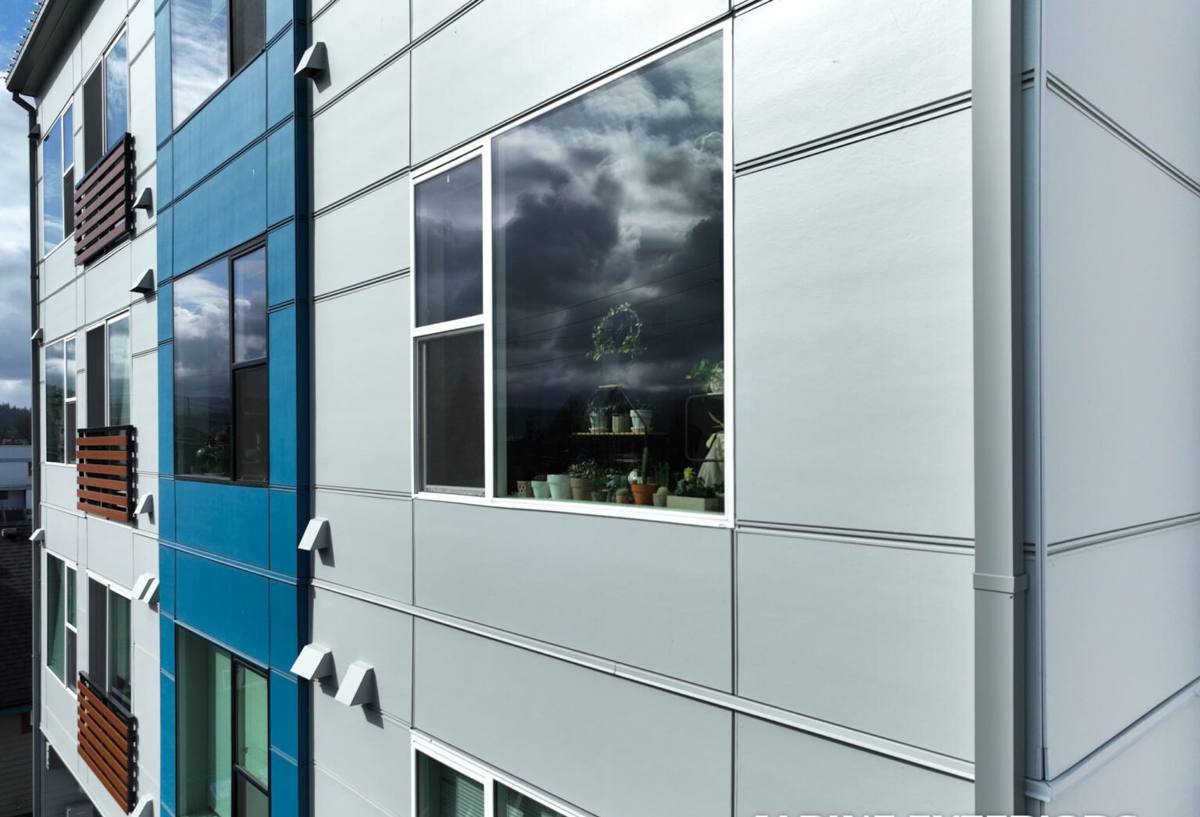
James Hardie siding is fiber cement: a mix of Portland cement, sand, and cellulose fiber, cured and pressed into planks, panels, and trim. It is not plastic (like vinyl), and it is not wood or wood composite (like LP SmartSide or primed spruce). That distinction matters more than most homeowners realize, because it changes how the material behaves when it gets wet, when it sits in the sun, and when something presses against it.
Fiber cement doesn't absorb water the way wood-based products can, and it doesn't expand and contract with temperature swings the way vinyl does. It's also non-combustible, which is a genuine safety consideration and one insurers increasingly ask about on new builds and re-sides in Washington.
How It's Made and Why That Matters On a House
Hardie's manufacturing process is engineered, not improvised — the cement/sand/cellulose ratio is tuned specifically for moisture resistance and dimensional stability, then autoclave-cured to lock that stability in before the board ever reaches a jobsite. That's a big part of why a Hardie board installed correctly today looks close to the same in twenty years, rather than cupping, swelling at the edges, or telegraphing seams the way lower-grade composite products can.
Why We Don't Install Vinyl
Vinyl is inexpensive and it's fast to hang, and we understand why it dominates a lot of national siding sales. But vinyl is a thin plastic profile that relies on being able to expand and contract freely behind fasteners — install it too tight and it buckles, install it too loose and it rattles in wind. In a marine climate with big daily temperature swings between a cold, wet morning and afternoon sun, that tolerance window gets tested constantly.
Vinyl also fades under UV exposure over time, and once it fades there's no repainting it back to match — the color is baked through the material, so a faded panel next to a new replacement panel will always show a seam. And in a wind-driven rain event, vinyl's lap-and-lock design can let water track behind the panel if it's not flashed and installed with real precision. We'd rather not build a home's weather barrier around a product with that little margin for error.
Why We Don't Install LP SmartSide, Cemplank, or Allura
LP SmartSide is an engineered wood product — strand board with a resin-saturated overlay. It performs reasonably well when it's kept fully sealed and maintained, but any breach in that factory coating (a fastener miss, a cut edge left unsealed, a persistent moisture point) exposes wood fiber, and wood fiber that stays wet in a climate like ours is where rot starts. We see enough moss-shaded, rarely-dried north walls in Ferndale that we're not willing to install a product whose long-term performance depends on a coating staying perfectly intact for decades.
Cemplank and Allura are themselves fiber cement products, and structurally they compete in the same category as Hardie. Where we draw the line is warranty structure, factory finish consistency, and the caliber of the certified installer network standing behind the product regionally. Hardie's ColorPlus finish and installer certification program are, in our assessment, the most consistent in the fiber cement category, and consistency is what a 30-plus-year exterior investment needs.
Why We Don't Install Primed Spruce or Cedar
Real wood siding has a genuine appeal — texture, grain, a look manufactured products still chase. But primed spruce and cedar are the highest-maintenance option on this list by a wide margin. They need repainting on a real cycle (not a "someday" cycle), every cut end and fastener penetration needs to be sealed, and in a county with our rainfall totals and moss pressure, an unmaintained wood wall can show rot within a handful of years, especially on north- and west-facing elevations that stay damp longest. We'll talk homeowners through wood if they specifically want that look, but we don't install it as a standard product, because the maintenance burden it puts back on the homeowner doesn't match what we'd want to stand behind.
The HZ5 Engineering Behind What We Install
James Hardie doesn't sell one universal product — it engineers regional formulations called HZ (HardieZone) products, and the Pacific Northwest falls under the HZ5 specification. HZ5 boards are formulated for high-moisture, high-humidity climates specifically, with engineering attention to moisture and freeze-thaw resistance that a one-size-fits-all national product doesn't carry. That's a meaningful difference from a siding line that's the same product whether it's going on a house in Ferndale or a house in Phoenix.
The ColorPlus Factory Finish
Most of what we install uses Hardie's ColorPlus finish — a multi-coat, baked-on factory finish applied under controlled conditions rather than field-painted on a ladder. It carries its own finish warranty separate from the product warranty, and because it's cured in a factory rather than applied on-site in variable weather, the coverage and adhesion are more consistent than a job-site paint job can achieve. It also means touch-up and color-match products exist for the rare repair, which matters when a board gets damaged years down the line.
Product Lines and Where They Fit
| Product | Profile | Best Use |
|---|---|---|
| HardiePlank | Lap siding, multiple reveal widths | Standard wall siding, most common choice |
| HardieShingle | Staggered or straight-edge shingle panels | Accent gables, Craftsman and cottage styles |
| HardiePanel | Vertical large-format panel | Modern facades, board-and-batten look |
| HardieTrim | Boards for corners, fascia, window/door surrounds | Finish detailing on any of the above |
| HardieSoffit | Vented and non-vented panel | Eaves and overhangs, attic ventilation |
What Correct Installation Actually Requires
Fiber cement's biggest failure mode isn't the material itself — it's incorrect installation. A Hardie board hung wrong will fail early for reasons that have nothing to do with the product's engineering. This is where a lot of the horror stories homeowners hear actually come from.
- Proper clearance from grade, roofing, and decks — Hardie specifies minimum gaps to keep board bottoms from sitting in standing moisture
- Correct fastener type, spacing, and depth — over-driven or under-driven nails void warranty coverage and invite water intrusion
- A functioning weather-resistive barrier and rain screen or drainage plane behind the siding, not siding fastened straight to sheathing
- Field-cut edges sealed before installation, since factory-primed edges are the weak point if left exposed
- Proper flashing at every window, door, and penetration — siding is only as good as the flashing detail behind it
- Manufacturer-specified overlap and reveal, not "close enough" spacing
Every one of those steps is a place where a rushed or unfamiliar crew can create a problem that won't show up for two or three years — right about when it's someone else's problem to diagnose. Hardie's own installer certification exists because this gap between a well-made board and a well-installed wall is real, and we treat it that way on every job.
What It Costs, in Honest Ranges
We won't quote a number without seeing the house — elevation count, trim complexity, tear-off scope, and access all move the price. In broad terms, fiber cement sits above vinyl and engineered wood siding and below full masonry or stone veneer on a typical cost spectrum. What that upfront difference buys is a non-combustible product with a factory finish, a strong transferable warranty, and a service life that, installed to spec, is measured in decades rather than a single ownership cycle. We'd rather walk a homeowner through that math honestly than win a bid on a lower number attached to a product we wouldn't put on our own house.
Maintenance: What Ferndale Owners Actually Need to Do
- Rinse siding annually, especially shaded north and west walls where moss and algae take hold fastest in our climate
- Keep gutters clear so overflow isn't running down a wall section repeatedly
- Trim back landscaping that keeps a wall section shaded and damp
- Inspect caulking at trim and penetrations every couple of years and recaulk as needed
- Repaint only if the ColorPlus finish is field-painted over (not required under normal conditions) — otherwise the factory finish is designed to go a long stretch without repainting
That's a materially lighter maintenance list than what vinyl (replacement, not repair, when damaged) or wood/engineered wood (repainting and sealing on a real schedule) ask of a homeowner over the same span.
The Warranty Difference
James Hardie backs its fiber cement products with a substantial limited transferable warranty, and ColorPlus finishes carry a separate finish warranty. Transferability matters more than people expect — if a home sells within the warranty window, that coverage can follow the house, which is a real selling point we hear back from clients years after installation. We only install products where we're confident the warranty will actually mean something if it's ever needed, and that confidence is a big part of why Hardie is the only brand on our trucks.
If you're weighing a re-side in Ferndale or anywhere else in Whatcom County, we're happy to walk your specific house — sun exposure, moss history, wall orientation — and give you a straight answer on scope and cost. Reach out for a free, no-pressure estimate using the form below.