 Ferndale Siding
 Siding Built for Lynden's Corner of Whatcom County
Lynden sits inland from the water but still lives inside the same wet, marine-influenced weather system that shapes the rest of Whatcom County. Homes here go months at a time under low gray skies, with humidity that never fully lifts even between rain events. Add in the driving rain that blows sideways during winter storms, the salt-tinged air that reaches inland from the Sound and the Strait of Georgia on windy days, and a moss season that can run from late fall through early spring, and you have an exterior environment that rewards good materials and good workmanship, and punishes anything less.
Ferndale Siding Company works throughout this part of Whatcom County, and Lynden is a regular part of our service area. We know the difference between a siding job that looks fine at installation and one that still looks fine after ten Pacific Northwest winters. That difference almost always comes down to two things: the product itself, and how carefully it was installed.
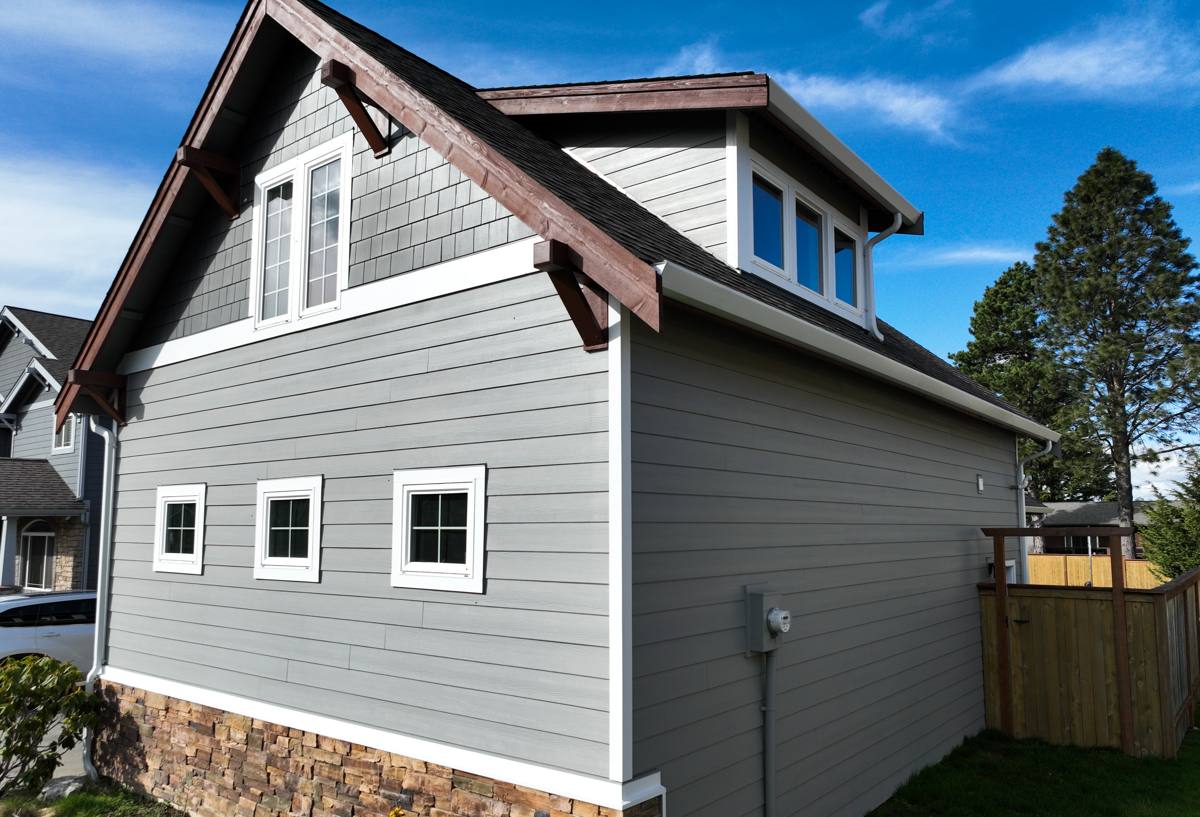
What This Climate Does to a House Over Time
Most siding failures we see in this region aren't dramatic. They're slow. Paint chalks and fades faster than it should. Caulk joints open up and let water behind the siding. Moss and algae take hold in shaded, north-facing areas and hold moisture against the wall longer than it should sit there. Wood-based products swell, then dry, then swell again, and eventually that cycle shows up as cupping, splitting, or soft spots near the bottom courses and around window trim.
None of this is unique to any one neighborhood in Lynden — it's a function of the region's rainfall totals, humidity, and the number of freeze-thaw cycles a wall assembly goes through each winter. But it means siding decisions made for a drier climate, or for a builder-grade budget, tend to age poorly here. A product that's marginal in Arizona or Texas can be a real liability on a Whatcom County exterior.
Why We Only Install James Hardie Fiber Cement
Ferndale Siding Company installs James Hardie fiber cement siding exclusively. We don't install vinyl, LP SmartSide, Cemplank, Allura, primed spruce, or cedar. That's a deliberate standard, not a lack of options, and it's worth explaining honestly rather than just asserting it.
What the Alternatives Get Right — and Where They Fall Short Here
Vinyl is inexpensive and low-maintenance in the sense that it doesn't need painting, but it's a thin plastic product that can warp in heat, crack in cold, and fade unevenly over time — and it simply can't match the look or rigidity of a fiber cement plank. LP SmartSide and other engineered-wood products perform reasonably well when installation and caulking are perfect and stay perfect, but they're wood-based at the core, which means moisture intrusion at a seam, nail hole, or cut edge can lead to swelling and rot — a real risk in a climate where wall assemblies rarely get a long dry stretch to recover. Cedar is beautiful and has real heritage appeal, but it demands ongoing maintenance — staining, sealing, pest and rot vigilance — that most homeowners underestimate until they're five years in. Primed spruce lap siding is a budget option that requires diligent, repeated painting to hold up at all in a wet climate, and it's one of the first products to show failure when that maintenance schedule slips.
James Hardie fiber cement is cement, sand, and cellulose fiber — it doesn't rot, it isn't attractive to insects, and it's non-combustible. It holds its shape and its finish through repeated wet-dry cycles in a way wood-based and vinyl products can't match. That's why we standardized on it rather than offering a menu of products with different long-term risk profiles.
The James Hardie System We Install
HZ5 Climate-Engineered Formulation
James Hardie engineers its siding by climate zone, and the Pacific Northwest falls under the HZ5 formulation — built specifically to resist moisture damage, freeze-thaw stress, and the humidity that defines a Whatcom County winter. This isn't a marketing detail; it's a real difference in how the board is manufactured for the environment it's going on.
ColorPlus Factory Finish
Most of what we install uses Hardie's ColorPlus finish — a color baked on at the factory under controlled conditions, rather than field-painted on site. It resists fading and chipping better than a site-applied coat, and it comes with its own finish warranty separate from the product warranty. For a home in a moss-prone, low-sun-exposure setting, a finish that holds its color and adhesion matters more than it might in a drier climate.
Product Lines
Depending on the home's architecture, we typically work with HardiePlank lap siding for a traditional look, HardiePanel for board-and-batten or modern styling, and HardieTrim for window, corner, and fascia detailing. All three integrate into one coherent system rather than being mismatched products stitched together.
Beyond Siding: Roofing, Windows, and Decks
Siding doesn't work in isolation — it's one piece of a home's exterior envelope, and problems in one area often show up in another. We also handle roofing, window replacement, and deck construction for Lynden homeowners, and we look at the whole exterior when we're on site, not just the wall surface. A roof that's shedding water onto a wall, or window flashing that's letting moisture behind the trim, will undermine even a perfectly installed siding job. Addressing these systems together, with one crew that understands how they interact, tends to produce a longer-lasting result than treating each as a separate project with separate contractors.
What Correct Installation Actually Involves
James Hardie siding is only as good as its installation. The product is engineered to perform, but poor flashing, wrong fastener placement, or skipped clearances will undercut all of that. Here's what we hold to on every job:
- Proper water-resistive barrier and flashing details behind every siding course, especially around windows, doors, and roof-to-wall transitions
- Correct fastener type, spacing, and placement per Hardie's published installation guidelines
- Minimum clearance between siding and grade, decks, roofing, and other horizontal surfaces to prevent wicking moisture
- Properly caulked and sealed joints where the manufacturer specifies sealant, and properly gapped joints where it doesn't
- Factory-finished ColorPlus touch-up done correctly at cut edges, or field painting done to Hardie's specification when using primed product
- Attention to ventilation behind the siding so the wall assembly can dry out between the region's wet stretches
Skipping any one of these doesn't usually cause an immediate problem — it causes a problem in year three or year five, which is exactly the kind of failure a homeowner shouldn't have to discover the hard way.
What Affects the Cost of a Lynden Siding Project
| Factor | Why It Matters |
|---|---|
| Home size and wall complexity | More corners, dormers, and trim detail mean more cutting, fitting, and labor time |
| Removal of existing siding | Tear-off, disposal, and any sheathing repair found underneath add to the scope |
| Product line selection | HardiePlank, HardiePanel, and trim combinations vary in material cost and installation time |
| Finish type | Factory-applied ColorPlus finish typically costs more upfront than primed board but reduces future painting costs |
| Underlying moisture or rot repair | Damage found once old siding comes off can add material and labor before new siding goes up |
| Access and site conditions | Slope, landscaping, and structure height affect staging and labor time |
We walk every property in person before quoting, because the honest answer to "what will this cost" depends on what's actually happening behind the existing siding — not just the square footage.
Why a Local Crew Matters in a Town Like Lynden
A siding job done by a crew that regularly works in Whatcom County understands things a traveling or out-of-area contractor might not: how much slope and drainage detail matters around a Lynden foundation, how long moss and algae growth actually take to become a problem in a shaded exposure, and how the region's rain patterns should shape scheduling and sequencing on a project. Local also means accountability — we're not driving off after the last nail. If a question comes up during the warranty period, we're a short drive away, not a call center.
If you're weighing a siding, roofing, window, or deck project on a Lynden home, we're glad to take a look and walk you through what we see — no pressure, no obligation. A free estimate gives you a clear, honest picture of your home's exterior and what it would take to get it right, using the form below.