 Ferndale Siding
 Building on the Water's Edge
Homes in and around Lummi Nation sit closer to salt water than almost anywhere else in Whatcom County. That waterfront position is part of what makes the area special, but it also means houses here take a beating that inland Ferndale and Bellingham homes simply don't see. Salt-laden air moves off Bellingham Bay and the Georgia Strait and settles on every exterior surface, day after day, all year. Add in Western Washington's driving winter rains and a moss and algae season that can stretch from October through May, and you have a climate that is genuinely harder on a building envelope than most manufacturers' warranty language assumes.
We've worked on exteriors throughout Whatcom County long enough to know that a siding, roofing, window, or deck product that performs fine in a dry inland climate can fail early on a shoreline-adjacent home. That's a big part of why we standardized on one siding system instead of offering a menu of options — more on that below.
What Salt Air, Rain, and Moss Actually Do to a House
Salt Air and Metal Fatigue
Airborne salt is corrosive to exposed metal — fasteners, flashing, window hardware, gutter systems, and railing brackets all age faster near the water. On homes close to the Lummi shoreline, we see corrosion show up years before it would on a comparable house a few miles inland. This is one of the reasons fastener and flashing choice matters as much as the siding material itself.
Wind-Driven Rain
Storms coming off the Strait don't just drop rain straight down — they push it sideways into wall assemblies, especially on west- and southwest-facing elevations. Any gap in flashing, any siding seam that wasn't lapped correctly, any window that wasn't properly integrated with the water-resistive barrier becomes an entry point. Over time, water that gets behind the cladding causes far more damage than water that simply runs off the surface.
Moss, Algae, and Shade
Lummi Nation's tree cover and coastal humidity create long stretches where north- and east-facing walls, along with lower roof slopes, stay damp for days at a time. That's exactly the environment moss and algae need. On wood-based siding products, sustained moisture and organic growth accelerate rot. On roofing, moss can lift shingles and hold water against the deck. A siding and roofing system that resists moisture absorption in the first place is worth more here than almost anywhere else in the county.
Why We Only Install James Hardie Fiber Cement Siding
We don't install LP SmartSide, vinyl, Cemplank, Allura, primed spruce, or cedar. That's a deliberate standard, not a lack of options. Each of those products has genuine strengths — vinyl is inexpensive, cedar is beautiful, engineered wood siding is easy to work with — but each also carries a trade-off that shows up faster in a marine climate than in a catalog photo.
- Cedar and primed wood look excellent new but require ongoing painting, caulking, and moisture vigilance. In a climate with this much rain and shade-driven dampness, wood siding's maintenance schedule tightens considerably, and skipped maintenance shows up as rot.
- Engineered wood siding (like LP SmartSide) has improved a great deal, but it's still a wood-strand product with edges that are vulnerable if caulking and paint aren't kept up, particularly on rain-exposed walls.
- Vinyl siding is budget-friendly and low-maintenance, but it's a thinner, more flexible material that can warp in direct sun and crack in cold snaps, and it relies entirely on its color coating never fading or chalking — a real concern under strong reflected light off open water.
- Cemplank and Allura are also fiber cement, and fiber cement as a category is the right call for this climate. Where we differ is on the specific manufacturer, warranty structure, and factory finish system.
James Hardie fiber cement is non-combustible, dimensionally stable in wet-dry cycling, and finished at the factory with the ColorPlus coating system rather than field-painted. That factory finish resists the fading and chalking that salt air and UV accelerate, and it comes with its own finish warranty separate from the substrate warranty. Hardie's HZ5 product line is engineered specifically for climates like ours — wet, marine-influenced, and prone to moisture cycling. We install what we're willing to warranty on our own reputation, and for Lummi Nation homes, that's Hardie.
Siding: What We Actually Install and Why It Fits This Area
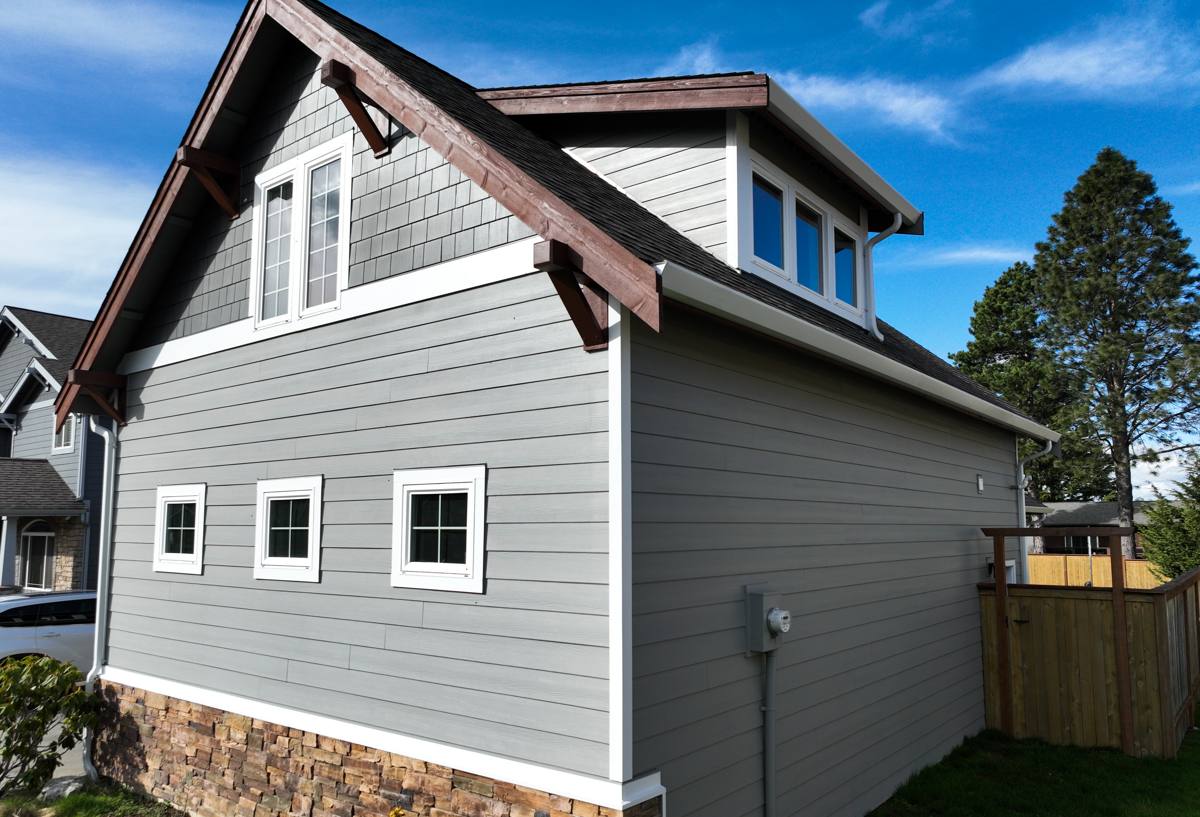
For most Lummi Nation homes we recommend HardiePlank lap siding as the primary field material, with HardieShingle for accent gables or a more traditional coastal look, and HardieTrim for corners, fascia, and window casing. All of it carries the same ColorPlus factory finish, so color stays consistent across every component instead of relying on field-matched paint. On homes with heavier salt exposure closer to the water, we also pay close attention to fastener selection — using corrosion-resistant fasteners rated for the exposure rather than defaulting to standard hardware.
Installation Details That Matter Here
Correct installation is what actually determines how a siding system performs over 20 or 30 years, not just the material choice. On coastal Whatcom County jobs we're careful about:
- Proper clearance between the bottom of the siding and grade, decks, or roof lines, so standing water and splash-back don't sit against the material
- Correctly lapped and integrated flashing at every window, door, and penetration, sized for wind-driven rain rather than just vertical runoff
- A continuous water-resistive barrier behind the siding with all seams properly taped and shingle-lapped
- Butt joints and seams sealed per Hardie's specifications, not just caulked as an afterthought
- Fastener spacing and depth set to manufacturer spec, since over- or under-driven nails are one of the most common causes of early siding failure
Roofing, Windows, and Decks for a Waterfront Property
Roofing
A roof on a Lummi Nation home does double duty against wind-driven rain and moss buildup. We look at ventilation, underlayment quality, and flashing detail around every penetration, and we talk with homeowners honestly about moss prevention rather than just moss removal after the fact.
Windows
Window failure on coastal homes is rarely about the glass — it's almost always about the flashing and integration with the wall assembly. We install windows as part of a complete water-management system, not as a standalone swap, which matters even more when a home sits directly in the path of Strait weather.
Decks
Decks near the water face their own version of the same problem: fastener corrosion, moisture trapped between boards, and structural framing that's exposed to splash and shade simultaneously. We build and repair decks with corrosion-resistant hardware and spacing that lets the structure actually dry out between storms.
Comparing Common Siding Materials in a Marine Climate
| Material | Moisture Resistance | Maintenance Burden | Finish Durability Near Salt Air |
|---|---|---|---|
| James Hardie Fiber Cement | High — dimensionally stable, engineered HZ5 line for wet climates | Low — no repainting cycle needed for years | High — factory ColorPlus finish, separate finish warranty |
| Cedar / Primed Wood | Moderate — vulnerable if maintenance lapses | High — regular painting and caulking required | Moderate — depends entirely on upkeep |
| Engineered Wood (LP SmartSide) | Moderate — improved but edge-sensitive | Moderate — caulking and paint maintenance | Moderate |
| Vinyl | Moderate — doesn't rot but can warp/crack | Low | Lower — prone to fading and chalking over time |
Every one of these materials has a place somewhere in residential construction. For homes absorbing this much salt air and rain, we've simply found that Hardie's combination of moisture stability and factory-applied finish holds up with the least ongoing maintenance burden on the homeowner.
Signs Your Exterior Is Falling Behind the Climate
Homeowners in this area often don't realize how much wear their exterior has taken until a project reveals it. Watch for:
- Soft or spongy spots on wood trim, fascia, or siding, especially on north-facing or shaded walls
- Persistent moss or dark streaking that returns quickly after cleaning
- Peeling or chalking paint on siding that hasn't been repainted in the last several years
- Rust staining below fasteners, hinges, or metal flashing
- Drafts, fogging, or visible gaps around window frames
- Soft decking boards or corroded fasteners on outdoor structures
Any of these is worth a look before it turns into a larger repair. Catching moisture intrusion early is almost always cheaper than replacing rotted sheathing or framing later.
Why a Local Crew Matters for This Area
A crew that works throughout Whatcom County knows how differently a house on the Lummi shoreline behaves compared to one a few miles inland in Ferndale. We know which elevations take the worst of the wind-driven rain in this area, how much of the year moss pressure stays active under the tree cover here, and how corrosion moves faster on hardware the closer a home sits to open water. That local knowledge shapes real decisions — fastener choice, flashing detail, where we push back on a design that would trap moisture — not just talking points.
Cost Factors to Expect
| Factor | Why It Matters Here |
|---|---|
| Home size and wall complexity | More corners, gables, and dormers mean more flashing and trim detail work |
| Extent of moisture or rot damage found | Salt air and shade can hide damage under intact-looking siding until removal |
| Siding profile (lap vs. shingle vs. panel) | Different HardiePlank and HardieShingle profiles carry different material and labor costs |
| Scope — siding only vs. siding with roofing/windows | Bundling exterior work often reduces overall cost versus separate projects |
We won't quote a number without seeing the house — every waterfront property carries a different amount of hidden moisture history — but we're always upfront about what's driving the cost once we've had a look.
Get a Free, No-Pressure Estimate
If you're weighing a siding, roofing, window, or deck project for a home in Lummi Nation, we're happy to come take a look and walk you through what we see, no obligation attached. Use the form below to request a free estimate, and we'll get back to you to set up a time.