 Ferndale Siding
 Siding Built for a Peninsula Climate
Point Roberts sits on its own finger of land jutting into the Strait of Georgia and Boundary Bay, surrounded on three sides by water and separated from the rest of Whatcom County by the Canadian border. That geography makes it one of the more demanding exterior environments we serve. Homes here take on salt-laden air coming off the water, near-constant winter rain driven sideways by open exposure, and long stretches of shade and dampness that keep moss and algae established on roofs and siding almost year-round. It's a different set of stresses than a home fifteen minutes inland in Ferndale deals with, and it changes what "good" exterior work actually looks like out here.
We treat Point Roberts as its own case, not a copy-paste of a Ferndale or Bellingham job. Salt air accelerates corrosion on fasteners and flashing, driving rain finds every gap in a siding system that isn't detailed correctly, and moss holds moisture against a wall or roof surface long after a storm has passed. Materials, fastener choice, and flashing details all get adjusted for that reality.
What the Exclave Location Means for Homeowners
Point Roberts is a U.S. exclave — reaching it from Ferndale means crossing into Canada and back out again, which is a logistics detail most contractors elsewhere never have to think about. It affects scheduling, material delivery, and which crews are willing to take on work out there at all. Homeowners in Point Roberts have told us they've had a harder time getting contractors to even quote a job, let alone show up reliably for the full length of a project. That's part of why we plan Point Roberts jobs with the border crossing built into the schedule from day one, rather than treating it as an afterthought.
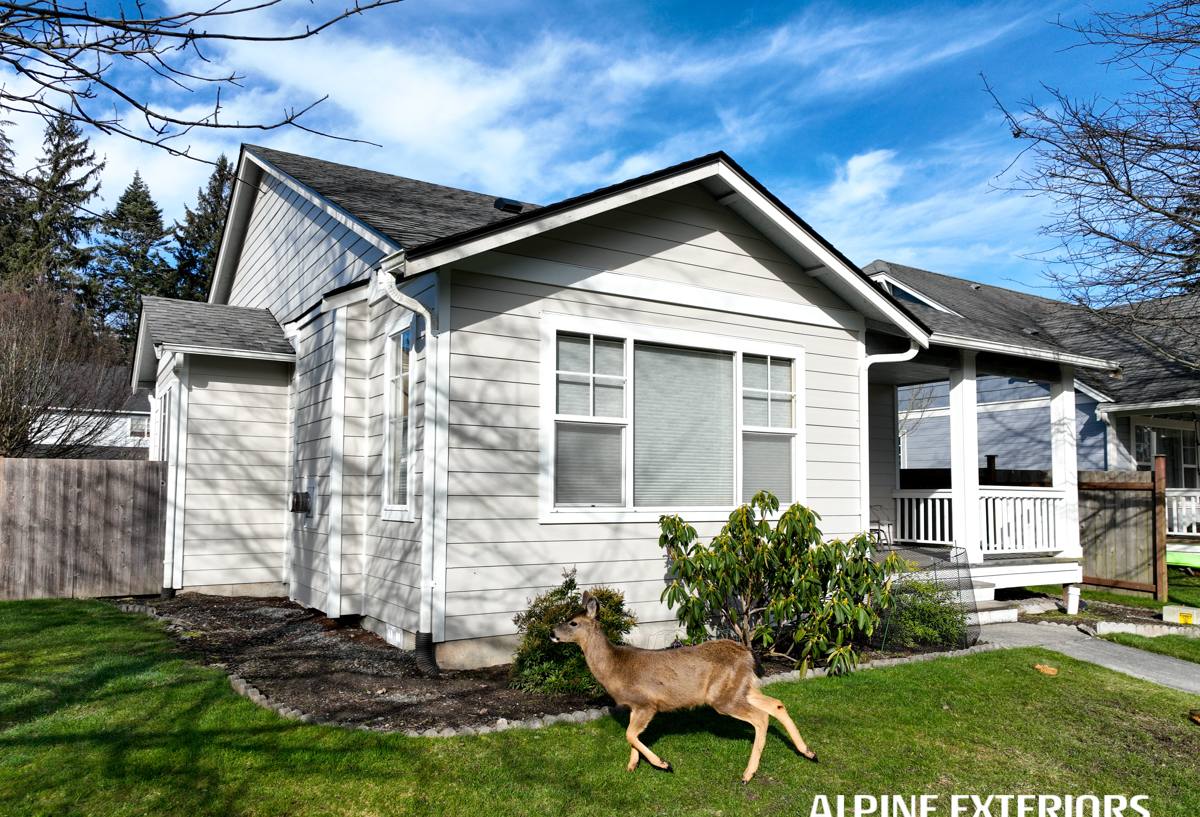
What Salt Air and Driving Rain Do to a Home's Exterior
Coastal exposure doesn't damage every material the same way, and understanding the failure pattern is the first step in choosing the right siding.
- Salt air corrosion — attacks exposed metal fasteners, flashing, and hardware faster than it does inland; low-quality or improperly coated fasteners can start showing rust streaks on siding within a few seasons.
- Wind-driven rain — pushes water sideways and upward at butt joints, window and door trim, and any place two materials meet; poor flashing details are where almost all water intrusion starts.
- Moss and algae growth — thrives on the north and shaded sides of homes where surfaces stay damp longest; moss holds moisture against siding and roofing, which is a slow but real path to rot and material breakdown over years.
- Wood-destroying moisture cycles — repeated wetting and drying is what eventually breaks down wood-based and composite products that aren't engineered for it.
None of these forces are unique to Point Roberts, but the combination — open water exposure on multiple sides, limited tree cover in places, and a marine layer that lingers — makes the wear cycle faster than it is in more sheltered parts of the county.
Why We Install Only James Hardie Fiber Cement
We made the decision years ago to install one siding system: James Hardie fiber cement. That's not a marketing position, it's a practical one, built around what actually holds up in a climate like this one.
Fiber cement is non-combustible and dimensionally stable — it doesn't expand and contract with moisture the way wood-based products do, which matters when a home spends months of the year in a damp marine environment. James Hardie's ColorPlus finish is baked on at the factory under controlled conditions, which gives it better fade and moisture resistance at the coating level than field-applied paint, and it comes backed by a real transferable warranty on both the substrate and the finish.
Just as important is that James Hardie makes climate-engineered product lines — including versions designed specifically for wetter, cooler regions — so the material itself is suited to the environment rather than being a generic product installed everywhere regardless of climate.
Why We Don't Install Everything Else
We get asked why we don't offer vinyl, LP SmartSide, or other composite and cedar options. The honest answer: we looked at how each performs over a full ownership cycle in this climate, not just at installation, and standardized on the one system we're confident holding up.
| Material | Trade-off in this climate |
|---|---|
| Vinyl siding | Can warp or become brittle with temperature swings and coastal wind loads; color is baked through but seams and fastening are more failure-prone in driving rain |
| LP SmartSide / engineered wood | Wood-strand core is more sensitive to sustained moisture exposure than fiber cement; performance depends heavily on caulking and maintenance discipline |
| Cedar / primed spruce | Natural wood movement and moisture absorption require ongoing refinishing; salt air and moss shorten the interval between maintenance cycles |
| James Hardie fiber cement | Non-combustible, dimensionally stable, factory-cured finish, engineered for wet climates |
Every one of those alternative products has legitimate uses and real strengths elsewhere. Our position is narrower: for the specific combination of salt exposure, driving rain, and moss pressure that a Point Roberts home deals with, we're not willing to put our name on an installation of a product we don't think holds up as well over the long run.
Siding Installation Details That Matter Out Here
The material is only half the equation. How it's installed determines whether it actually performs the way it's supposed to.
Flashing and Water Management
Every window, door, and horizontal trim transition is a place water can get behind the siding if it isn't flashed correctly. In a driving-rain environment, we pay particular attention to head flashing above openings, kick-out flashing where rooflines meet walls, and proper weather-resistive barrier integration behind the Hardie panels.
Fastener Selection
Given the salt air exposure, fastener corrosion resistance isn't optional. We follow James Hardie's fastening specifications for coastal and high-moisture applications rather than using whatever's cheapest or fastest to install.
Ventilation Behind the Cladding
Proper rainscreen or drainage plane detailing lets any moisture that does get past the siding surface drain and dry out instead of sitting against the wall assembly — important anywhere on the peninsula where shade and dampness linger.
Roofing, Windows, and Decks in the Same Environment
Siding doesn't work in isolation — the roof, windows, and any exterior decking on a Point Roberts home face the same salt air, moss pressure, and driving rain. We handle all four so the whole exterior envelope is considered together instead of patched piecemeal by different trades on different timelines.
- Roofing — moss growth and sustained dampness are the two biggest long-term threats to roof coverings out here; proper ventilation and moss-resistant material choices matter more than they would in a drier part of the county.
- Windows — window flashing integration with new siding is one of the most common failure points in any re-side; doing both together lets us get that detail right the first time.
- Decks — exposed decking takes the same wind-driven rain and salt exposure as the siding, and deck-to-house flashing is another spot where water intrusion commonly starts.
What a Point Roberts Project Timeline Looks Like
Because of the border crossing, we plan Point Roberts jobs with a bit more lead time on scheduling and material staging than a comparable Ferndale project. That's a logistics reality of the location, not a reflection of the work itself — once a crew and materials are on-site, the installation process and quality standard are identical to any other job we run.
- On-site assessment of existing siding, moisture damage, and flashing condition
- Material selection — Hardie product line, plank profile, and ColorPlus color
- Scheduling that accounts for border crossing and material delivery logistics
- Removal of old siding with a check for hidden moisture or rot in the sheathing
- Installation to Hardie's fastening and flashing specifications
- Final walkthrough and warranty documentation
Checklist: Signs Your Point Roberts Home May Need Exterior Attention
- Persistent moss or dark streaking on north- or shade-facing walls that keeps returning after cleaning
- Rust streaks running down from fasteners, trim, or flashing
- Soft or spongy spots on wood-based siding, especially near window and door trim
- Visible gaps, cracking, or separation at siding seams and butt joints
- Paint that's failing faster than expected, or peeling in patches near ground level or roof lines
- Interior signs like musty smells or discoloration on walls that share an exterior with heavy weather exposure
Any one of these on its own might be minor. Several showing up together, especially on the water-facing or shaded sides of a home, usually means it's worth having someone look at the whole exterior system rather than patching one spot.
If you own a home in Point Roberts and want a straight answer on what your siding, roofing, windows, or decking actually need, we're happy to come take a look. Reach out for a free, no-pressure estimate using the form below.