 Ferndale Siding
 Homeowners in Ferndale ask us about LP SmartSide often enough that we think it deserves a straight answer, not a sales pitch. It's a legitimate product with real advantages, and plenty of contractors install it well. We don't — and we think you deserve to know exactly why, in plain terms, without us trying to scare you into a different choice.
What LP SmartSide Actually Is
LP SmartSide is an engineered wood siding product. The core is strand board — wood fibers and resin pressed together, similar in concept to OSB sheathing — treated with a zinc borate solution to resist termites and fungal decay, then coated with a resin-saturated overlay and a factory primer. It's manufactured in panels, lap boards, and trim, and it's designed to be cut and installed much like traditional wood siding, which is part of its appeal to builders who are used to working with lumber.
It is not vinyl, and it is not fiber cement. It sits in its own category: an engineered wood product built to look and install like wood while resisting some of wood's traditional weaknesses.
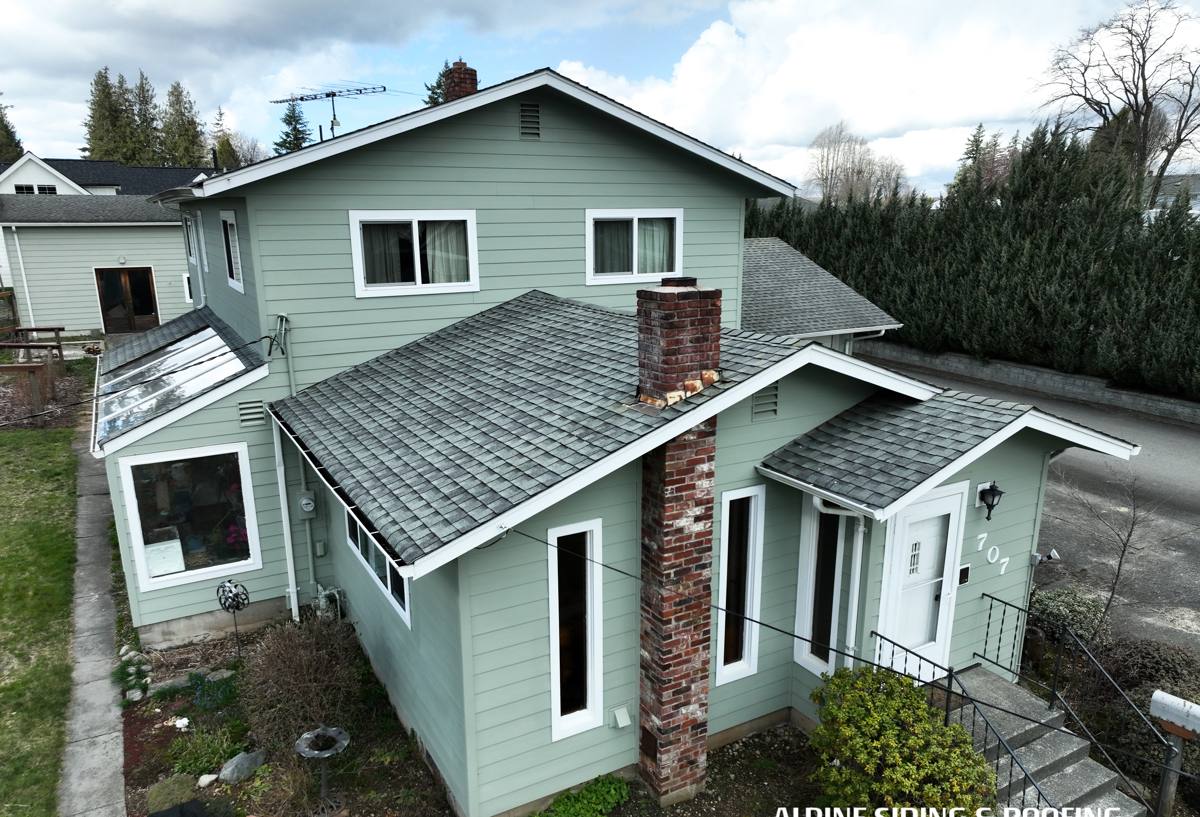
What LP SmartSide Gets Right
We're not going to pretend this product has no merit. It doesn't.
- Lighter weight than fiber cement, which can make handling and installation faster on some jobs.
- Easier to cut with standard woodworking tools — no special blades or dust control measures required the way fiber cement demands.
- Good impact resistance for an engineered wood product, holding up reasonably well against hail and incidental contact.
- Familiar work method for crews trained on traditional wood siding, which can mean fewer installation errors from crews unfamiliar with fiber cement techniques.
If you're comparing it against old-school cedar lap or plain plywood siding, LP SmartSide is a meaningful step up in decay resistance. That's a fair comparison, and it's the one LP's marketing leans on.
The Test Our Climate Puts to Any Wood-Based Product
Ferndale and the rest of Whatcom County sit in a specific kind of punishing environment for exterior building materials. We're close enough to Bellingham Bay and the Salish Sea that salt-laden air is a constant, not an occasional event. Rain here doesn't just fall — it drives sideways against west and south-facing walls for months at a stretch. And our mild, damp winters produce a long moss season that coats roofs, fences, and siding in organic growth that holds moisture against the surface far longer than a drier climate ever would.
None of that is a problem unique to LP SmartSide. It's a problem for every exterior product installed in this county. The difference is how a given material responds when moisture finds a way in — and that's where wood-based cores and cement-based cores part ways.
Why the Core Material Matters More Here Than Elsewhere
Any engineered wood product, no matter how well treated, has a wood fiber core. Wood fiber swells when it absorbs water. In a climate with occasional rain and long dry stretches, that's rarely tested. In a climate where driving rain and moss are near-constant companions for half the year, the core gets tested constantly — at every cut edge, every fastener penetration, every seam where caulk has to do its job perfectly for years on end.
Fiber cement doesn't have that vulnerability, because there's no wood fiber to swell. That single structural difference is the biggest reason our installation standard doesn't include LP SmartSide, and it's not a knock on the product — it's a fact about what wood-based cores do in wet, salty, moss-prone conditions.
Where the Trade-Offs Actually Show Up
We're not talking about hypothetical failures. We're talking about known, well-documented behavior of engineered wood siding products in wet coastal climates:
- Cut-edge exposure. Every field cut exposes raw core material. If the cut edge isn't fully sealed with the correct primer or sealant — every time, on every board — that edge becomes the entry point for moisture.
- Caulk-dependent joints. Panel and lap seams rely on caulking to stay watertight. Caulk is a maintenance item with a service life measured in years, not decades, and our climate's UV and moisture cycle wears it out faster than drier regions.
- Swelling at fastener points. Repeated wetting and drying around nail penetrations can cause localized swelling over time if the finish isn't perfectly maintained.
- Moss and organic growth retention. A textured wood-look surface gives moss and algae more to hold onto than a smooth factory finish, and constant moisture from moss buildup is exactly the condition that stresses a wood-fiber core.
Every one of these is manageable with diligent maintenance. That's the honest trade-off: LP SmartSide can perform well here, but it asks the homeowner to be the ongoing quality control department for the life of the siding.
What Keeping LP SmartSide Looking Good Actually Requires
This is the maintenance reality we walk homeowners through before they commit to any wood-based siding in this county:
- Inspect caulked joints and seams at least once a year, more often on walls exposed to driving rain.
- Recaulk seams as soon as cracking, shrinkage, or gaps appear — not after the next rainy season.
- Repaint on the manufacturer's recommended schedule, since the factory primer is not a finish coat.
- Wash off moss and organic buildup before it establishes a persistent moisture layer against the surface.
- Address any impact damage or exposed raw edges immediately, sealing them before the next rain event.
- Keep gutters, downspouts, and grading in good order so bulk water isn't running down or pooling against the siding.
That's not a criticism of homeowners — it's simply a longer maintenance list than a factory-finished, cement-based product requires, and in a climate this wet, the consequences of skipping a year fall harder than they would somewhere drier.
Warranty Fine Print Worth Reading Closely
Engineered wood siding warranties are often structured around strict maintenance compliance — meaning coverage can be reduced or voided if the recommended caulking, painting, and inspection schedule isn't documented and followed. That's a reasonable position for the manufacturer to take, since the core material's performance really does depend on that maintenance. But it puts the burden of proving compliance on the homeowner, years down the road, if a claim ever comes up.
| Factor | LP SmartSide (engineered wood) | James Hardie (fiber cement) |
|---|---|---|
| Core material | Wood strand, resin-bonded | Cement, sand, cellulose fiber |
| Moisture response of core | Can swell if water reaches it | Does not swell; dimensionally stable when wet |
| Factory finish | Primed; field paint typically required | ColorPlus factory finish available, baked on |
| Ongoing maintenance | Regular caulk/paint inspection required | Minimal; occasional wash and repaint of field-painted units |
| Warranty structure | Often maintenance-compliance dependent | Long-term, less dependent on caulk upkeep |
| Combustibility | Wood-based, combustible core | Non-combustible |
Why We Standardized on James Hardie
We made a decision a while back to install exactly one siding system: James Hardie fiber cement. That's not because we think every alternative is worthless — it's because we wanted to stop being in the business of hoping a maintenance schedule gets followed for the next 20 years. A cement-based core doesn't swell, doesn't rot, and isn't a food source for the organic growth that our moss season produces so reliably. It's also non-combustible, which matters more every wildfire season, even out here on the wet side of the state.
Hardie's ColorPlus factory finish takes the "repaint every several years" item off the maintenance list for most homeowners, and the HZ5 product line is engineered specifically for climates like ours — the Pacific Northwest's moisture-and-moderate-freeze pattern, not the dry heat of the Southwest. Combined with a strong, transferable warranty, it's the product we're willing to put our name behind for the long haul, on homes exposed to Whatcom County's salt air and driving rain for decades to come.
Correct Installation Matters More Than the Brand Name
We'll say this plainly: a poorly installed Hardie job can fail, and a carefully installed LP SmartSide job can perform well for years. Flashing details, proper clearances from grade and roof lines, correct fastener placement, and disciplined joint treatment matter as much as the material itself. Part of why we limit ourselves to one product is so our crews build deep, repeatable expertise in exactly one installation standard, rather than spreading that expertise thin across several systems with different rules.
If you're getting quotes for LP SmartSide from another contractor, ask pointed questions about their flashing details, joint treatment, and how they handle cut edges — the answers will tell you more about the eventual outcome than the brand name on the box.
If you're weighing siding options for a home in Ferndale or anywhere else in Whatcom County, we're happy to walk your property, point out what our climate has already done to your current siding, and give you a straightforward, no-pressure estimate for a James Hardie install.