 Ferndale Siding
 Cordata's Exterior Problem Isn't Cosmetic — It's Moisture
Cordata sits in the stretch of Whatcom County where Puget Sound air, Nooksack Valley rain bands, and a long, damp shoulder season all overlap. If you own a home here, you already know the drill: rain that doesn't fall hard so much as it just doesn't stop, mornings where everything outside is damp to the touch even when it hasn't rained in a day or two, and north-facing walls that seem to grow moss no matter how often you clean them. None of that is unusual for this part of Washington. But it does mean the exterior of your home is doing more work, more of the year, than exteriors in drier climates ever have to.
Siding, trim, and the roof are the first line of defense against that moisture load. When those systems are installed correctly and made from materials that actually tolerate this climate, a home can go decades without a moisture problem. When they're not, the damage is usually slow, hidden behind the siding, and expensive by the time anyone notices it. That's the lens we bring to every project in Cordata and the rest of the Ferndale service area — not "what looks good on install day," but "what still looks good and still keeps water out in fifteen years."
Salt Air, Driving Rain, and a Long Moss Season
Salt Air
Homes closer to Bellingham Bay and the Strait of Georgia deal with airborne salt that settles on siding, trim, fasteners, and metal flashing. Salt accelerates corrosion in exposed fasteners and can slowly break down finishes that weren't engineered to handle it. Cordata isn't right on the water, but Whatcom County's marine air still reaches inland, and over a couple of decades that exposure adds up on any exterior surface that isn't built to shrug it off.
Driving Rain
Whatcom County doesn't just get a lot of rain — it gets a lot of wind-driven rain, especially during fall and winter storm systems. Driving rain doesn't just wet a wall's surface; it pushes moisture sideways into seams, laps, and any gap where flashing or caulking has failed. Siding that relies on paint film or a thin factory coating to keep water out is the siding most likely to fail under these conditions, because driving rain finds the weak point and works it over and over, storm after storm.
Moss Season
"Moss season" in this part of Washington is really most of the year — anywhere shaded, north-facing, or slow to dry stays damp long enough for moss, algae, and mildew to take hold. On siding, that's not just an appearance issue. Organic growth holds moisture against the surface, and materials that absorb water or swell when wet are far more vulnerable to rot and finish failure under a mossy patch than a material that stays dimensionally stable when damp.
Why We Install James Hardie Fiber Cement — and Nothing Else
We made a deliberate decision to install James Hardie fiber cement siding exclusively. We don't install vinyl, LP SmartSide, Cemplank, Allura, primed spruce, or cedar. That's not a marketing position — it's a standard we hold because of what we've seen this climate do to exteriors over the years, and because we'd rather stand behind one system we trust completely than offer several and hope the cheaper ones hold up.
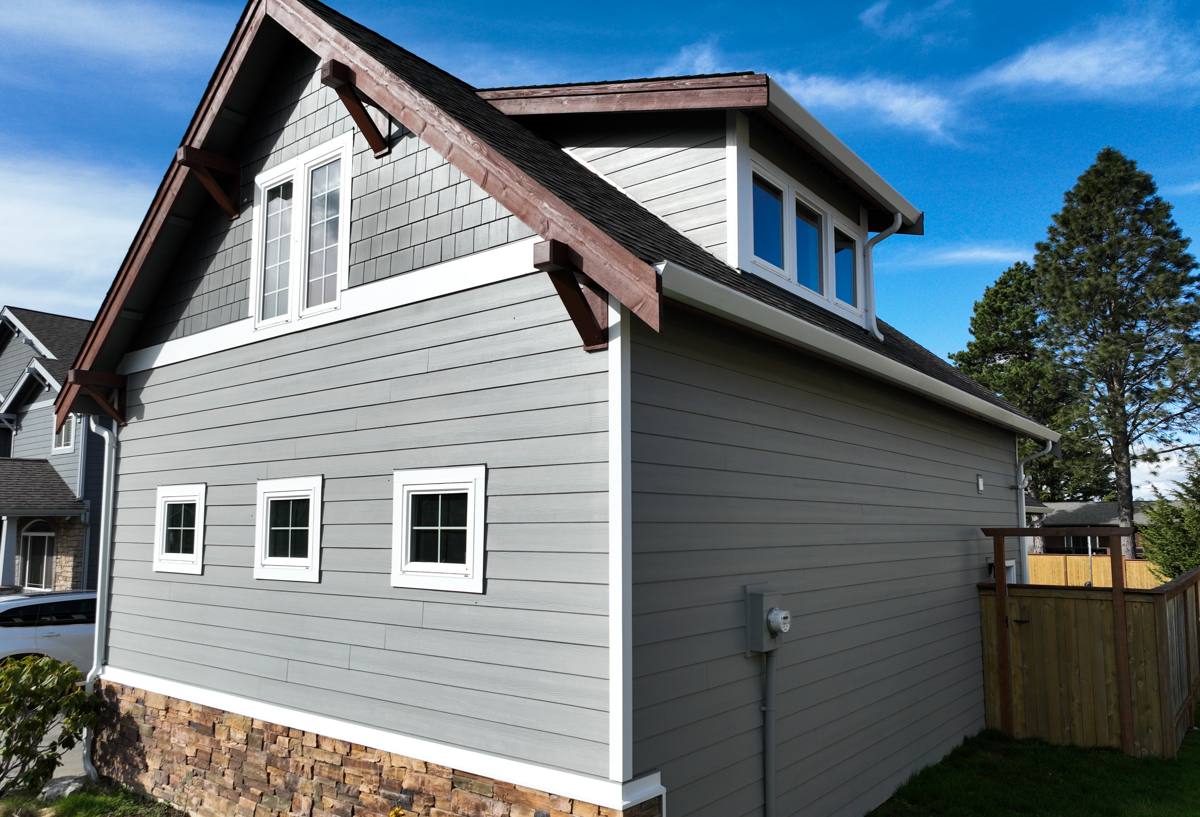
Fiber cement is made from cement, sand, and cellulose fibers, which makes it non-combustible and dimensionally stable — it doesn't swell, warp, or rot the way wood-based products can when they take on moisture. James Hardie's ColorPlus finish is baked on at the factory under controlled conditions, rather than field-applied with paint, which gives it far more consistent resistance to fading, chipping, and moisture intrusion at the surface. For a climate that keeps siding damp for long stretches of the year, that difference matters more here than it would somewhere dry.
Where the Alternatives Fall Short in This Climate
- Vinyl siding can warp or crack in temperature swings and relies on interlocking panels that can loosen over time in high-wind, driving-rain conditions — and it can't be painted a darker color without risking heat distortion.
- LP SmartSide, Cemplank, and Allura are wood-fiber or fiber-cement alternatives that compete on price, but each comes with its own trade-offs in moisture tolerance, finish durability, or long-term warranty strength compared to what we've found with Hardie.
- Primed spruce and cedar are natural wood products that need real, ongoing maintenance — recoating, caulking, and vigilance — to keep moisture out. In a climate this wet, that maintenance burden is constant, not occasional.
We're not saying these products can't work anywhere. We're saying that after years of doing exterior work in Whatcom County's specific climate, we don't think they're the right bet for homes here, and we'd rather install one product correctly than several products with a shrug.
James Hardie Product Lines We Work With
James Hardie makes climate-engineered "HZ" product lines — HZ5 is formulated for regions with freeze-thaw cycles and heavy moisture exposure, which fits Whatcom County's winters well. Depending on the home, we typically work with:
- HardiePlank lap siding — the classic horizontal siding look, in smooth or cedar-textured finishes
- HardiePanel — vertical panel siding, often used for a more modern look or as an accent
- HardieTrim — matching trim boards for a finished, factory-consistent look around windows, corners, and fascia
- HardieShingle — a shingle-profile option for homes that want that texture without the maintenance of real wood shakes
James Hardie backs its products with a strong, transferable limited warranty — which matters if you plan to sell the home down the road, since it's one less question a buyer's inspector will flag.
It's Not Just the Material — It's the Installation
Even the best siding fails early if it's installed wrong, and installation mistakes are exactly where driving rain and moss season expose weaknesses fastest. Correct James Hardie installation in this climate means:
| Detail | Why It Matters Here |
|---|---|
| Proper flashing at windows, doors, and roof lines | Driving rain finds every gap; flashing directs water away before it can get behind the siding |
| Correct fastener spacing and type | Salt-air exposure corrodes the wrong fasteners over time; Hardie specifies fastener types for a reason |
| Proper clearance from grade, decks, and roof lines | Constant dampness at ground contact is one of the most common causes of premature siding failure |
| Correct panel gaps and caulking at joints | Fiber cement needs room to handle moisture cycling; tight, uncaulked joints trap water |
| Factory-finish touch-up done to spec | Cut edges need proper sealing so the ColorPlus warranty coverage isn't compromised |
This is why hiring a local, experienced crew matters more than it might seem. A crew that's installed Hardie all over Whatcom County knows exactly how to detail a home against this specific weather — not generic best practices from a manual, but what actually holds up through a Ferndale winter.
Roofing, Windows, and Decks: The Rest of the Envelope
Siding doesn't work in isolation. We also handle roofing, windows, and decks, because a home's exterior only performs as well as its weakest connected system:
- Roofing — the roof and siding meet at flashing points that are common failure spots under driving rain; having one contractor coordinate both reduces the chance of a gap between trades.
- Windows — window flashing integrates directly with siding installation; poorly flashed windows are one of the most common sources of hidden water intrusion we find behind old siding.
- Decks — deck ledger connections and the siding around them need careful flashing too, since that's a spot where wood, fasteners, and constant moisture all meet.
Handling all four means fewer handoffs, fewer finger-pointing situations if something doesn't line up, and one crew accountable for how the whole exterior performs together.
What to Expect From a Local Crew
A contractor based in and around Ferndale isn't guessing about Whatcom County weather — it's what we deal with on every job. Here's what that should look like in practice:
- An in-person estimate that actually inspects your current siding, trim, and moisture-prone areas — not just a drive-by quote
- A clear explanation of why a product or approach is (or isn't) right for your specific home, orientation, and exposure
- Straight talk about what correct flashing and installation involves, not just a price per square foot
- A realistic maintenance conversation — including how little ongoing maintenance James Hardie actually requires compared to wood-based options
- A crew that shows up when scheduled and communicates about weather delays, which matter more here than in drier climates
Cost Factors Homeowners in Cordata Should Know
Every home is different, and we don't quote sight-unseen, but the factors that move a siding project's cost are consistent:
| Factor | Why It Affects Cost |
|---|---|
| Amount of existing damage or rot | Hidden moisture damage found during tear-off adds repair work before new siding goes on |
| Home size and wall complexity | More corners, gables, and dormers mean more cutting, flashing, and labor time |
| Siding profile chosen | Lap, panel, and shingle profiles differ in material and labor cost |
| Trim and detail work | Full HardieTrim packages cost more than minimal trim but finish more consistently |
| Access and site conditions | Steep lots, tight setbacks, or landscaping can add time and equipment needs |
Because moisture damage in this climate is often worse than it looks from the outside, we'd rather give you an honest number after we've actually looked at your walls than a rough figure that changes once we start tear-off.
Maintenance and Longevity in a Wet Climate
One of the biggest advantages of James Hardie fiber cement in Whatcom County is how little it asks of you afterward. It doesn't need the recurring recoating and caulk maintenance that wood siding does, and it doesn't warp or crack the way vinyl can under temperature swings. That doesn't mean zero maintenance — you'll still want to keep gutters clear, trim back vegetation that holds moisture against walls, and rinse off moss buildup on shaded sides periodically — but it's a far lighter lift than what wood-based or lower-grade products demand in a climate that stays damp this much of the year.
If you're in Cordata, Ferndale, or elsewhere in Whatcom County and want a straight answer about what your home's exterior actually needs, we're happy to take a look. Reach out for a free, no-pressure estimate — no obligation, just an honest assessment from a crew that works in this weather every day.