 Ferndale Siding
 Marietta sits low along Bellingham Bay, close enough to salt water that it shapes almost everything about how a house ages here. Homes in this part of Whatcom County take on a different kind of weather than you'd find a few miles inland — salt-laden air off the bay, wind-driven rain that comes in sideways instead of straight down, and a moss season that can run eight or nine months out of the year under the right (or wrong) conditions. Siding that isn't built for this specific combination tends to show it early: chalking finishes, swelling seams, soft spots at the bottom courses, and moss creeping up from the foundation line by year three or four.
Ferndale Siding Company works this area regularly, and Marietta's exterior problems tend to follow a pattern we recognize on sight. This page covers what local homes are up against, how we approach siding, roofing, window, and deck work for properties in this specific microclimate, and why we standardized on one product system instead of offering the usual menu of options.
Why Marietta's Climate Is Harder on Siding Than It Looks
On paper, Whatcom County's weather doesn't sound extreme — mild temperatures, moderate rainfall totals compared to some parts of the Pacific Northwest. But totals don't tell the whole story. What matters for siding longevity is exposure time: how many days a year the material stays damp, how much salt aerosol settles on painted surfaces, and how much shade keeps moss and algae fed.
Salt Air and Marine Exposure
Proximity to Bellingham Bay means airborne salt is a constant, low-level presence on exterior surfaces in Marietta, even on homes that aren't directly waterfront. Salt is corrosive to fasteners and abrasive to paint films over time. Materials that rely on a factory or field-applied coating for their weather resistance are the ones most affected — the salt accelerates the breakdown of that surface layer faster than it would inland.
Driving Rain and Wind-Loaded Moisture
Open exposure near the water also means wind that pushes rain horizontally into wall assemblies rather than letting it run straight off a roofline. That matters at every seam, joint, and butt end of a siding installation. Products that are sensitive to edge moisture — where water finds its way into a cut end or a lap joint and doesn't fully dry — are more likely to develop swelling, soft spots, or paint failure in a wall assembly that's regularly hit with driving rain.
Moss, Algae, and Shade
Whatcom County's long wet season and the tree cover common on Marietta lots create ideal conditions for moss and algae growth on north-facing and shaded walls. Left unaddressed, moss holds moisture against the siding surface for extended periods, which compounds whatever other moisture issues a wall already has. Regular gentle cleaning helps, but the underlying material still needs to be able to tolerate damp conditions without breaking down.
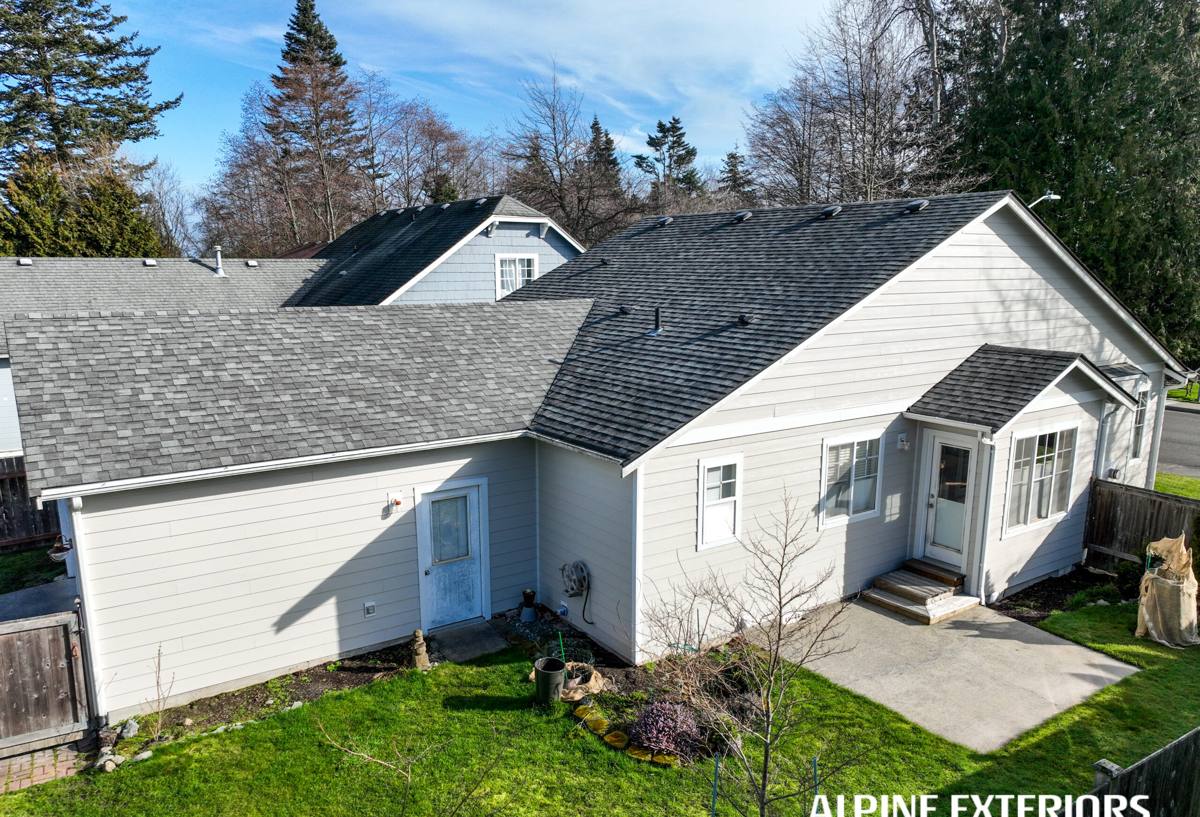
What This Means for Siding Choices in Marietta
Given all of that, the siding material matters more here than it would in a drier, less exposed part of the state. This is the core of our company position: we install James Hardie fiber cement siding exclusively. We don't offer vinyl, LP SmartSide, Cemplank, Allura, primed spruce, or cedar as alternatives, and we want homeowners to understand exactly why before they hire anyone for exterior work.
Why We Don't Install the Alternatives
Each of these products has legitimate uses and each has real advocates in the industry. Our decision isn't about calling any of them bad products — it's about what happens to them specifically in a marine, high-moisture environment like Marietta's, and what we're willing to stand behind long-term.
- Vinyl siding is affordable and low-maintenance in mild climates, but it can warp or distort in sustained heat reflection off windows, and its color is baked in rather than field-refinishable — once it fades or the profile fails, replacement is usually the only fix.
- LP SmartSide is engineered wood, which means it's dimensionally stable but still wood at its core. Wood-based products are more sensitive to sustained moisture exposure at cut ends and seams than cement-based products, which raises the stakes in a wind-driven-rain environment.
- Cemplank and Allura are both fiber cement competitors to Hardie, and structurally they're in the same family. Our reservations there are less about the base material and more about finish consistency, warranty structure, and product availability for future repairs and color matching in our specific service area.
- Primed spruce and cedar are traditional, attractive choices, but solid wood siding requires the most disciplined maintenance schedule of anything on this list — recoating, caulking, and moisture monitoring on a regular cycle. In a moss-heavy, salt-air environment, that maintenance burden goes up, not down.
Why James Hardie
James Hardie fiber cement is non-combustible, dimensionally stable, and manufactured in climate-specific formulations — the HZ5 product line is engineered for the kind of freeze-thaw and moisture-cycling conditions the Pacific Northwest sees. The ColorPlus factory finish is baked on under controlled conditions, which gives it better fade and chip resistance than field-applied paint, and it comes with its own finish warranty separate from the substrate warranty. For a Marietta home dealing with salt air and heavy seasonal moisture, that combination of non-combustible core, factory-cured finish, and a real transferable warranty is what we're willing to install and stand behind.
Siding Installation: What Correct Work Looks Like Here
Fiber cement siding is only as good as its installation. Hardie's own installation instructions are specific about fastening patterns, gapping at butt joints, flashing details, and clearance from grade and roof lines — and in a high-moisture area like Marietta, cutting corners on any of these shows up faster than it would in a drier climate.
- Proper weather-resistive barrier and flashing integration behind every board, not just at windows and doors
- Correct fastener spacing and type — Hardie is specific about nail gauge and placement, and under-fastening is a common cause of premature failure
- Adequate clearance between the bottom siding course and grade, decking, or roofing to avoid wicking moisture
- Properly gapped and sealed butt joints, especially on walls exposed to wind-driven rain
- Factory-cut and factory-primed edges used wherever possible, with field cuts sealed per manufacturer spec
Roofing, Windows, and Decks: The Rest of the Envelope
Siding doesn't work in isolation — it's one piece of a building envelope that has to work together to keep water out. We handle roofing, window replacement, and deck construction alongside siding because a house in this climate needs all four working correctly, not just the walls.
Roofing
A roof in poor condition undermines even the best siding job, since water that gets past a compromised roofline often ends up running down behind wall cladding. When we're on a Marietta property for siding, we look at roof condition as part of the overall picture, not as an afterthought.
Windows
Window flashing and integration with the surrounding siding is one of the most common failure points on any home, and it's especially unforgiving in a wind-driven-rain environment. Replacing windows and siding together lets us tie the flashing details into one continuous water management plan instead of patching around whatever was there before.
Decks
Decks in this area take the same moss and moisture exposure as walls, plus direct foot traffic and standing water risk. Ledger board flashing where a deck attaches to the house is a frequent source of hidden rot, and it's another spot where doing deck and siding work together pays off — we can address the connection point properly instead of two separate contractors working around each other.
Cost Factors for Marietta Homes
Every home is different, but the factors that move a siding project's cost up or down in this area tend to be consistent. This isn't a quote — it's a guide to what actually drives the number.
| Factor | Why It Matters Here |
|---|---|
| Existing siding removal | Tear-off of old vinyl, wood, or damaged material adds labor, especially if there's hidden moisture damage to sheathing underneath |
| Sheathing and framing repair | Marine moisture exposure sometimes means rot repair is discovered once old siding comes off |
| Home size and wall complexity | Cutouts for windows, dormers, and multiple gables add labor time regardless of material |
| Product line and profile | Hardie offers several plank profiles, shingle-style panels, and trim options at different price points |
| Color and finish | Standard ColorPlus colors versus custom field-painted finishes affect both cost and long-term maintenance |
| Access and site conditions | Sloped lots, tree cover, and tight setbacks near the water can add setup and staging time |
Why a Local Crew Matters in Marietta
A crew that works Whatcom County regularly knows what this specific stretch of coastline does to a house over time — where moss tends to build up first, which wall orientations take the worst of the driving rain, and how much clearance actually holds up against salt air and heavy wet seasons. That's different from general siding knowledge, and it shows in the details: flashing choices, fastener selection, and where extra attention goes during installation.
It also matters for warranty support and future service. A local company that's still in the area in ten or fifteen years is in a much better position to honor workmanship warranties and help homeowners navigate manufacturer warranty claims than a crew that worked a region once and moved on.
Maintenance Expectations After Installation
Even the right material benefits from basic upkeep, especially in a moss-prone, salt-air environment.
- Periodic gentle rinsing to remove salt residue and surface grime — avoid high-pressure washing directly at seams
- Prompt moss and algae removal on shaded or north-facing walls before it builds up
- Annual visual inspection of caulking at trim, windows, and butt joints
- Keeping gutters clear so roof runoff doesn't sheet down over siding unnecessarily
- Trimming back vegetation that shades walls and keeps them damp longer than necessary
If you own a home in Marietta and you're weighing your options for siding, roofing, windows, or a deck, we're happy to take a look and talk through what your specific property is facing. Reach out for a free, no-pressure estimate using the form below.