 Ferndale Siding
 Roofing Built for Cordata's Weather, Not Just Any Weather
Cordata sits close enough to the water and to Bellingham Bay's weather patterns that roofs here take a different kind of beating than roofs even twenty miles inland. Homes in this neighborhood deal with a mix of salt-laced air, long stretches of driving rain off the water, and a moss season that can run eight or nine months out of the year if a roof isn't maintained. Asphalt shingles can handle all of that when they're installed correctly and matched to the exposure of the specific house. The trouble is that "correctly" means something different here than it does in a drier climate, and a lot of roofing problems we get called out for in Cordata trace back to a roof that was installed using general practices instead of Whatcom County practices.
This page is about one thing: asphalt shingle roofing on homes in and around Cordata. Not siding, not gutters, not a generic rundown of shingle types. Just what a roof in this specific area actually needs, what a correct installation looks like, and why hiring a crew that already works this neighborhood matters more than it might seem.
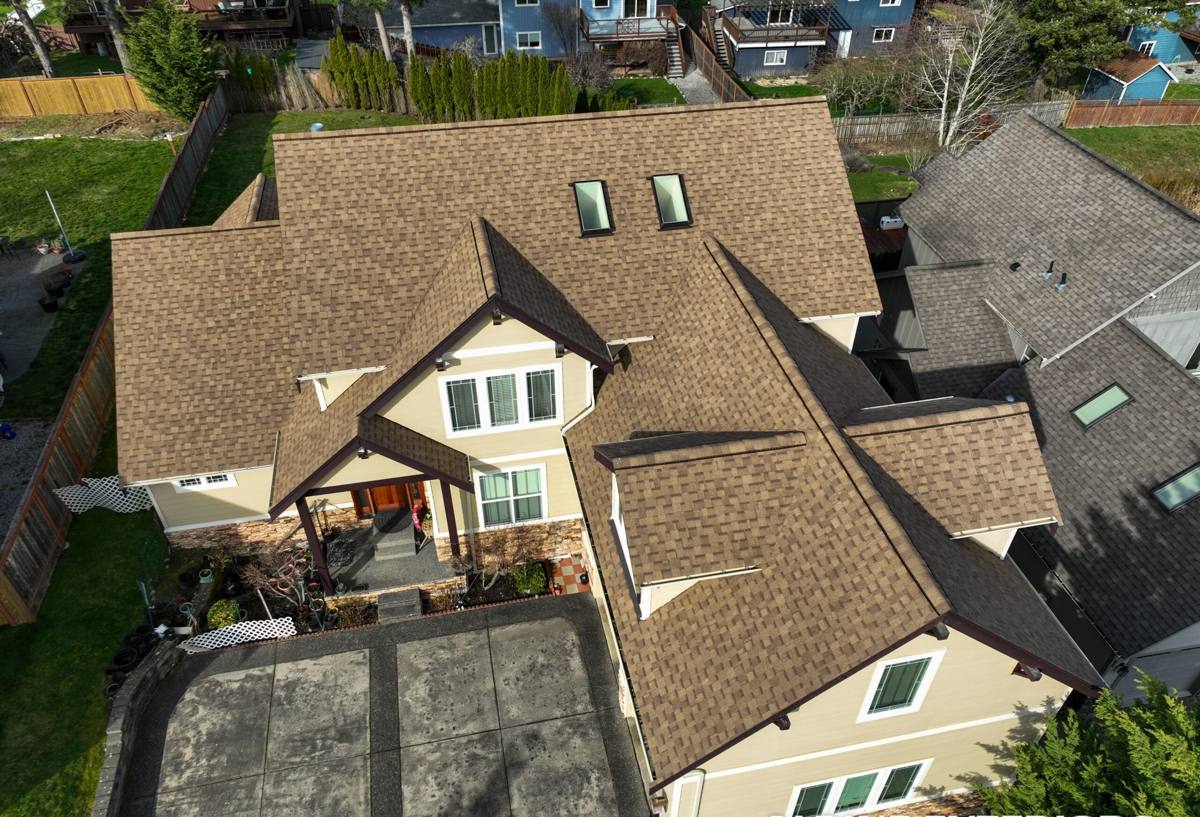
What Cordata's Climate Actually Does to a Roof
Moss and Organic Growth
Whatcom County's damp, mild climate is close to ideal moss-growing conditions, and Cordata's tree cover and shaded lots make it worse in spots. Moss holds moisture against the shingle surface long after the rest of the roof has dried out. Over time it lifts shingle edges, traps grit and debris underneath, and accelerates granule loss. A roof that's shedding granules early isn't necessarily a bad product — it's often a roof that's been sitting under a layer of moss for a few seasons without anyone noticing.
Driving Rain and Wind-Driven Water
Storms coming off the water don't always arrive straight down. Wind-driven rain pushes water sideways and upward under shingle edges, which is exactly the scenario that underlayment, flashing, and proper shingle nailing patterns are designed to defend against. A roof that would be fine in a calm, vertical-rain climate can leak in Cordata if those details were rushed.
Salt Air and Material Fatigue
Proximity to Bellingham Bay means a low but steady dose of salt-laden air, which is harder on exposed metal — flashing, fasteners, vent caps — than most homeowners expect. Lower-grade metal components corrode faster here than they would inland, and once flashing starts to degrade, the shingles around it are only as good as the metal protecting the seams.
Temperature Swings and Freeze-Thaw
Whatcom County doesn't get brutal winters, but it does get enough freeze-thaw cycling to matter. Water that gets trapped under lifted shingles or compromised flashing can freeze, expand, and widen the problem overnight. It's a slower, quieter form of damage than a big wind event, but it adds up.
What a Correct Asphalt Shingle Roof Includes
A roof that's going to hold up under Cordata conditions isn't just shingles nailed to plywood. Every layer underneath the visible shingle does a specific job, and skipping or shortcutting any of them is where premature failures start.
- Deck inspection and repair: Soft, delaminated, or water-stained decking gets replaced before anything goes on top of it — covering a bad deck just hides the problem.
- Ice-and-water shield at vulnerable points: Eaves, valleys, and roof-to-wall transitions get a self-adhering waterproof membrane, not just felt, because these are the spots where wind-driven rain and ice most often force water backward under the shingle line.
- Synthetic underlayment across the field: A durable, water-resistant layer under the shingles that doesn't sag or wrinkle when it gets damp during the install — which, in this climate, it usually will at some point.
- Proper flashing at every penetration: Chimneys, vent pipes, skylights, and wall intersections all need step flashing, counter-flashing, or pipe boots sized and installed correctly, in corrosion-resistant metal suited to salt-air exposure.
- Correct nailing pattern and fastener count: Manufacturer-specified nail placement, not a faster shortcut pattern, so shingles stay put in wind events instead of lifting at the edges.
- Balanced ventilation: Intake at the eaves and exhaust at the ridge, sized to the attic, so trapped moisture doesn't condense on the underside of the deck and rot it from within.
- Ridge cap and edge detailing: The finishing details that keep water moving off the roof at the edges and ridge instead of pooling or working backward.
Comparing Shingle Options for This Climate
Not every asphalt shingle product performs the same way under moss pressure, wind-driven rain, and salt exposure. The table below reflects general trade-offs we consider when helping a homeowner choose, based on how each type actually behaves in this kind of environment — not brand marketing claims.
| Shingle Type | Moss/Algae Resistance | Wind Performance | Typical Lifespan Here | Best For |
|---|---|---|---|---|
| 3-Tab Standard | Lower unless algae-resistant granules specified | Adequate on protected slopes | Shorter end of range | Budget-conscious re-roofs on simpler rooflines |
| Architectural/Dimensional | Good, especially with algae-resistant (AR) granules | Strong when properly fastened | Mid-to-upper range | Most Cordata homes — balance of durability and cost |
| Impact-Resistant Architectural | Good, same AR granule options available | Very strong | Upper range | Exposed lots with more tree debris or wind exposure |
For most homes in this neighborhood, we lean toward architectural shingles with algae-resistant granules as the sensible default — they cost more up front than 3-tab but hold up noticeably better against the moss cycle that defines roofing here, which usually pencils out over the life of the roof.
Our Process for a Cordata Roof
1. On-Site Inspection
We walk the roof and the attic, not just look at it from the ground. That means checking the deck for soft spots, looking at existing flashing condition, checking attic ventilation and any signs of moisture staining, and noting tree cover and shading that affects moss risk.
2. Honest Scope and Options
We explain what needs to happen — full replacement, partial repair, or targeted flashing and ventilation fixes — and why, in plain terms. If a roof can be reasonably repaired instead of replaced, we'll say so.
3. Material Selection
We walk through shingle options suited to the home's exposure, budget, and roofline, including the moss-resistance and wind-rating trade-offs relevant to this specific property.
4. Tear-Off and Deck Prep
Full tear-off to bare deck on replacements, deck repair as needed, and a clean job site — debris and old materials don't sit around for days.
5. Installation to Spec
Underlayment, ice-and-water shield, flashing, and shingles installed to manufacturer specifications and local climate practice, with attention to the details — valleys, penetrations, ridge — that determine whether a roof leaks in year three or holds up for decades.
6. Final Walkthrough
We review the completed work with the homeowner, including basic guidance on moss prevention and what to watch for going forward.
Maintenance That Actually Matters Here
A correctly installed roof in Cordata still needs some attention because of the local climate — this isn't a set-it-and-forget-it product in a region with this much moisture and moss pressure.
- Keep overhanging branches trimmed back where practical to reduce shade and debris buildup on the roof surface.
- Clear gutters and valleys of needles and debris at least once or twice a year so water has a clear path off the roof.
- Watch for early moss growth along shaded slopes and ridgelines and address it before it spreads and lifts shingles.
- Have flashing and penetrations checked periodically, since these are the components most affected by salt-air corrosion over time.
- Address small leaks or missing shingles quickly — in this climate, a small gap turns into trapped moisture fast.
Why Local Experience with Cordata Roofs Matters
A roofing crew that mainly works drier or more inland regions can still install a technically correct roof on paper, but they may not think in terms of Whatcom County's specific combination of moss pressure, wind-driven rain, and salt exposure. Choices like which underlayment holds up best under sustained dampness, how aggressive the ice-and-water shield coverage should be at valleys and eaves, and which flashing metal resists corrosion near the bay aren't universal defaults — they're regional judgment calls built from seeing how roofs actually perform here over years, not just how they look the day the crew leaves.
Working regularly in and around Cordata also means we're familiar with the general housing stock, common roofline styles, and the kind of tree cover and shading patterns that drive moss growth in this specific area. That local pattern recognition speeds up diagnosis and helps us make better material recommendations from the first inspection.
Signs Your Cordata Roof Needs Attention
| What You Notice | Likely Cause | Urgency |
|---|---|---|
| Green or black streaking on shingles | Algae or early moss growth | Moderate — address before it spreads |
| Visible moss patches, especially on shaded slopes | Trapped moisture under moss mats | High — moss actively lifts and damages shingles |
| Granules collecting in gutters | Shingle wear, often accelerated by moss or age | Moderate — worth an inspection |
| Water stains on interior ceilings | Active leak, often at flashing or valleys | High — needs prompt inspection |
| Rusted or lifted flashing | Salt-air corrosion or age | High — flashing failure leads to leaks quickly |
Get a Straightforward Look at Your Roof
If you're noticing moss buildup, a past leak, or you're simply due for an honest assessment of where your roof stands, we're glad to take a look. A free, no-pressure estimate gets you a clear picture of your roof's condition and straightforward options — no exaggerated urgency, no upsell tactics. Use the form below to get started.