 Ferndale Siding
 Roofing in a Salt Air, High-Rain Microclimate
Semiahmoo sits right on the water in Whatcom County, and that changes what a roof has to deal with compared to a house a few miles inland in Ferndale or Bellingham. Salt-laden air off the bay accelerates corrosion on anything metal — fasteners, flashing, vent caps, gutter hardware. Add in wind-driven rain that comes off the water sideways rather than straight down, and a long, damp moss season that runs from fall through spring, and you have a roofing environment that punishes shortcuts. A roof that would hold up fine in a drier part of the state can fail early out here if it wasn't built with these specific stresses in mind.
That doesn't mean Semiahmoo homes need exotic materials or a completely different approach. It means the details that are optional elsewhere — corrosion-resistant fasteners, properly lapped underlayment, real attic ventilation, clean flashing work at every penetration — are not optional here. Get those right and a roof will do its job for decades. Skip them and you'll be dealing with leaks, rot, and premature replacement well before the shingles themselves wear out.
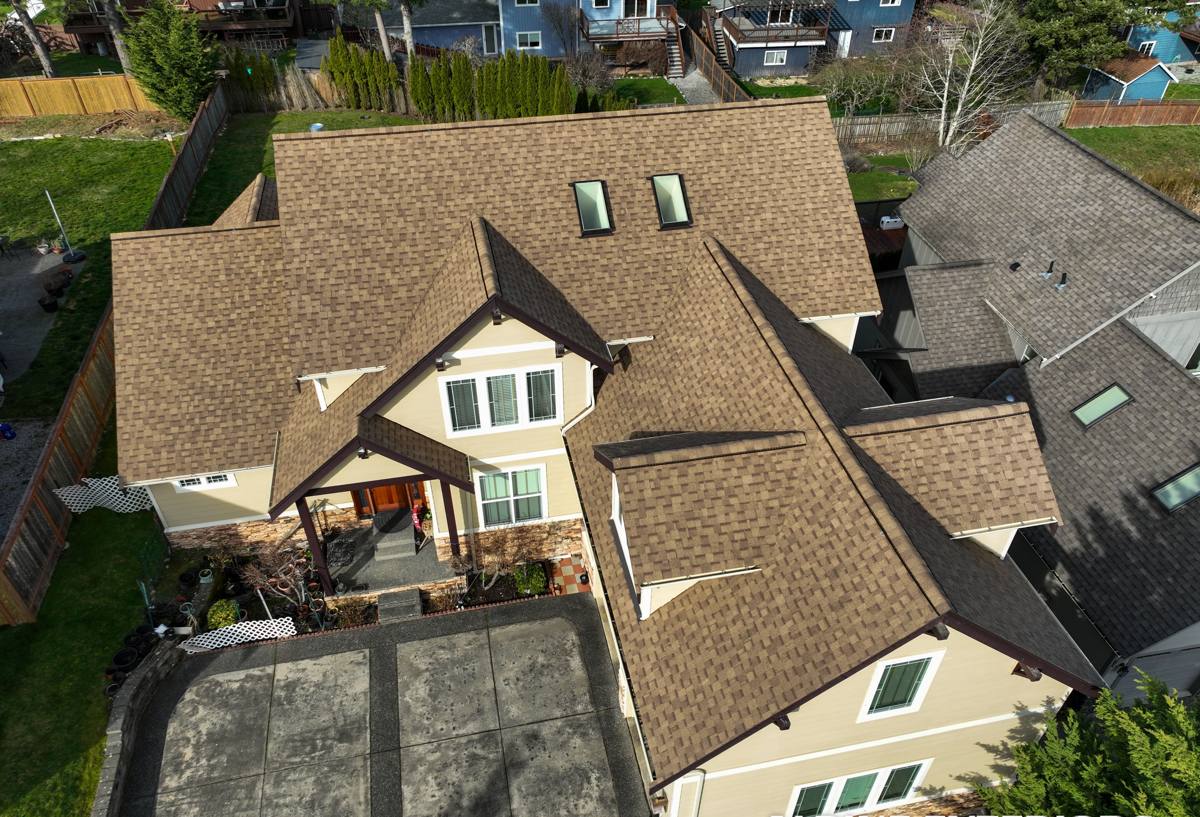
How Salt Air and Driving Rain Actually Damage a Roof
Salt Air and Corrosion
Airborne salt settles on every exposed surface and speeds up rust and oxidation on exposed metal. Standard steel fasteners, cheap flashing, and unprotected nail heads corrode faster near the water than they would even ten miles inland. Once a fastener or flashing seam starts to corrode, it stops sealing the way it should, and that's how water finds its way under the roofing material.
Wind-Driven Rain
Rain that comes in at an angle off the bay behaves differently than rain falling straight down. It can work its way up under shingle edges, through poorly lapped underlayment, and into gaps around vents and chimneys that would stay dry in calmer conditions. This is why lap direction, fastener placement, and flashing detail matter more here than the brand of shingle on the roof.
Moss and Sustained Moisture
Whatcom County's long wet season keeps roofs damp for extended stretches, and shaded, north-facing slopes near mature trees are especially prone to moss. Moss holds moisture against the roofing surface, lifts shingle edges as it grows, and can work its way under tabs over time. Left unchecked for years, it contributes to premature granule loss and, eventually, decking rot underneath.
Signs a Semiahmoo Roof Needs Replacement, Not Another Repair
Not every issue means a full tear-off. But there's a point where patching stops making financial sense and a full replacement becomes the honest recommendation. Common signs include:
- Granule loss heavy enough that you can see bare asphalt in multiple spots, not just one worn patch
- Shingles that are cupping, curling, or cracking across large sections of the roof, not isolated to one repair area
- Soft spots or sagging in the decking, which usually means moisture has already reached the wood
- Repeated leaks in different locations after previous repairs, suggesting the underlayment has failed broadly
- Heavy, persistent moss growth that keeps returning even after cleaning
- A roof that's simply reaching or past the expected service life for its material and installation
If only one or two of these apply and the roof is otherwise sound, a targeted repair may be the right call. We'll tell you that honestly rather than push a replacement that isn't needed yet.
What a Correct Roof Replacement Involves Here
Full Tear-Off, Not Overlay
We remove the existing roofing down to the deck rather than layering new material over old. Overlaying traps moisture, hides deck damage, and adds weight without solving the underlying problem — a bad trade-off anywhere, and a worse one in a climate this wet.
Deck Inspection and Repair
Once the old roofing is off, we inspect the decking for soft spots, delamination, or rot, particularly around valleys, chimneys, and areas that have had chronic moss growth. Any compromised sheathing gets replaced before anything new goes down — installing new roofing over bad decking just guarantees another failure later.
Underlayment Built for Wet Climates
We use synthetic or self-adhered underlayment appropriate for high-moisture coastal exposure, with correct overlap and fastening patterns so wind-driven rain can't work its way underneath. In vulnerable areas — eaves, valleys, and low-slope transitions — we add extra protection rather than relying on the field underlayment alone.
Corrosion-Resistant Flashing and Fasteners
Given the salt exposure around Semiahmoo, we pay close attention to the materials used at flashing points — chimneys, skylights, vent stacks, and roof-to-wall transitions — and use fasteners rated to hold up in salt air rather than the cheapest option available. This is one of the details that separates a roof that lasts from one that starts leaking at the seams within a few years.
Ventilation That Actually Works
Proper intake and exhaust ventilation keeps the attic space dry and temperature-balanced, which reduces condensation buildup and helps prevent the kind of trapped moisture that speeds up moss growth and deck rot. We check existing ventilation as part of every replacement and correct it where it's inadequate.
Choosing a Roofing Material for a Coastal Whatcom County Home
There's no single "best" material for every house — it depends on your roof's slope, exposure, budget, and how much maintenance you want to take on. Here's how the common options stack up for a salt air, high-rain setting like Semiahmoo:
| Material | Coastal Performance | Maintenance | Trade-Offs |
|---|---|---|---|
| Architectural Asphalt Shingle | Good, with quality underlayment and flashing | Periodic moss treatment on shaded slopes | Best value; wide color range; solid warranty options |
| Standing Seam Metal | Very good if fasteners and coatings are corrosion-rated | Low; occasional fastener/seam check | Higher upfront cost; sheds moss and debris well |
| Cedar Shake | Requires diligent upkeep in this moisture level | High — regular treatment against moss and rot | Traditional look, but maintenance burden is significant near the water |
| Composite/Synthetic Shake | Good; more moisture-stable than natural wood | Low to moderate | Higher cost than asphalt, more maintenance-friendly than cedar |
For most Semiahmoo homes, a quality architectural asphalt shingle with correct installation delivers the best balance of durability, cost, and appearance. Metal is a strong option for homeowners who want the lowest long-term maintenance and don't mind the higher upfront investment. We'll walk through the real trade-offs for your specific roof rather than steering you toward whatever is easiest to install.
Our Process for a Semiahmoo Roof Replacement
- On-site inspection. We look at the current roofing, decking condition, ventilation, and any moss or moisture problem areas before quoting anything.
- Written estimate. You get a clear scope of work and pricing, including material options, so there are no surprises once work starts.
- Tear-off and deck check. Old roofing comes off, decking gets inspected and repaired as needed.
- Underlayment and flashing. Installed to standards suited for coastal wind and rain exposure, not just minimum code.
- Roofing installation. Your chosen material goes on with correct fastening patterns and attention to every penetration.
- Ventilation check and final walkthrough. We confirm intake/exhaust balance and walk the finished roof with you before calling the job done.
What to Ask Before Hiring a Roofing Crew Near Semiahmoo
Roof replacement is a significant investment, and the quality of the installation matters as much as the material you choose. Before hiring anyone, it's worth asking:
- Are you licensed and insured to do roofing work in Washington State?
- Do you perform a full tear-off, or do you offer overlays as a cheaper option?
- What underlayment and flashing do you use, and why, for a coastal property?
- Will you inspect and repair decking as part of the job, and how is that priced?
- What does the manufacturer's warranty require, and will your installation meet those terms?
- Do you have experience with homes specifically in this area, dealing with this climate?
A contractor who can answer these clearly, without vague reassurances, is one worth trusting with your roof.
Why Local Experience in Semiahmoo Matters
A crew that regularly works in and around Semiahmoo already knows which slopes tend to hold moss, how wind off the bay behaves against different roof orientations, and which flashing and fastener choices actually hold up under sustained salt exposure. That local pattern recognition shows up in fewer callbacks and a roof that performs the way it's supposed to for its full expected life. It's the difference between a crew applying a generic installation and one that's adjusting the details based on what actually fails on roofs in this specific stretch of Whatcom County.
As a Ferndale-based crew, we work this coastline regularly, and we bring that pattern recognition to every Semiahmoo roof replacement — from material selection through the final flashing detail.
Ready to Talk About Your Roof?
If your roof is showing its age, dealing with persistent moss, or just due for an honest assessment, we're happy to take a look. Fill out the form below for a free, no-pressure estimate — we'll tell you straight whether you need a full replacement or if a repair will do.