 Ferndale Siding
 Why Birch Bay Roofs Take More Punishment
Birch Bay sits right on the water, and that changes what a roof has to survive. Homes close to the bay deal with a steady drift of salt-laden air that settles on shingles, flashing, and exposed fasteners year-round. Salt doesn't just sit there — it accelerates corrosion on metal roofing components and speeds up the breakdown of adhesives and sealants that hold a roofing system together. A roof a few miles inland in Ferndale can go through the same twenty years and look noticeably better than one that's been facing the water the whole time.
Add in wind-driven rain off the Strait of Georgia and Salish Sea, and you get a second problem: water that doesn't just fall straight down but gets pushed sideways and even upward under shingle laps and around flashing. A roof that's fine in a light, vertical rain can still leak in a Birch Bay windstorm if the details underneath aren't built for lateral water intrusion. Then there's moss. Whatcom County's long, wet, mild winters give moss months to establish itself, and shaded, north-facing slopes near mature trees are especially prone to it. Moss holds moisture against the roofing material, works its way under shingle tabs, and lifts edges over time — which is exactly how small leaks start.
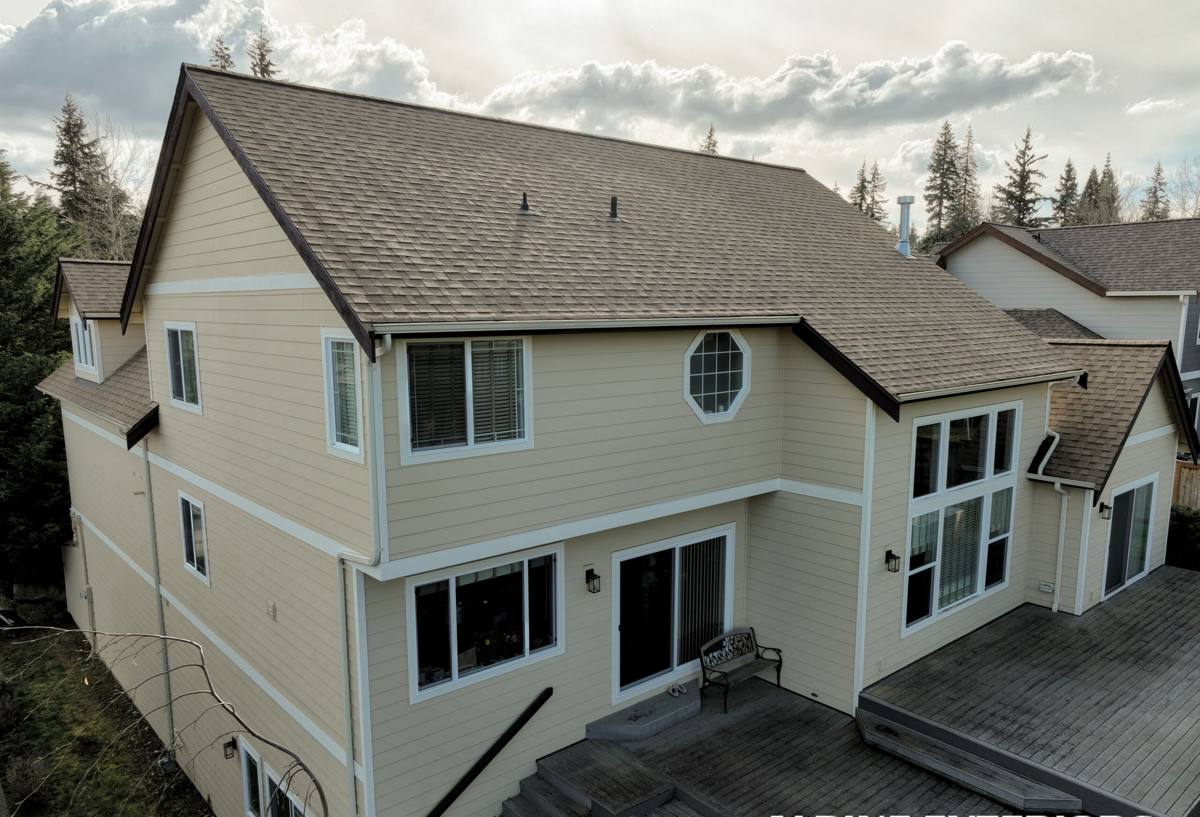
Repair or Replace? Reading the Signs
Not every roofing problem calls for a full replacement, and we'll tell you honestly when a repair is the right call. But there's a point where patching stops being cost-effective and starts being a way to delay an expense that's coming regardless. Here's what tends to tip a roof from "repair" to "replace" territory:
- Granule loss heavy enough that you're finding shingle grit in gutters and downspouts consistently, not just after one storm
- Shingles that are curling, cracking, or cupping across multiple areas of the roof, not just one isolated patch
- Soft spots or sagging in the roof deck when walked, which usually means water has reached the wood underneath
- Repeated leaks in different locations after prior repairs, suggesting the underlayment has failed broadly rather than in one spot
- Visible daylight through the attic roof boards, or moisture staining spreading across multiple rafter bays
- A roof already past or near the end of its material's expected service life, especially one that's spent that whole life exposed to salt air
- Persistent moss or algae growth that keeps returning within a season or two of cleaning
If you're only seeing one or two of these, a targeted repair may still make sense. If several apply at once, a replacement is usually the more honest recommendation — and we'll walk you through why, not just tell you it's needed.
What a Correct Roof Replacement Actually Involves
Tear-Off and Deck Inspection
A full tear-off matters more here than in drier climates. Layering new shingles over old ones hides the condition of the deck underneath, and in a place where moisture has had years to work on that plywood or plank sheathing, that's a real risk. Every tear-off should include an inspection of the deck itself, with any soft, delaminated, or water-damaged sections replaced before anything new goes down. Skipping this step is one of the most common ways a roof replacement fails early.
Underlayment Built for Wind-Driven Rain
Given how much lateral water movement Birch Bay roofs deal with in winter storms, the underlayment layer is not a place to cut corners. Self-adhering ice-and-water membrane at eaves, valleys, and around every penetration gives you a second line of defense if wind ever forces water past the shingles themselves. Synthetic underlayment across the rest of the deck holds up better than old-style felt when it's exposed to moisture during the install process, which matters in a region where a dry work window isn't guaranteed.
Flashing Details
Flashing is where most roof leaks actually originate, not out in the open field of shingles. Every chimney, skylight, vent pipe, and roof-to-wall transition needs properly formed, correctly lapped flashing — and in a salt-air environment, the metal type matters. We favor corrosion-resistant flashing materials and fasteners for coastal homes specifically because standard galvanized steel can start showing rust well before the shingles around it are due for replacement.
Ventilation
A roof replacement is also the right time to correct ventilation problems, since the deck and old materials are already exposed. Balanced intake and exhaust ventilation keeps the attic space closer to outdoor temperature and humidity, which reduces condensation buildup on the underside of the deck — a real issue during Whatcom County's long, damp winters — and helps new shingles last their full rated life instead of failing early from trapped heat and moisture.
Choosing Materials for a Coastal Whatcom County Home
There's no single "best" roofing material for Birch Bay — the right choice depends on your home's exposure, your budget, and how much long-term maintenance you want to take on. Here's how the common options actually compare under local conditions:
| Material | Salt Air Durability | Moss Resistance | Typical Lifespan | Notes |
|---|---|---|---|---|
| Architectural asphalt shingle | Good, with corrosion-resistant flashing and fasteners | Moderate; benefits from periodic cleaning | 25–30 years | Best balance of upfront cost and performance for most Birch Bay homes |
| Standing seam metal | Very good with a marine-grade or coated finish; poor with uncoated or mismatched fasteners | Strong; sheds moss more easily due to smooth, steep surfaces | 40–50+ years | Higher upfront cost; finish and fastener spec matter more here than almost anywhere |
| Composite/synthetic shake or slate | Good | Moderate to good, depending on surface texture | 30–50 years | Higher cost; a good fit for homes wanting a specific look without the maintenance of real wood |
| Cedar shake | Fair; needs regular maintenance in salt air and moisture | Weak without treatment; holds moisture and feeds moss growth | 20–30 years with upkeep | We'll install it if requested, but it's the highest-maintenance option for this specific climate |
We're not going to steer every homeowner toward the most expensive option. For most Birch Bay homes, a quality architectural shingle with the right underlayment and flashing package delivers the durability you need without the added cost of metal. Where a home is especially exposed — right on the water, high wind area, steep pitch — metal earns its higher price tag.
Our Process, Start to Finish
- On-site inspection. We walk the roof and attic, check the deck condition where accessible, and look at flashing, ventilation, and any existing moss or water staining.
- Honest recommendation. We tell you whether you're looking at a repair or a full replacement, and why — with the reasoning, not just a number.
- Written estimate. Materials, scope of work, and pricing laid out clearly, with material options explained so you're choosing based on understanding, not guesswork.
- Scheduling around Whatcom County weather. We plan tear-off and install around dry windows where possible, and protect exposed decking if weather turns mid-job.
- Tear-off, deck repair, and install. Full removal of old materials, deck inspection and repair as needed, then underlayment, flashing, ventilation, and roofing material installed to manufacturer specification.
- Cleanup and walkthrough. Site cleared of debris and nails, magnetic sweep of the yard, and a final walkthrough so you can see the finished work before we consider the job done.
Cost Factors Worth Understanding
Roof replacement pricing varies enough between homes that a flat number off a website wouldn't be honest. What actually drives the cost is a combination of:
- Roof size and complexity — number of planes, valleys, dormers, and penetrations
- Pitch and accessibility — steep or hard-to-access roofs take more time and safety setup
- Current deck condition — hidden rot found during tear-off adds material and labor
- Material choice — asphalt, metal, and composite options span a wide price range
- Underlayment and flashing package — upgraded coastal-grade materials cost more upfront but reduce long-term risk
- Ventilation corrections — adding or upgrading intake/exhaust venting if the current setup is inadequate
We'll walk through each of these during the estimate so you understand exactly what you're paying for and where, if anywhere, there's room to adjust scope to fit your budget.
Protecting the New Roof: Moss and Maintenance
A new roof in Birch Bay still needs some seasonal attention given the moss pressure here. Keeping gutters clear so water isn't backing up under the eaves, trimming back overhanging branches that shade the roof and keep it damp, and periodic gentle moss treatment on shaded slopes will meaningfully extend the life of whatever material you choose. None of this is intensive work, but skipping it entirely in this climate tends to shorten a roof's service life more than homeowners expect.
Why a Local Birch Bay Crew Matters
A roofing crew that works Birch Bay regularly already knows which details actually matter here — where wind-driven rain tends to find weak flashing, which slopes hold moss the longest, and how salt exposure changes fastener and flashing choices compared to a roof a few miles inland. That's knowledge that comes from doing the work in this specific area repeatedly, not from a general roofing checklist. We're also familiar with Whatcom County permitting requirements and scheduling around this region's weather patterns, so there are fewer surprises once work is underway.
If your Birch Bay roof is showing its age or you just want an honest read on where it stands, we're happy to take a look. There's a free, no-pressure estimate through the form below — walk away with a straight answer either way.