 Ferndale Siding
 Why Everson Homes Put Extra Demands on a Roof
Everson sits inland from the coastline, but it doesn't escape the weather pattern that shapes roofing decisions across Whatcom County. Moist marine air moves through the Nooksack valley for much of the year, rainfall is frequent rather than heavy-and-occasional, and the tree cover that makes this area attractive also means a long moss season on any roof that holds shade and moisture. A roofing material that works fine in a dry climate can struggle here — not because it's a bad product everywhere, but because it wasn't built for a climate where a roof might stay damp for days at a stretch between drying-out windows.
Metal roofing has become a common answer to that problem for homeowners in and around Everson, and for good reason. Done correctly, it sheds water fast, resists the moss and algae growth that plague shaded roofs, and holds up to decades of freeze-thaw cycling and driving rain without the granule loss or moisture absorption that shortens the life of other materials. Done poorly — wrong fastener pattern, missed flashing detail, no ventilation plan — it can fail in ways that are expensive to fix. The material is only half the equation.
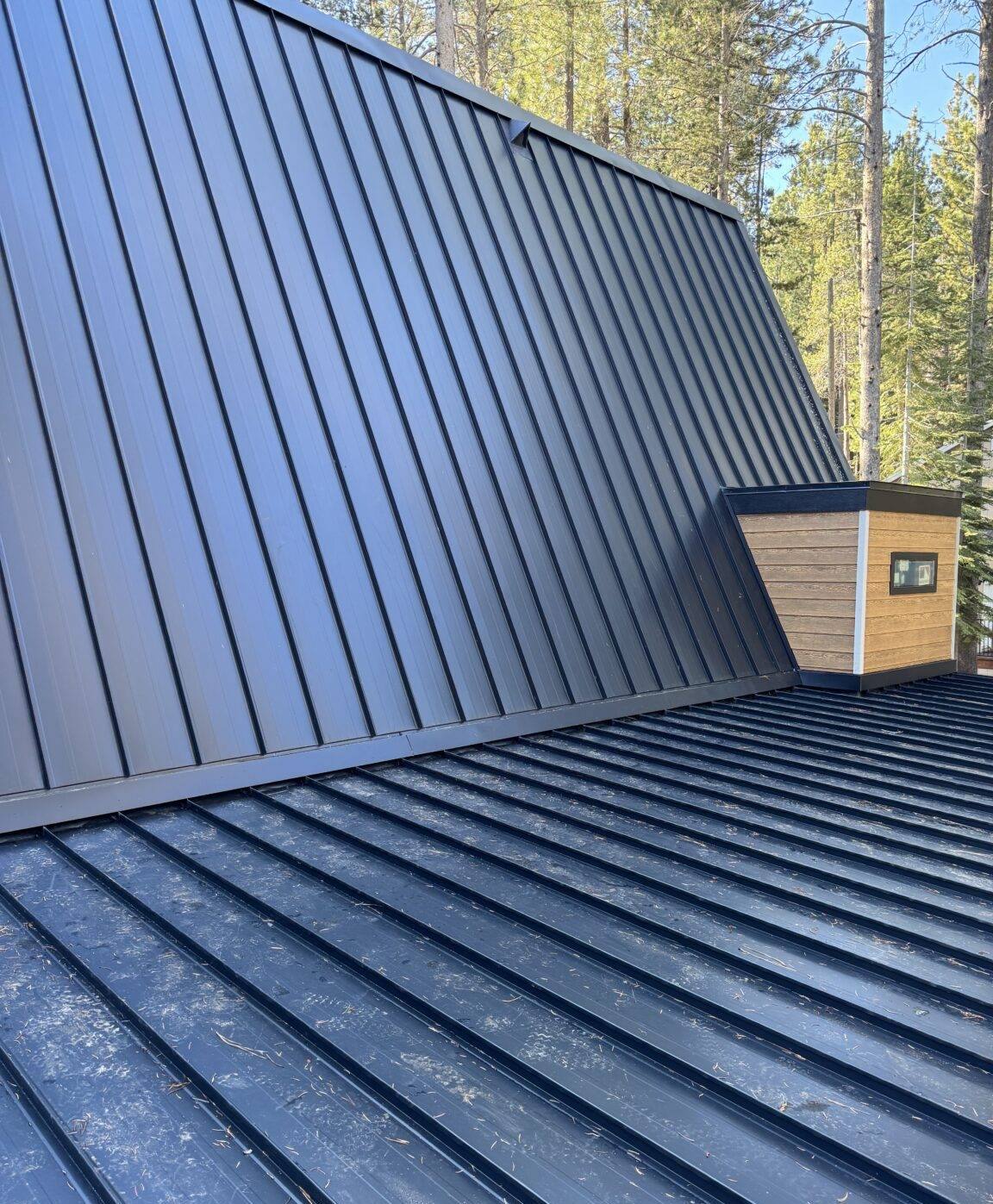
What a Correct Metal Roof Actually Solves Here
Homeowners often come to us asking about metal roofing because they're tired of one specific problem. It's worth being clear about what metal roofing does and doesn't fix, so the decision is based on facts rather than a sales pitch.
What metal handles well in this climate
- Sheds driving rain quickly off steep and moderate pitches, reducing the time water sits on the surface
- Resists moss and algae growth far better than roofs with a porous or granular surface — moss struggles to root on smooth, non-absorbent panels
- Doesn't absorb water the way some materials do, so it isn't prone to the freeze-thaw cracking that shows up after a hard winter
- Handles heavy, wind-driven rain without the wind-uplift issues that show up on lighter materials with age
- Lasts decades with minimal maintenance when installed correctly, which matters on properties with tall trees and limited roof access
What it doesn't fix on its own
Metal roofing won't compensate for a poorly ventilated attic, undersized gutters, or trees overhanging the roofline. If moss, moisture, or ice damming has been a recurring issue, we look at the whole system — ventilation, gutters, flashing, tree clearance — not just the roof surface. A new roof over an old problem just delays the problem.
What a Correct Metal Roof Installation Involves
Most metal roof failures we're called to inspect trace back to installation shortcuts, not the material itself. A correct install in this climate includes several details that are easy to skip and hard to notice until something leaks.
Underlayment and moisture barrier
A synthetic or self-adhered underlayment rated for the panel type goes down first, with extra attention at valleys, eaves, and any penetration. In a climate where a roof deck can stay damp for extended stretches, this layer is the actual waterproofing — the metal panel is the weather shield on top of it.
Fastening and panel spacing
Exposed-fastener and standing-seam systems have different fastening requirements, and both need the correct screw pattern, torque, and washer type for the panel gauge. Over-driven or under-driven fasteners are one of the most common causes of leaks we find on metal roofs installed by crews without much metal-specific experience.
Flashing at every transition
Chimneys, skylights, dormers, and roof-to-wall intersections are where nearly every roof leak actually starts, regardless of material. Metal roofing requires flashing details specific to the panel profile — a flashing kit designed for asphalt shingles doesn't translate directly.
Ventilation
Metal roofs perform best with balanced intake and exhaust ventilation. Without it, condensation can form on the underside of the panels in cold, damp weather — a problem that shows up as mysterious moisture stains that have nothing to do with the roof leaking from outside.
Choosing the Right Metal Roofing System
Not every metal roof is the same product. The two systems homeowners in this area typically compare are standing seam and exposed-fastener (ribbed) panel systems.
| Factor | Standing Seam | Exposed-Fastener Panel |
|---|---|---|
| Fasteners | Hidden, clipped beneath the seam | Visible screws through the panel face |
| Long-term maintenance | Very low — no exposed fasteners to fail | Fastener washers age and may need replacement over time |
| Upfront cost | Higher | Lower |
| Best fit | Steep-slope, high-visibility, or low-access roofs | Outbuildings, secondary structures, budget-driven projects |
| Expansion/contraction handling | Built into the seam design | Relies on fastener hole design and spacing |
For a primary residence in a climate with this much rain and temperature swing, we usually recommend standing seam when the budget allows it — the lack of exposed fasteners removes the single most common long-term failure point. Exposed-fastener panels are a legitimate, lower-cost option for garages, shops, and other structures where the roof is less visible and re-servicing fasteners down the road isn't a major inconvenience.
Moss, Tree Cover, and What "Low Maintenance" Actually Means
Metal roofing is often marketed as maintenance-free. It's much lower maintenance than asphalt or wood, but "low" isn't "zero," especially on a tree-shaded lot. Needles, leaves, and organic debris can still collect in valleys and against roof-to-wall transitions, and where debris sits, moisture sits with it. Gutters clog faster under heavy tree cover, and a clogged gutter can back water up under the roof edge regardless of how good the roofing material is.
The realistic maintenance routine for a metal roof here is simple: clear debris from valleys and gutters once or twice a year, especially after fall leaf drop, and have flashing and sealant points checked periodically. That's a fraction of what an asphalt roof needs, but it's not nothing.
Our Process, Start to Finish
- On-site inspection and measurement — we look at the existing roof, deck condition, ventilation, and any trouble spots before quoting anything.
- System and panel recommendation — based on your roof's pitch, exposure, and budget, not a one-size answer.
- Written estimate — clear scope, materials, and timeline, no vague allowances.
- Tear-off and deck inspection — we check the deck for rot or soft spots before anything new goes down, since covering a bad deck is how future leaks get built in.
- Underlayment, flashing, and panel installation — done to the manufacturer's spec for the specific panel system, not a generic install.
- Final walkthrough — we go over the finished roof with you before calling the job done.
What Drives the Cost
We don't publish flat prices because roof size, pitch, tear-off scope, and panel choice all move the number significantly. What we can share is what tends to drive cost up or down.
| Cost Factor | Effect |
|---|---|
| Panel system (standing seam vs. exposed-fastener) | Standing seam typically costs more per square due to material and labor |
| Roof pitch and complexity | Steep pitches, multiple valleys, and dormers add labor time |
| Tear-off vs. deck condition | Rotted decking found underneath adds repair cost before install can proceed |
| Panel gauge and finish | Heavier gauge and premium coatings cost more but last longer with less fading |
| Access and site conditions | Steep lots or limited equipment access can add labor time |
A broad range for a full metal roof replacement on a typical single-family home runs from the mid-teens into the $30,000s depending on these factors — final numbers only come from an actual measurement and inspection.
Why Hiring a Crew That Already Works This Area Matters
Metal roofing has fewer forgiving margins than asphalt shingle work. A crew that mostly installs shingles and takes the occasional metal job is more likely to miss a flashing detail or fastener spec that only shows up as a problem two winters later. We work metal and other roofing systems regularly across Whatcom County, which means we've already worked through the local conditions — how wet the deck tends to be during install season, how much ventilation local attic setups typically need, and which flashing details actually hold up through a full year of this area's rain cycle.
There's also a practical side to hiring local: if a warranty question or a storm-related issue comes up years down the road, a crew based nearby is a phone call away, not a company that installed a roof on a regional swing and moved on.
Signs It's Time to Have Your Roof Looked At
- Moss or dark streaking building up faster than it used to, especially in shaded sections
- Granule buildup in gutters (a sign of an aging asphalt roof, useful to know before comparing to metal)
- Visible rust, loose panels, or popped fasteners on an existing metal roof
- Water stains on interior ceilings near roof valleys or chimney flashing
- Sagging or soft spots visible from a ladder or across the yard
- A roof approaching or past 20 years old with no major work done
If any of that sounds familiar, it's worth having someone take a real look rather than guessing from the ground.
If you're weighing metal roofing for a home in Everson, we're happy to come take a look, walk the roof, and give you a straight answer about what it needs — no pressure, no obligation. Use the form below to request a free estimate.