 Ferndale Siding
 Custer's Climate Is Harder on Siding Than Most Homeowners Realize
Custer sits in the corner of Whatcom County where farmland meets the Salish Sea air — close enough to Birch Bay and the Strait of Georgia that salt-laden wind is a regular visitor, and far enough into open, rural exposure that homes take direct hits from storms rolling in off the water. Add in the Pacific Northwest's long wet season and the shade from mature evergreen tree lines that ring so many Custer properties, and you get a combination that few siding products handle well over the long term: salt air, driving rain, and a moss season that can run eight months or more.
Siding in this area isn't decorative. It's a working system that has to shed water, resist corrosion, and keep organic growth from taking hold on a north-facing wall for most of the year. Get the product or the install wrong, and Custer's climate will find every weak point within a few winters.
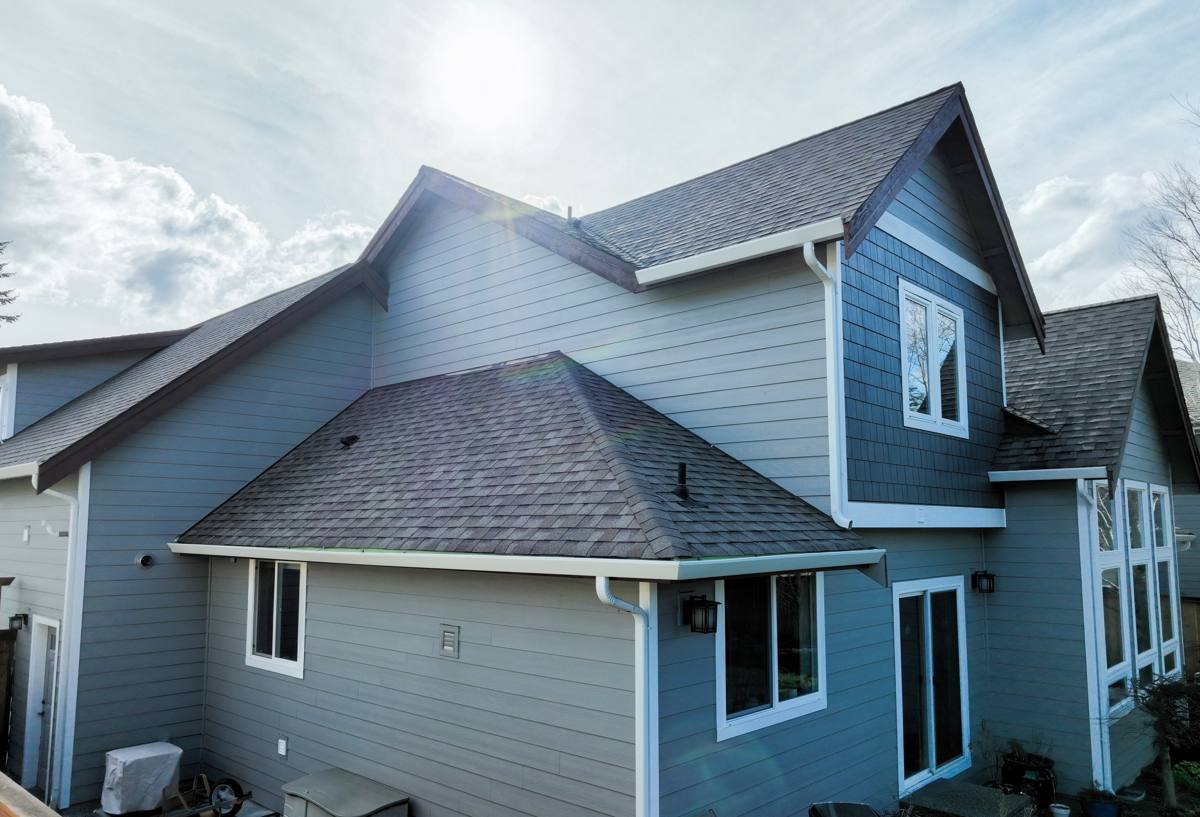
What Salt Air, Driving Rain, and Moss Actually Do to a House
Salt Air
Airborne salt from the Strait accelerates corrosion on fasteners, flashing, and any metal trim that isn't properly rated or protected. It also degrades cheaper paint and coating systems faster than inland exposure would, leading to chalking, fading, and adhesion failure years ahead of schedule.
Driving Rain
Whatcom County storms don't just fall straight down — wind pushes rain sideways into wall assemblies, especially on unobstructed rural lots around Custer with little windbreak. That means siding laps, seams, and penetrations (windows, doors, hose bibs, vents) are under real pressure to keep water out, not just shed it in calm weather.
Moss and Prolonged Moisture
Shade, humidity, and mild temperatures are a perfect recipe for moss and algae. On siding that holds moisture — especially wood-based products — that growth isn't just cosmetic. It keeps the surface damp, which accelerates rot, delamination, and paint failure underneath.
Why We Install James Hardie Fiber Cement — and Nothing Else
We're a James Hardie-only contractor. We don't install vinyl, LP SmartSide, Cemplank, Allura, primed spruce, or cedar, and we're upfront about why: in a climate like Custer's, the material matters as much as the workmanship.
- Non-combustible fiber cement — Hardie board is engineered from cement, sand, and cellulose fiber, not wood or wood byproducts, so it doesn't rot, delaminate, or feed moss the way organic materials can.
- HZ5 engineered formulation — Hardie manufactures regional formulations for different climate zones. The HZ5 product line used in the Pacific Northwest is engineered for our freeze-thaw and moisture cycle specifically, not a one-size-fits-all national product.
- ColorPlus factory finish — a baked-on, multi-coat finish applied in a controlled facility, which holds up to UV and salt exposure far better than field-applied paint and doesn't need repainting on the same schedule.
- Dimensional stability — fiber cement doesn't swell, warp, or crack the way wood-based siding can when it cycles between wet Custer winters and drier summer stretches.
Vinyl can crack in cold snaps and fade under UV; LP SmartSide and other wood-strand products rely on their outer coating to keep moisture out and are more sensitive to installation error near ground level and in shaded, damp areas — exactly the conditions common around Custer. Cedar is a beautiful, honest material, but it demands a maintenance commitment (staining, sealing, moss treatment) most homeowners don't want to sign up for indefinitely. We'd rather put a product on your house that's engineered for this exact climate than sell you something that looks right on day one and becomes a maintenance project by year five.
What a Correct James Hardie Installation Involves
Hardie siding's performance is only as good as the installation behind it. Most siding failures we see on older homes in this area aren't a product problem — they're a water-management problem from an install that skipped steps.
Moisture Management Details
- Weather-resistant barrier (house wrap) installed and lapped correctly, with all seams taped
- Flashing at every window, door, and penetration, integrated with the water-resistant barrier so water sheds outward, not behind the siding
- Proper starter strip at the base of the wall to keep the first course of siding correctly angled and gapped
- Minimum clearance maintained between siding and grade, roof lines, decks, and patios so water and moss-feeding debris can't sit against the bottom edge
- Rain screen or drainage gap where conditions call for it, giving any moisture that gets behind the cladding a path to escape
Fastening and Manufacturer Specs
Hardie publishes specific fastening and clearance requirements — nail type, spacing, penetration depth, and joint treatment — and following them isn't optional if you want the warranty to remain valid. Corrosion-resistant fasteners matter even more here given the salt exposure; the wrong fastener can rust and stain the siding face within a few seasons.
Comparing Siding Materials for a Custer Property
| Factor | James Hardie Fiber Cement | Vinyl | Wood-Based (LP SmartSide, Cedar) |
|---|---|---|---|
| Salt air resistance | Strong — cement composition doesn't corrode or degrade from salt | Moderate — can fade and become brittle over time | Depends on coating/finish upkeep; wood is vulnerable once compromised |
| Moisture/moss resistance | High — non-organic, doesn't feed growth | High on the surface, but seams and fastening are weak points | Lower — organic material is a food source for moss and rot once damp |
| Finish longevity | ColorPlus factory finish, long repaint interval | Color molded in, but fades and chalks with UV/salt exposure | Field-applied paint/stain needs recoating on a shorter cycle |
| Fire performance | Non-combustible | Combustible | Combustible |
| Ongoing maintenance | Low — periodic wash, no sealing/staining | Low, but cracking/warping repairs are common over time | Higher — staining, sealing, and moss treatment are recurring tasks |
Our Process for a Custer Job
We work rural and semi-rural Whatcom County properties regularly, and Custer jobs follow the same disciplined process every time:
- On-site assessment — we walk the whole exterior, check current siding and any moisture or moss damage, and evaluate exposure (wind direction, shade, drainage around the foundation).
- Product and color selection — matching the right Hardie line and ColorPlus finish to your home and the site's sun/shade exposure.
- Tear-off and inspection — removing old siding and checking sheathing and framing underneath for any hidden moisture damage before it gets covered up again.
- Weather barrier and flashing install — the part of the job that determines whether your siding lasts 10 years or 40, done to manufacturer spec.
- Hardie installation — fastened, gapped, and finished to Hardie's published requirements so the warranty stays intact.
- Final walkthrough — reviewing the completed work with you before we consider the job done.
Keeping Your Siding Performing Long-Term
Even the right product needs basic upkeep in this climate. A short annual routine keeps Hardie siding looking and performing the way it's supposed to:
- Rinse the exterior once or twice a year, focusing on shaded, north-facing walls where moss and algae collect first
- Trim back vegetation and tree branches that keep siding damp or shaded for long stretches
- Keep gutters clear so overflow doesn't run down the siding face
- Check caulking around windows, doors, and trim annually and re-caulk if it's cracked or pulling away
- Watch for any staining near fasteners or trim, which can signal a corroding fastener that should be addressed early
Why It Matters That We Already Work in Custer
A crew unfamiliar with this specific stretch of Whatcom County can underestimate what the exposure here actually requires — treating a Custer property the same as an inland, sheltered lot. We already know the wind patterns, the salt exposure off the Strait, and how aggressively moss establishes itself on shaded walls in this area, because we see it on job after job. That local pattern recognition shows up in the details: where we pay extra attention to flashing, which fastener spec we won't compromise on, and where a drainage gap earns its keep.
Hiring locally also means straightforward access for follow-up. If a question comes up two years after installation, you're not waiting on a crew that has to drive in from another region — we're already working in your area.
Get a Straight Answer for Your Home
If you're weighing a siding replacement or new install in Custer, we're happy to take a look at your specific exposure — wind direction, shade, drainage — and give you an honest read on what it needs. Reach out for a free, no-pressure estimate; there's a form right below to get started.