 Ferndale Siding
 Why Marietta Decks Take More Punishment Than Most
Marietta sits close enough to the water that homes here deal with a combination most inland Whatcom County neighborhoods don't: salt-laden air, long stretches of driving rain off the water, and a moss and algae season that can run most of the year. Any one of those on its own is manageable. Together, they're exactly the conditions that expose the weak points in a deck faster than almost anywhere else in the region.
Salt air accelerates corrosion on fasteners, brackets, and any exposed metal hardware. Driving rain doesn't just fall straight down — wind pushes it sideways, under railings, and into ledger connections that a calmer climate would never test. And once the fall rains settle in, shaded and low-airflow deck surfaces stay damp long enough for moss and algae to take hold, which is where a lot of wood decks start to fail from the inside out, at the framing, long before the boards look bad on top.
A composite deck built for Marietta has to be designed around all three of these at once — not just picked because composite doesn't need painting.
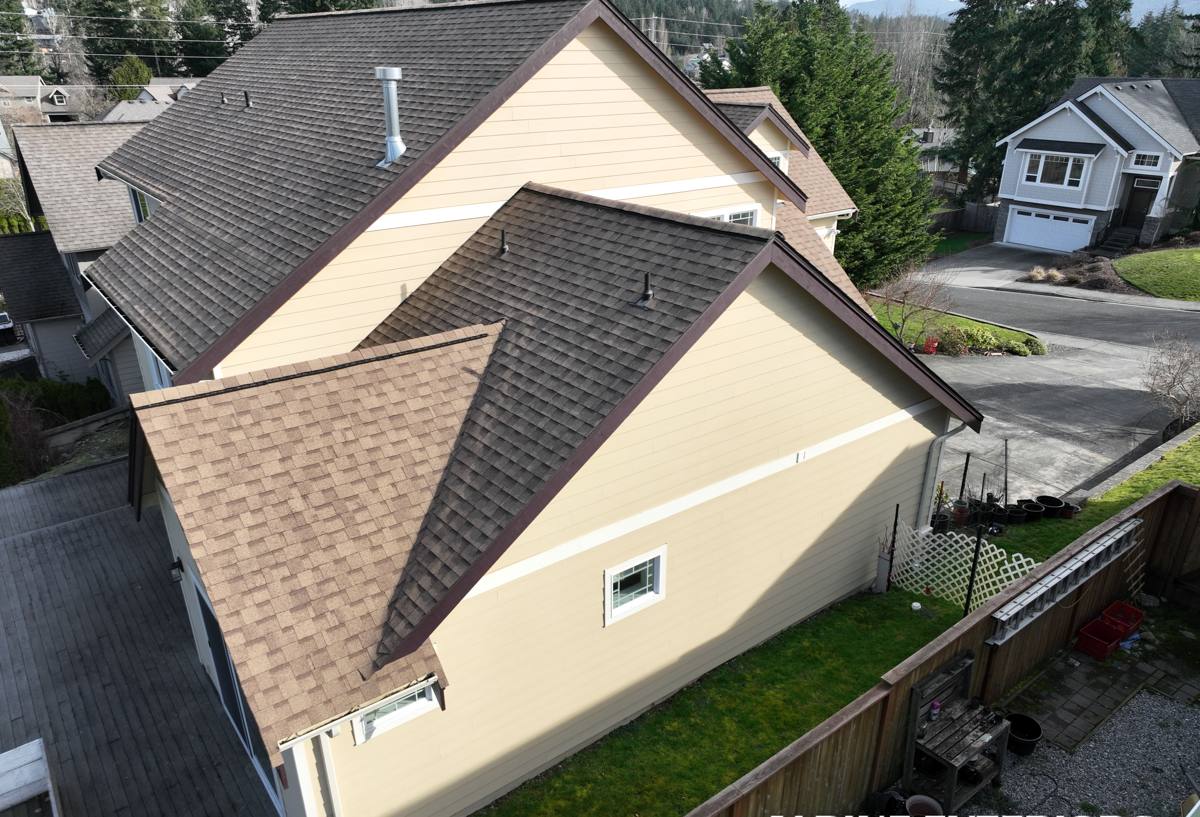
What a Deck Actually Needs to Survive Here
Framing and Substructure
The decking boards get the attention, but the substructure is what determines whether a deck lasts 10 years or 30. In a wet climate like this, that means pressure-treated or naturally durable framing lumber, joist tape or flashing on top of every joist to keep water out of end grain, and enough airflow underneath the deck that moisture doesn't just sit there all winter. Decks built low to the ground or over a poorly ventilated area age faster here than they would in a drier part of the state — the framing rots from underneath while the composite boards on top still look fine.
Fasteners and Hardware
Salt air is hard on standard hardware. We use fasteners and structural connectors rated for coastal or corrosive-exposure environments — stainless steel or heavily coated hardware at ledgers, joist hangers, and railing posts. This costs more upfront than using whatever hardware is on the shelf, but it's the difference between a deck that's still solid in fifteen years and one where the hidden connections have started rusting out while everything above looks fine.
Ledger and Flashing Details
Where the deck attaches to the house is the single most common failure point on any deck, wood or composite. Driving rain finds gaps in ledger flashing that would never leak in a calmer climate. We flash every ledger connection as if the deck will take rain from the side, not just from above, because in Marietta it often does.
Choosing the Right Composite Board for This Climate
Not all composite decking behaves the same way in a wet, salty, shaded environment, and this is where a lot of the difference between a good composite deck and a disappointing one gets decided.
Capped vs. Uncapped Composite
Capped composite boards have a protective polymer shell wrapped around a wood-plastic core, which resists moisture absorption, staining, and mold growth far better than older uncapped composite products. In a climate with this much sustained moisture and shade, we favor fully capped boards — capped on all four sides, not just the top — because the cut ends and underside are just as exposed to splash-back and standing moisture as the visible surface.
Surface Texture and Grip
A smooth, glossy composite board looks great in a showroom and gets slick fast once moss spores and algae film start to build on a shaded deck. We generally steer toward boards with a textured, low-sheen finish for exactly this reason — better footing when it's wet, and less obvious surface staining if biofilm forms before a cleaning.
Color Considerations
Very dark composite boards run hotter in direct sun and show mineral or pollen dust more, but in a shaded, moisture-heavy setting like a lot of Marietta lots, color has less to do with heat and more to do with how visible early moss or algae growth will be. Mid-tone, variegated colors tend to hide the early stages of biofilm better than solid light or solid dark boards.
Composite vs. the Alternatives, Honestly
We install composite because, for a climate like this, it's the option that holds up with the least ongoing burden on the homeowner — not because every other material is bad. Here's how the common choices actually compare for a Marietta deck:
| Factor | Composite (capped) | Pressure-Treated Wood | PVC / Vinyl |
|---|---|---|---|
| Moisture resistance | Very good — engineered not to absorb water | Fair — depends entirely on upkeep | Excellent — fully synthetic |
| Moss/algae resistance | Good, especially with a textured cap | Poor without regular treatment | Good, but can look slick when wet |
| Upfront cost | Moderate to high | Lowest | Highest |
| Ongoing maintenance | Occasional washing | Annual sealing/staining | Occasional washing |
| Natural wood look | Good, improving every product cycle | Authentic, but fades and grays | Least natural appearance |
| Typical lifespan | 25–30+ years | 10–15 years with upkeep | 25–30+ years |
Wood is still a reasonable choice for homeowners who don't mind the annual maintenance and like the look of real cedar or fir. PVC is a legitimate alternative to composite in very wet spots. We simply find that capped composite hits the best balance of low maintenance, natural appearance, and proven performance for most Marietta homeowners.
How We Approach a Composite Deck Build
- On-site assessment. We look at drainage, sun and shade exposure, existing framing condition if it's a rebuild, and how the deck ties into the house.
- Framing and structural work. Any rotted or undersized framing gets replaced, not built around. Joists get taped or flashed before boards go down.
- Ledger flashing and waterproofing. This is the step that gets rushed on cheap jobs and the one that determines whether you have a leak into the house in five years.
- Board installation. Proper gapping for drainage and expansion, hidden fastener systems where the product supports it, and attention to how water sheets off the surface.
- Railings, stairs, and trim. Finished with corrosion-resistant hardware throughout, not just at the primary structural connections.
- Final walkthrough. We go over basic care so you know what to expect in year one and beyond.
Moss, Algae, and Living With a Wet-Season Deck
No decking material is completely immune to moss and algae in a climate that stays damp and shaded for months at a time — the goal isn't zero growth, it's a surface that's easy to clean and doesn't degrade from it. Composite doesn't feed mold and mildew the way untreated wood fiber can, but surface film still builds up on any material that sits wet and shaded long enough.
A simple seasonal wash — a garden hose, mild soap, and a soft-bristle brush, or a low-pressure wash — keeps most composite decks looking clean through the wet months. Avoid high-pressure washing directly into the board surface, which can wear the cap layer prematurely. Keeping gutters and nearby vegetation trimmed back so the deck gets some sun and airflow makes a bigger difference than any cleaning product.
Permits and Local Requirements
Deck projects in Whatcom County, including in the Ferndale area, typically require a building permit once the deck is above a certain height or attached to the house — the exact thresholds and setback rules depend on your specific property and zoning. We handle the permitting conversation as part of the planning process so you're not left guessing what's required before work starts.
Why It Matters That We Already Work in Marietta
A deck built by a crew that's only ever worked drier, inland projects can miss the details that matter here — under-flashing a ledger because it "usually" doesn't need it, using standard-grade hardware because it's cheaper, or picking a glossy board because it photographs well. We work siding, decking, and exterior projects throughout the Ferndale area, including Marietta, and we build decks assuming the salt air, the driving rain, and the moss season are all going to test the work — because they will.
Questions to Ask Before You Commit
- Is the framing being replaced or built around if it's rotted or undersized?
- What fastener and hardware grade is being used, and is it rated for coastal exposure?
- Is the ledger board being flashed, and how?
- Are the composite boards capped on all sides, or only on top?
- What's the realistic maintenance routine for the specific board being installed?
- Is a permit required for this project, and who's pulling it?
If you're planning a new deck or replacing one that's showing its age, we're happy to take a look and walk you through what a properly built composite deck would involve for your specific property. The estimate is free, there's no pressure, and you'll leave the conversation knowing exactly what you're paying for and why.