 Ferndale Siding
 Building Decks for Point Roberts' Marine Climate
Point Roberts sits right on the water, and that location shapes every deck built here. Salt-laden air moves in off the water and settles on every exposed surface, metal fasteners take a beating, and the peninsula's exposure to wind-driven rain means water finds its way into places a deck built fifty miles inland would never have to worry about. Add Whatcom County's long, damp shoulder seasons — the stretch from fall through spring when surfaces rarely fully dry out — and you get a moss season that can run six months or more on a deck that doesn't get much direct sun.
None of that means a deck in Point Roberts has to be high-maintenance or short-lived. It means the build has to account for those conditions from the framing up, not just at the surface. A deck that looks the same as one built in a drier part of the state, but wasn't detailed for salt exposure and standing moisture, will show problems years earlier — usually right where you can't see them until they're expensive.
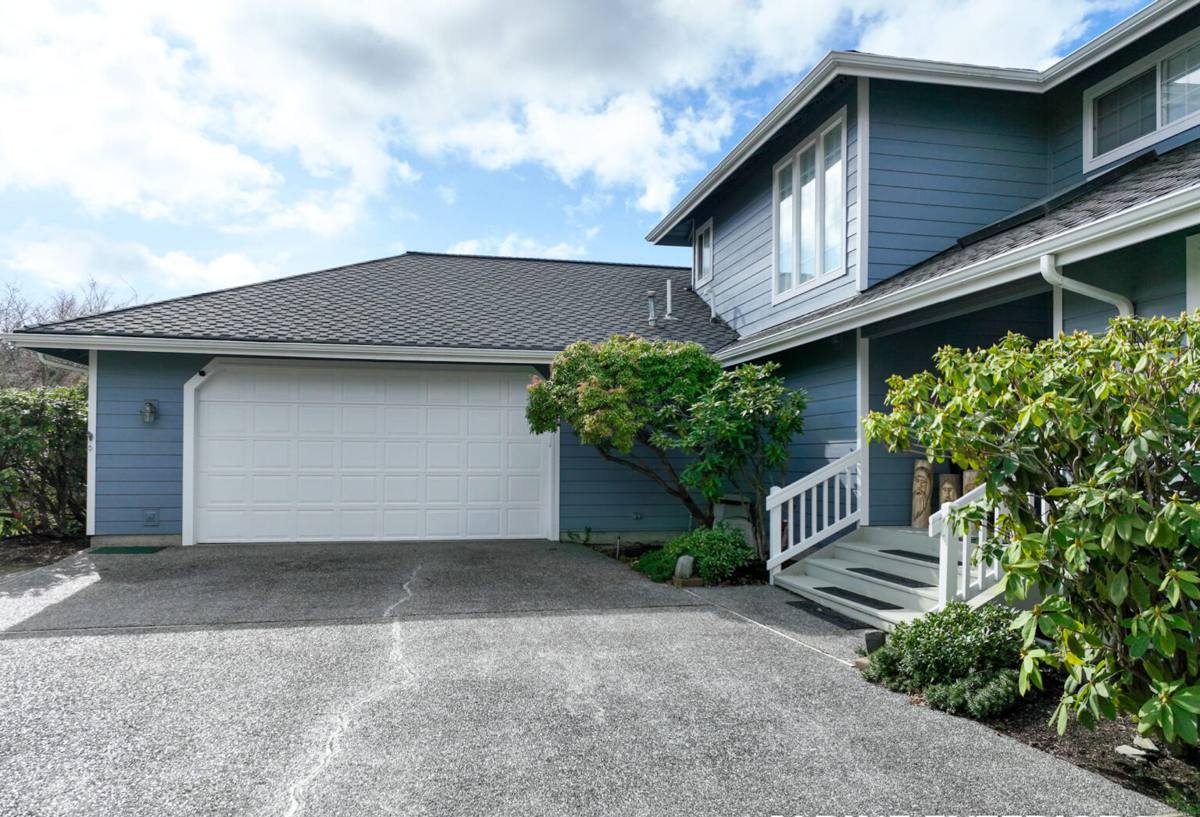
What Salt Air, Rain, and Moss Actually Do to a Deck
It helps to understand the specific failure points, because they're different from generic "weather damage."
Salt Air and Corrosion
Airborne salt accelerates corrosion on any exposed metal — screw heads, joist hangers, bolts, railing hardware. Standard galvanized fasteners can start showing rust streaks within a couple of seasons in a heavy salt-exposure spot, and once a fastener corrodes it loses holding strength long before it looks obviously bad. This is a hardware problem more than a decking-material problem, and it's one of the most commonly overlooked details in deck construction near the water.
Driving Rain and Water Intrusion
Rain that comes in sideways off the water doesn't just fall on a deck's top surface — it drives into ledger connections, gaps between decking boards, and any point where the deck meets the house. If flashing and gaps aren't detailed correctly, water gets trapped against framing or against the house wall behind the ledger board, which is one of the more serious and expensive problems a deck can develop, since it can lead to rot in structural framing or in the home's wall assembly.
Moss and Prolonged Moisture
Moss doesn't just grow on roofs. Any deck surface that stays shaded and damp for long stretches — under trees, on the north side of a house, or in spots that don't get much wind or sun — will grow moss and algae over time. Beyond looking bad, moss holds moisture against the decking surface, which shortens the life of wood decking and can make any deck surface slippery and unsafe underfoot.
Framing and Fasteners: Getting the Bones Right
The framing is the part of a deck nobody sees once it's finished, and it's also the part that determines whether the deck is still solid in fifteen years or needs major repair in five. In a location like Point Roberts, we treat the framing package as the place to spend the extra care, not the place to cut corners.
- Stainless steel or heavy-duty coated fasteners in high-exposure areas, not standard galvanized hardware
- Joist hangers and structural connectors rated for the corrosion exposure of the site
- Pressure-treated framing lumber rated for ground contact where posts meet grade
- Proper joist spacing for the decking material chosen — composite and PVC boards often need tighter spacing than wood
- Post bases that keep wood off concrete or wet grade, avoiding standing water at the base of every post
None of this shows once the decking is installed, which is exactly why it's worth confirming with any contractor before work starts, not after.
Choosing a Decking Material for Coastal Exposure
There's no single "best" decking material — there's a best material for a given budget, sun exposure, and maintenance appetite. Here's how the common options hold up under Point Roberts conditions specifically.
| Material | Salt Air / Moisture Behavior | Moss Resistance | Maintenance |
|---|---|---|---|
| Pressure-treated wood | Good if properly sealed; fasteners are the weak point | Needs regular cleaning in shaded areas | Annual cleaning, periodic re-staining/sealing |
| Cedar | Naturally rot-resistant but still needs sealing near salt exposure | Same as pressure-treated — shade and moisture invite growth | Regular sealing to hold color and resist checking |
| Composite decking | Very good — doesn't absorb moisture like wood | Better, but not immune in constantly shaded spots | Occasional washing; no staining or sealing |
| PVC / capped polymer | Excellent — fully sealed surface, no wood fiber to hold moisture | Best of the group; smooth cap sheds algae growth more easily | Lowest — mostly just washing |
We don't push one material on every homeowner. Wood has a warmer, more traditional look and a lower upfront cost, but it asks more of the owner over time in a climate like this. Composite and PVC cost more upfront but trade ongoing maintenance for material cost — a fair trade for a lot of Point Roberts homeowners who want a deck they use rather than maintain. We'll walk through the honest trade-offs for your specific site — sun exposure, budget, and how much upkeep you want to take on — rather than defaulting to whatever is easiest to install.
Ledger Attachment, Flashing, and Drainage
Where a deck attaches to the house is the single most important detail on the entire structure, and it's the one most likely to be done poorly by a crew that isn't paying close attention. The ledger board needs proper flashing that directs water away from the house wall, not just a bead of caulk and a hope. Behind the ledger, we make sure the house's existing weather-resistive barrier is integrated with the new flashing correctly, so water shed off the deck or driven in by wind doesn't end up behind the siding.
Below the deck surface, drainage matters just as much. Water that runs through the gaps between boards needs somewhere to go that isn't pooling against posts or footings. On decks with usable space underneath, an under-deck drainage system can keep that area dry and usable — a detail worth discussing if you want covered storage or a dry patio space below.
Railings, Stairs, and Code Requirements
Railings and stairs are also code-regulated components, and they matter more on a coastal, wind-exposed site than people usually expect. Railing hardware faces the same corrosion pressure as deck fasteners, and a railing that loosens over time because of corroded connections is a real safety issue, not just a maintenance annoyance. We build railings and stair stringers to current code requirements for height, baluster spacing, and load, using hardware rated for the site's exposure — and we're glad to explain the reasoning behind each requirement rather than just citing "code" and moving on.
Our Process From Estimate to Finished Deck
A deck project runs smoother when the homeowner knows what to expect at each stage:
- On-site assessment — we look at sun exposure, wind direction, existing ledger conditions if it's a replacement, and drainage on the site before quoting anything
- Material and design conversation — honest trade-offs between wood, composite, and PVC based on your budget and how you'll use the space
- Permitting — decks generally require a permit; we handle that process rather than leaving it to the homeowner
- Framing and structural work — the part that determines the deck's real lifespan, done with corrosion-appropriate hardware
- Decking, railings, and finish details — the visible work, done to the spacing and fastening specs the chosen material actually requires
- Final walkthrough — going over the finished deck and any maintenance recommendations specific to its exposure
Maintenance Checklist for Coastal Decks
Whatever material you choose, a few habits go a long way toward getting the full lifespan out of a Point Roberts deck:
- Rinse salt residue off railings and hardware periodically, especially after storms
- Sweep debris out of gaps between boards so moisture doesn't sit trapped against the framing
- Wash shaded or north-facing sections more often to stay ahead of moss and algae growth
- Check fastener heads and railing connections annually for early rust or looseness
- Re-seal wood decking on the schedule the product calls for — don't wait until it's visibly gray or checking
- Keep gutters and downspouts near the deck clear so roof runoff isn't adding extra water onto the deck area
Why Hire a Crew That Already Works Point Roberts
A deck built without accounting for salt exposure, driving rain, and moss will still look fine on installation day — the problems show up years later, in the framing and fasteners you can't see. Crews that build decks regularly in this part of Whatcom County know which hardware holds up, where flashing details actually matter, and which materials are worth the extra upfront cost for a specific site's exposure. That local pattern recognition is hard to substitute with a generic build sheet.
If you're planning a new deck or replacing one that's showing its age, we're glad to come take a look and put together a straightforward, no-pressure estimate — just fill out the form below.