 Ferndale Siding
 Why Decks in Sudden Valley Wear Differently
A deck in Sudden Valley doesn't fail the same way a deck in a dry, open subdivision does. This is a wooded, lake-adjacent setting, and that combination changes what a deck is up against day to day. Whatcom County already sees a long, wet stretch of the year, and homes tucked under tree cover or close to the water hold onto that moisture longer than homes out in the open. We've repaired enough decks in this part of the county to know the failure pattern is usually the same: it's not one dramatic event, it's months of slow moisture exposure that nobody notices until a board flexes underfoot or a rail post starts to wiggle.
Moisture From More Than One Direction
Rain is the obvious culprit, but it's not the only one. Homes near the lake and under heavy tree canopy also deal with ambient humidity and morning dew that never fully burns off before the next damp evening sets in. That means the wood is rarely bone dry, which is exactly the condition wood-decay fungi need to get established in framing and decking boards.
Shade and a Long Moss Season
Tree cover is part of what makes Sudden Valley a nice place to live, but it also means less direct sun hitting the deck surface. Less sun means slower drying after every rain, and slower drying means moss, algae, and mildew get a much longer season to work with than they would on a south-facing deck out in the sun. Moss isn't just cosmetic — it holds water against the wood surface and accelerates the very decay it's a symptom of.
Fasteners and Hardware Under Constant Damp
In coastal and lake-adjacent parts of Whatcom County, salt-laden air and persistent moisture are hard on standard fasteners and hardware. Galvanized nails and undersized screws corrode faster than homeowners expect, and once a fastener starts to rust it loses grip on the wood fibers around it — which is how a solid-looking board ends up loose.
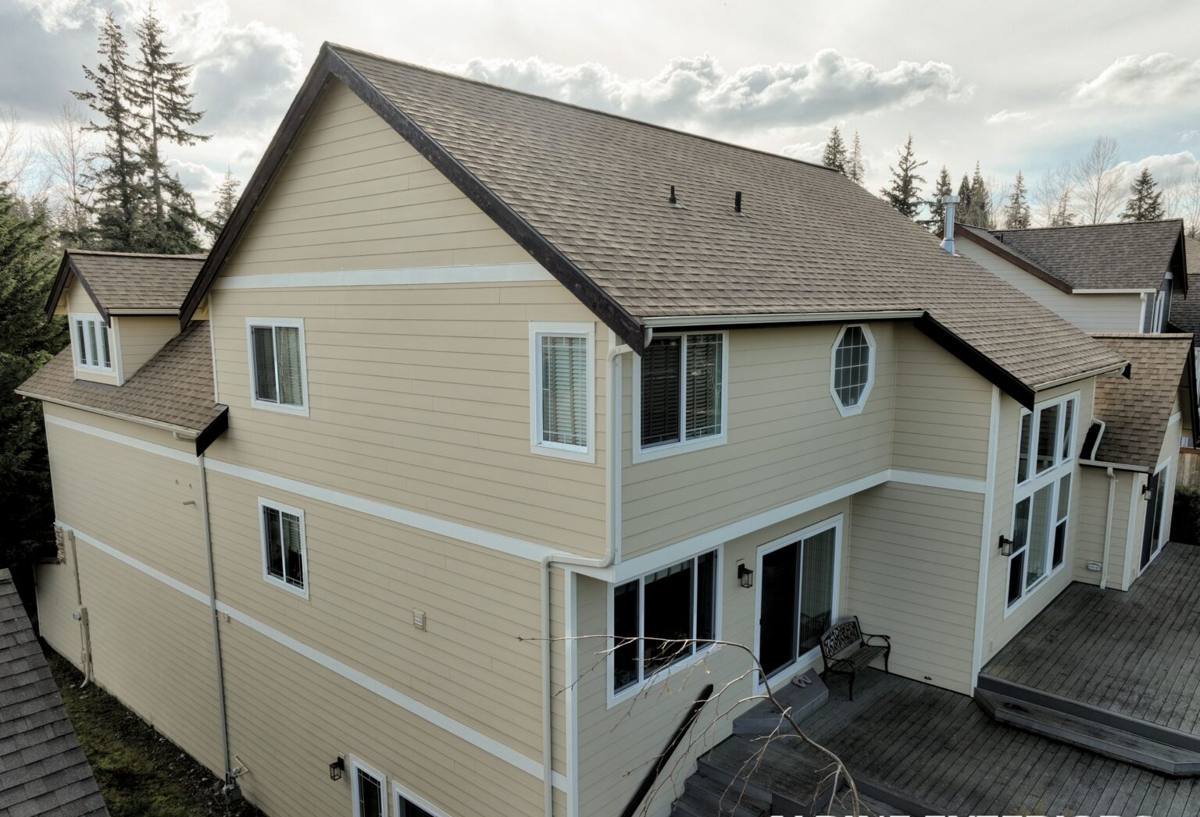
Signs Your Deck Needs Repair — Not a Full Rebuild
Most decks we look at in this area don't need to be torn out. They need the damaged sections identified and corrected before the problem spreads. Here's what we tell homeowners to watch for between inspections:
- Boards that feel spongy, springy, or noticeably softer than the boards around them
- Any board you can flex or push a screwdriver tip into without much resistance
- Rail posts or balusters that wiggle, even slightly, when pushed
- Persistent green or black staining that comes back within weeks of cleaning
- Fasteners with rust "bleeding" out around the screw or nail head
- Gaps opening up between deck boards and the ledger board where it meets the house
- A noticeable dip, bounce, or sag when walking across a specific section
- Peeling or bubbling finish concentrated in one shaded corner rather than across the whole deck
Any one of these on its own is usually a repair, not a rebuild. Several of them together, especially around the same area, tells us to look harder at what's underneath before we touch the surface.
What an Honest Deck Repair Actually Involves
Structure First, Surface Second
The mistake we see most often from past patch jobs is replacing the boards people can see while leaving the framing underneath untouched. If a joist or ledger connection is already compromised by rot, new decking on top of it is a short-term fix at best. A correct repair starts underneath — checking joists, beams, posts, and the ledger-to-house connection for soft spots, cracking, or fastener corrosion — before any decking goes back down.
Board-by-Board vs. Full Resurfacing
Not every repair needs new decking across the whole surface. If damage is isolated to a few boards near a downspout, a shaded corner, or a stair landing, replacing just those boards — matched as closely as possible to the existing material — is the honest, cost-effective call. If damage is spread across the deck or the boards are all roughly the same age and showing the same wear pattern, resurfacing the whole thing at once makes more sense than chasing individual boards for the next few years.
Fasteners and Flashing Matter as Much as the Wood
We use corrosion-resistant, coated or stainless fasteners rated for exterior ground-contact or damp-condition use — not standard hardware store screws, which is a common source of the recurring rust staining and loosening we get called out for in this area. Where a deck ledger meets the house, proper flashing keeps water from being funneled directly into the rim joist. A lot of the rot we find at ledger connections traces back to missing or improperly lapped flashing from the original build.
Rails and Guard Posts
Loose rails aren't just an eyesore — they're a safety issue, and post connections are often where rot hides longest because they're harder to inspect without pulling trim or decking back. We check post-to-frame connections directly, not just whether the rail itself looks stable, since a rail can feel firm right up until it doesn't.
Repair vs. Replace: What Actually Drives the Decision
| Factor | Leans Toward Repair | Leans Toward Replacement |
|---|---|---|
| Framing condition | Solid, no rot in joists/beams | Widespread soft or rotted framing |
| Age of deck | Under 12-15 years, single problem area | Original wood decking well past typical service life |
| Damage pattern | Isolated to one section or cause (downspout, shade pocket) | Uniform wear across the whole surface |
| Fastener condition | Localized rust or loosening | Widespread corrosion throughout deck hardware |
| Footings and posts | Stable, level, properly set | Settling, heaving, or undersized for current code |
These are guidelines, not hard rules — the only way to know for sure is to get underneath the deck and look. We'll always tell you plainly if we think repair is a short-term patch on a deck that's better off replaced, rather than selling a repair we don't believe in.
How We Handle a Sudden Valley Deck Repair
Inspection
We start by walking the whole deck surface, checking for soft spots, and then getting underneath to inspect joists, beams, posts, footings, and the ledger connection. In shaded or lake-adjacent lots, we pay particular attention to any area that stays damp longest after rain — that's usually where the story is.
A Straight Answer Before Any Work Starts
Once we know what we're dealing with, we tell you what's actually wrong, what it'll take to fix it correctly, and what it costs — before any board comes up. If the damage is worse than it looks from the surface, we'd rather tell you that up front than discover it mid-job and surprise you with a change order.
The Repair Itself
Damaged framing gets sistered or replaced first. Flashing at the ledger gets corrected if it's inadequate. Decking and rail components get replaced with corrosion-resistant fasteners throughout, matched to the existing material where a partial repair makes sense.
Cleanup and Care Guidance
We clear debris and old material from the site and walk you through what will help the repair last — mainly around moisture and moss management, since that's the recurring issue in this part of the county, not the repair work itself.
Materials: What We Use and Why
For framing repairs, we use pressure-treated lumber rated for ground contact where the application calls for it — this isn't optional in a damp, shaded environment, it's the baseline. For decking, both wood and composite have a place, and we'll give you the honest trade-offs rather than pushing one:
- Cedar and other wood decking looks and ages naturally but needs periodic sealing or staining to keep moisture out, which matters more in a shaded, humid setting where dry-time is already short
- Composite decking resists rot and doesn't need refinishing, but it's a bigger upfront cost and still needs the surface kept clear of moss and debris — composite resists rot, it doesn't resist moss growth on top of it
- Fasteners should always be corrosion-resistant coated or stainless steel in this climate — this is where we see the most corner-cutting from past work, and it's one of the cheapest things to do right the first time
We don't have a house favorite we push on every job. The right choice depends on your budget, how much upkeep you want to do, and how much sun that particular deck actually gets.
Keeping a Repaired Deck From Repeating the Problem
A repair only holds up if the conditions that caused the damage get addressed too. In Sudden Valley's tree-covered, lake-humid setting, that mostly comes down to moisture management: keeping gutters and downspouts directing water away from the deck structure, clearing leaves and debris out of gaps between boards where moisture collects, and addressing moss early with a gentle cleaning rather than letting it build up over a season. None of this is complicated, but it's the difference between a repair that lasts and one you're calling us back about in two years.
Why a Local Crew Makes a Difference Here
Sudden Valley's setting — wooded lots, proximity to the lake, longer damp periods than open ground gets — isn't something you diagnose correctly from a generic checklist. A crew that's already worked decks in this community knows which corners of a deck tend to rot first, how long a repair actually needs to cure given the shade and humidity, and what fastener and flashing choices hold up here versus what looks fine on paper but fails in three years. That local pattern recognition is what keeps a repair from being a repeat visit.
If you've got a soft board, a loose rail, or you just want an honest look at what a deck actually needs before winter rains set in again, we're glad to come out and take a look. The estimate is free, there's no pressure attached to it, and you'll get a straight answer about whether it's a repair or something bigger — just fill out the form below to get started.