 Ferndale Siding
 Windows Built for the Bellingham Side of Whatcom County
Homes near Bellingham face a specific combination of weather that most window products aren't really designed around. You've got salt-laden air drifting in off the bay, long stretches of driving rain that hits window walls sideways instead of straight down, and a moss season that can stretch from fall through spring in shaded lots. None of that shows up on a manufacturer's spec sheet, but it shapes how a window actually performs five, ten, and twenty years after installation. Our crew works this area regularly, and energy-efficient window replacement here is as much about moisture and material durability as it is about R-value and utility bills.
This page covers what Bellingham-area homeowners should actually know before replacing windows: what the climate does to a window over time, what a correct installation looks like, how our process runs from estimate to final walkthrough, and what tends to separate a window job that lasts from one that starts failing at the seams within a few years.
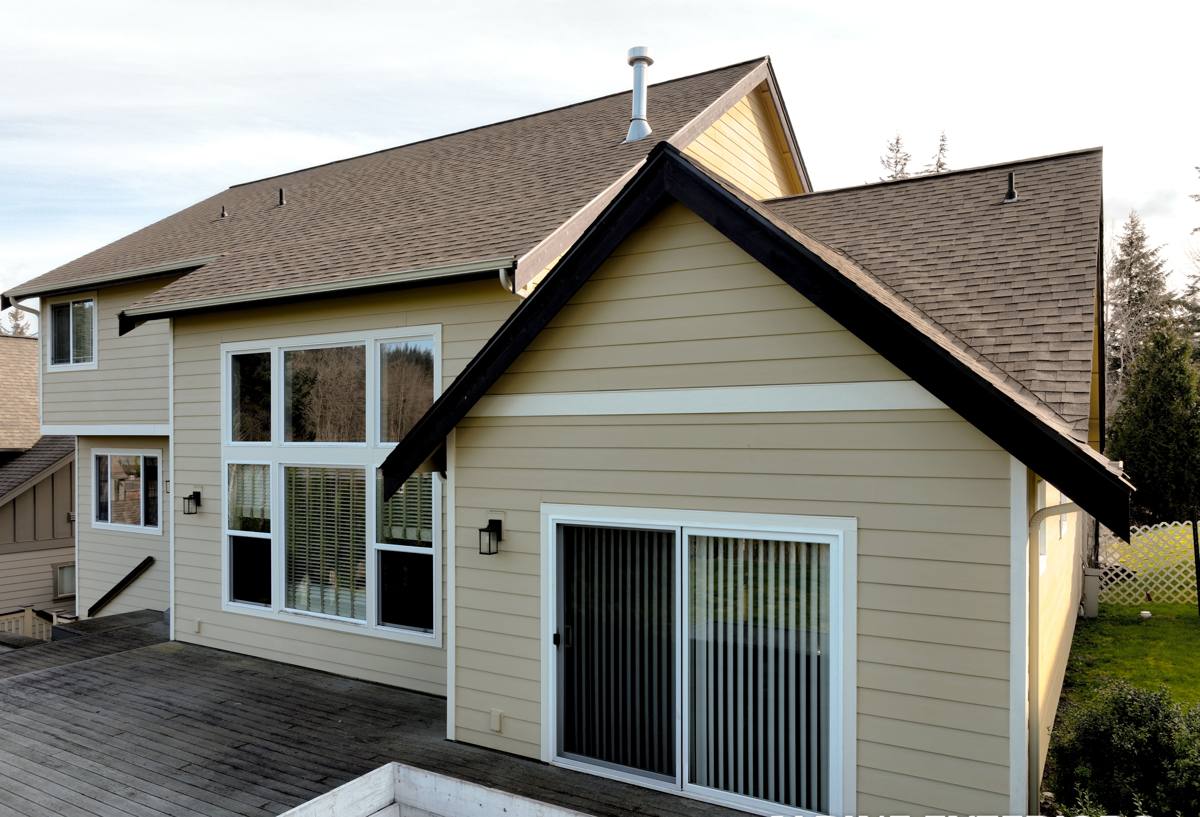
What the Local Climate Does to a Window Over Time
Salt Air and Metal Hardware
Proximity to Bellingham Bay means airborne salt is a real factor, even a few miles inland. Salt accelerates corrosion on exposed metal hardware — hinges, cranks, locks, and screws — and it can degrade certain finishes faster than the same product would wear in a drier inland climate. This is one reason material and hardware choice matters more here than in a lot of the country.
Driving Rain and Wind-Driven Moisture
Storms coming off the water often push rain sideways rather than straight down, which puts real pressure on window flashing, sill pans, and the seal between the window unit and the wall. A window that would perform fine in a calmer climate can leak here if the flashing detail was rushed or skipped.
Moss, Shade, and Prolonged Dampness
Wooded lots and consistent cloud cover keep a lot of Whatcom County siding and trim damp for extended periods, and moss follows that dampness. Around windows specifically, moss and lingering moisture at the sill or head flashing is usually a sign that water isn't shedding the way it should — often a caulking or flashing issue rather than the window itself.
What "Energy-Efficient" Actually Means for This Area
Energy efficiency isn't just about the glass. In a marine climate like ours, an efficient window has to manage heat loss, condensation, and air infiltration all at once — and they're connected. A window with a good U-factor but a poor seal will still let cold, damp air leak in around the frame, which shows up as condensation and drafts even though the glass itself is doing its job.
- U-factor — measures heat loss through the whole window unit. Lower is better for our winters.
- Low-E glass coatings — reduce heat transfer and UV exposure without noticeably darkening the glass.
- Argon or krypton gas fill — sits between glass panes to slow heat transfer; a common upgrade on dual- or triple-pane units.
- Air infiltration rating — how much outside air leaks through the window assembly itself, separate from the installation.
- Condensation resistance — relevant here specifically because of our humidity; a poorly rated window will fog or sweat on cold, damp mornings.
All of these matter, but in this climate, condensation resistance and air infiltration deserve more attention than homeowners in drier regions typically give them.
Signs Your Current Windows Are Working Against You
Most homeowners don't replace windows on a schedule — they replace them once the signs are hard to ignore. Around Bellingham, the early warning signs are usually:
- Condensation building up between the panes (a failed seal on a double- or triple-pane unit)
- Visible moss, black staining, or soft wood at the sill or corners
- Noticeable drafts near the frame, even with the window fully latched
- Hardware that's stiff, corroded, or won't lock flush anymore
- Rooms that feel noticeably colder near the window than the rest of the house
- A jump in heating costs without any other explanation
Any one of these on its own isn't necessarily urgent. Several at once, especially combined with visible moisture damage at the sill, usually means it's time to stop patching and start planning a replacement.
What a Correct Installation Actually Involves
The window product matters, but installation is where most failures actually start — especially in a climate that gets this much wind-driven rain. A correct install includes:
- Removing the old unit carefully to expose the rough opening and check the framing and sheathing underneath for hidden rot before anything new goes in.
- Installing a proper sill pan so any water that does get past the window has somewhere to drain instead of sitting against the framing.
- Correct flashing sequence — sill, jambs, then head flashing, layered so water sheds outward and down, never trapped behind the siding.
- Air-sealing the gap between the window frame and the rough opening with the right material — not just spray foam alone, which can trap moisture if it's the only barrier.
- Weatherproof exterior sealing using a sealant rated for our climate and UV exposure, applied at the right joints — not everywhere, since over-sealing can trap moisture too.
- Interior trim and finish work that seals the room side without blocking the window's ability to manage incidental moisture.
Skipping or rushing any one of these steps is how a brand-new, high-performance window ends up with a moisture problem within a couple of winters. It's rarely the glass that fails first — it's the details around it.
Comparing Window Materials for a Marine Climate
There's no single "best" window material — each has real trade-offs, and the right call depends on your home, your budget, and how much upkeep you want to take on. Here's how the common options stack up specifically for salt air, damp shade, and driving rain:
| Material | Salt Air / Corrosion | Moisture Handling | Maintenance | Typical Trade-off |
|---|---|---|---|---|
| Vinyl | Good — won't corrode | Good, doesn't absorb moisture | Low | Frame flexes more in temperature swings than fiberglass |
| Fiberglass | Very good | Excellent, very stable | Low | Higher upfront cost than vinyl |
| Aluminum-clad wood | Depends on hardware/finish quality | Good if properly sealed | Moderate | Wood interior needs occasional attention; classic look |
| Solid wood | Poor unless finish is maintained | Requires diligent upkeep here | High | Best appearance, most maintenance in a wet climate |
For most homes in this area, vinyl and fiberglass hold up with the least maintenance headache. Wood and wood-clad windows can absolutely work here, but only with an honest commitment to finish upkeep — otherwise the damp, shaded conditions common around Bellingham will find the weak points faster than in a drier climate.
What Drives the Cost of a Window Project
Every home is different, so we won't quote a number without seeing the job, but these are the main factors that move the price:
| Factor | Why It Matters |
|---|---|
| Number and size of openings | More and larger windows means more material and labor |
| Material choice | Vinyl, fiberglass, and wood-clad all carry different price points |
| Full-frame vs. insert replacement | Full-frame replaces the flashing and framing too; inserts reuse the existing frame and cost less but only make sense if that frame is still sound |
| Rot or framing repair needed | Damaged sheathing or framing found during removal adds labor before the new window can go in |
| Glass package | Triple-pane, upgraded Low-E coatings, or gas fill add cost but improve performance |
| Access and site conditions | Second-story or hard-to-reach openings take more time and equipment |
Insert replacements are often the more budget-friendly option, but only when the existing frame and flashing are still in good shape. If there's any sign of past water intrusion, a full-frame replacement is usually the more honest recommendation — it costs more upfront but avoids sealing a moisture problem behind a new window.
Our Process, Start to Finish
- Free on-site estimate — we look at your existing windows, check for signs of moisture or framing issues, and talk through what you actually need versus what's optional.
- Straightforward written quote — material options, scope, and price, with no pressure to decide on the spot.
- Scheduling around the weather — we plan installation windows with our local rain patterns in mind so openings aren't sitting exposed longer than necessary.
- Careful removal and inspection — we check the rough opening for hidden rot before installing anything new, and flag it if we find something.
- Proper flashing and sealing — done to the sequence described above, not shortcuts.
- Final walkthrough — we check operation, seals, and finish work with you before calling the job done.
A Checklist Before You Hire Anyone
Whether you go with us or someone else, these are worth confirming before signing a contract:
- Are they licensed and bonded to do this work in Washington State?
- Do they carry liability insurance, and will they show proof if asked?
- Will they inspect the rough opening for rot before installing, not just swap the window?
- Do they explain their flashing and sealing process, or just talk about the window brand?
- Is the warranty clear about what's covered — product versus installation — and for how long?
- Do they have experience with homes in this specific climate, not just window installation in general?
Why a Local Bellingham-Area Crew Matters
A window that's rated well on paper still has to be installed correctly for the conditions it's actually facing. A crew that works this part of Whatcom County regularly already knows how driving rain moves against a window wall here, how much attention salt air demands around hardware, and where moss and shade tend to create long-term moisture issues. That's not something a general contractor from outside the region necessarily thinks about — and it's the difference between a window that performs for twenty years and one that starts causing problems in five.
If your windows are drafty, fogging between the panes, or showing moss and staining at the sill, we're happy to take a look and give you an honest read on whether it's time to replace them — no pressure, no inflated urgency. Reach out for a free estimate using the form below, and we'll walk your home with you and talk through real options for your budget and your house.