 Ferndale Siding
 Birch Bay Sits Right at the Edge of Washington's Toughest Siding Climate
Birch Bay is one of the more exposed places to own a home in Whatcom County. Sitting directly on the water, homes here take a combination of punishment that inland Ferndale properties simply don't see in the same volume: salt-laden air blowing off the bay, wind-driven rain that hits siding sideways instead of running straight down it, and a moss and algae season that can stretch nearly nine months out of the year in the wetter stretches of the Pacific Northwest. Any one of those on its own is manageable. Together, over years, they're what turns a 15-year siding job into a 7-year siding problem.
This page is specifically about siding replacement for Birch Bay homes — not a general overview of siding, but what this particular stretch of coastline demands from the material, the installation, and the crew doing the work. If you own a home in Birch Bay, or you're weighing whether your current siding has more life left in it, this is the information that actually applies to your situation.
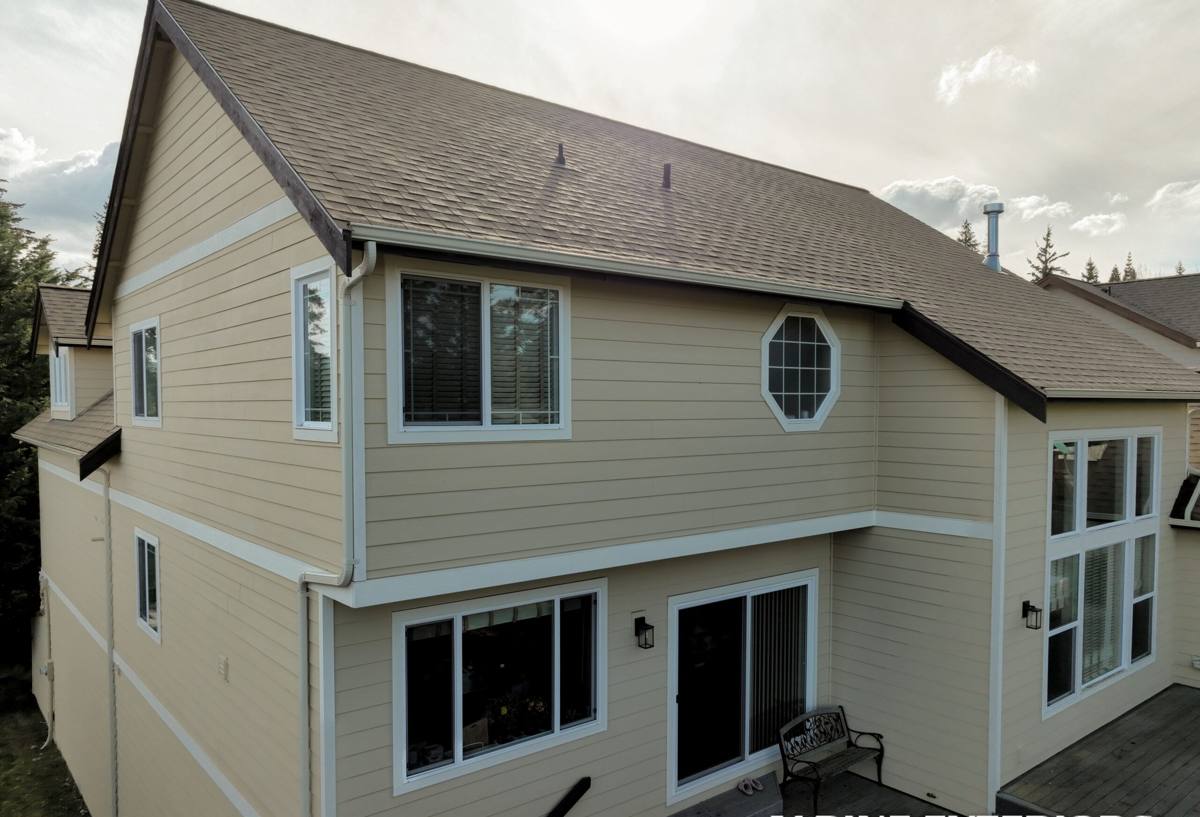
What Salt Air, Driving Rain, and Moss Actually Do to Siding
Salt Air
Airborne salt from the bay settles on every exterior surface, siding included. It's not dramatic — there's no single event where salt "damages" a wall. Instead it works slowly: salt is hygroscopic, meaning it pulls moisture out of the air and holds it against the surface it's sitting on. On wood and wood-composite sidings, that means the surface stays damp longer after every rain, which accelerates rot, delamination, and paint failure. On fasteners and trim hardware that aren't rated for coastal exposure, it accelerates corrosion. Homes closer to the waterline get more of this than homes set back or up a slope, but Birch Bay as a whole gets more salt exposure than almost anywhere else in Whatcom County.
Wind-Driven Rain
Rain that falls straight down is relatively easy for a building envelope to shed. Rain that's being pushed sideways by wind off the water finds every gap, lap, and seam a straight-down rain would never reach — behind trim boards, up under J-channel, into any joint that isn't properly lapped or sealed. This is why the details behind the siding (the water-resistive barrier, flashing, and how laps are shingled) matter as much in Birch Bay as the siding material itself.
Moss and Algae
Whatcom County's long wet season keeps north-facing walls, shaded elevations, and anything under tree cover damp for extended stretches. That's exactly what moss and algae need to establish. On some materials this is cosmetic. On materials that absorb moisture, sustained moss coverage keeps the substrate wet underneath, which is a slower but real path to material breakdown, not just a staining issue.
Signs a Birch Bay Home Needs Siding Replacement, Not Just Repair
Not every siding problem in Birch Bay means a full replacement. But there's a point where patching stops being worth it. Some of the clearer signals:
- Soft or spongy spots when you press on the siding, especially near the bottom courses or around window and door trim
- Visible swelling, delamination, or peeling paint that keeps coming back within a year or two of repainting
- Persistent moss or algae growth that returns quickly after cleaning, particularly on shaded or water-facing walls
- Gaps, warping, or boards pulling away from the wall after wind events off the bay
- Corrosion staining around fasteners or trim hardware
- Rising interior humidity, musty smells near exterior walls, or unexplained paint or drywall issues on interior walls that back up to exposed elevations
- Siding that's original to a home built more than 20-25 years ago in a bay-facing or waterfront lot
If you're seeing two or more of these, especially on the sides of the house that face open water or prevailing wind, it's worth having someone look at what's actually happening behind the siding, not just at the surface.
What a Correct Siding Replacement Involves Here
A siding replacement in a coastal setting like Birch Bay is not just swapping old boards for new ones. Done right, it's an opportunity to fix the parts of the wall assembly that were never built for this exposure in the first place. That includes:
- Full tear-off and inspection. Removing the old siding down to the sheathing is the only way to actually see what the salt air and wind-driven rain have done underneath. Hidden rot at window sills, corner boards, and the bottom plate is common on older coastal homes and can't be assessed from the outside.
- Sheathing repair. Any water-damaged or compromised sheathing gets replaced before anything new goes back on. Installing new siding over bad sheathing just hides the problem for a few more years.
- A continuous water-resistive barrier. This is the layer that actually keeps wind-driven rain out of the wall cavity if it gets past the siding — which, in a spot like Birch Bay, it eventually will at some point. It needs to be installed continuously and lapped correctly, not just stapled up quickly.
- Proper flashing at every penetration. Windows, doors, hose bibs, vents, and electrical penetrations are where wind-driven rain finds its way in. Flashing has to be integrated with the water-resistive barrier in the correct shingle-lap order, not caulked over as an afterthought.
- Correct fasteners and hardware. In a salt-air environment, fastener corrosion resistance isn't optional. Using standard hardware because it's cheaper or on hand is one of the more common shortcuts that shows up as rust streaks within a few years.
- Correct siding installation to manufacturer spec. Fastener spacing, clearance from grade and roof lines, caulking at the right joints (and not at the wrong ones), and factory-finish touch-up procedures all affect how the siding performs over the next few decades, not just how it looks on install day.
Why We Install Only James Hardie Fiber Cement on Birch Bay Homes
We've made a deliberate decision as a company to install James Hardie fiber cement siding exclusively — not vinyl, not LP SmartSide, not cedar, not primed wood. That's a bigger commitment in a place like Birch Bay than it would be somewhere sheltered and inland, because the material differences show up faster here.
| Material | How it holds up against salt air, driving rain, and moss |
|---|---|
| James Hardie fiber cement | Non-combustible and dimensionally stable; doesn't absorb moisture the way wood-based products do, which limits the rot and swelling that salt-driven moisture causes. HZ5 engineered products are formulated for wet climate zones like this one. ColorPlus factory finish resists the fading and peeling that repainting cycles on wood siding struggle with near the water. |
| Vinyl siding | Won't rot, but becomes brittle over time and can crack or blow off in wind events off the bay. Seams and J-channel are common entry points for wind-driven rain if not detailed carefully, and there's no real repaint option if it fades or gets damaged. |
| Wood and primed spruce | Handsome, but wood is the material most vulnerable to the exact combination Birch Bay produces: sustained dampness from salt-air humidity plus regular soaking from wind-driven rain, which is a direct path to rot and paint failure without an aggressive, ongoing maintenance schedule. |
| LP SmartSide / other engineered wood | More moisture-resistant than raw wood, but still an engineered wood product at its core — edge and cut-end sealing has to be maintained perfectly over time, and any breach lets moisture into the substrate the way it would with any wood-based product. |
None of these other products are unusable everywhere — plenty of homes in less exposed parts of Whatcom County get by fine with them. Our position is specifically about what holds up under Birch Bay's particular combination of salt, wind-driven rain, and moss, decade after decade, with a realistic amount of homeowner maintenance. Fiber cement is what we're willing to stand behind here, backed by a strong transferable manufacturer warranty and a factory finish that isn't riding on how well a repaint job was done.
Our Process for a Birch Bay Siding Replacement
The steps don't change dramatically from house to house, but the sequence matters:
- On-site assessment. We look at the existing siding, the exposure of each elevation (water-facing sides get treated differently than sheltered ones), and any visible signs of moisture intrusion or rot.
- Scope and estimate. You get a clear picture of what's involved — tear-off, any sheathing repair we anticipate, the Hardie product line and profile that fits the home, and a realistic cost range.
- Tear-off and wall inspection. Old siding comes off, sheathing gets inspected, and we flag anything that needs repair before moving forward — no surprises added after the fact without showing you what we found.
- Water-resistive barrier and flashing. This is the step that determines how the house performs in a wind-driven rain event five or ten years from now, and it's the step most likely to get rushed by crews unfamiliar with coastal installs.
- Hardie installation. Installed to manufacturer specification for fastener pattern, clearances, and joint treatment, with attention to the elevations that take the most direct salt and wind exposure.
- Final walkthrough. We go over the finished work with you before considering the job done.
Cost Factors for Siding Replacement in Birch Bay
Every home is different, so we won't quote a number without seeing the house, but the factors that move the price up or down in this area are fairly consistent:
| Factor | Why it matters here |
|---|---|
| Extent of hidden rot or sheathing damage | Coastal homes with deferred maintenance often need more substrate repair than the surface siding suggests |
| Home exposure (waterfront vs. set back) | Direct water-facing elevations may warrant additional flashing detail and product considerations |
| Siding profile and trim complexity | Lap siding, panel systems, and trim detailing all install differently and affect labor time |
| Number of stories and access | Multi-story or hard-to-access elevations require more scaffolding and time |
| Existing material being removed | Some materials (especially older wood or asbestos-era products) require more careful, and sometimes specialized, removal |
Why Hiring a Crew That Already Works Birch Bay Matters
Siding installation knowledge doesn't automatically transfer between climates. A crew that mostly works drier, inland, or more sheltered parts of the region can do a technically fine install and still miss the details that matter specifically here — how aggressively to flash a water-facing gable, which elevations need extra attention to moss-prone shading, or how fastener corrosion resistance should be specified for a property a few hundred feet from saltwater. None of that is exotic knowledge, but it's knowledge that comes from actually doing the work in Birch Bay's conditions repeatedly, not from a general siding background.
We work throughout Ferndale and the surrounding Whatcom County coastline, and Birch Bay's homes get treated according to their actual exposure, not a one-size-fits-all approach borrowed from calmer inland jobs. That's the difference between siding that looks right on install day and siding that's still performing well after its first decade of salt air and winter storms.
Get a Straight Answer on Your Siding
If you're not sure whether your Birch Bay home needs a full siding replacement or just targeted repair, the only honest way to know is to have it looked at in person. We offer free, no-pressure estimates — you'll get a clear read on the condition of your current siding, what we'd recommend, and a real cost range before you decide anything. Use the form below to get started.