 Ferndale Siding
 Siding Built for Blaine's Spot on the Water
Blaine sits at the far northern edge of Whatcom County, close enough to Semiahmoo Bay and Drayton Harbor that salt air is a daily condition for most homes in town, not an occasional inconvenience. We're based down the road in Ferndale, and Blaine is regular territory for our crew — close enough that a project there doesn't mean guessing at how the local climate behaves, and far enough north that the climate really is a step up from what a Ferndale home deals with. Salt-laden air, rain that arrives sideways off the water, and a moss season that barely takes a break all put more strain on an exterior wall here than in more sheltered parts of the county.
This page is specifically about James Hardie fiber cement siding for Blaine homes: what the product line actually is, why it holds up in this climate better than the alternatives, and what a correct installation looks like on a house this close to the water. We install James Hardie exclusively. We don't offer vinyl, LP SmartSide, Cemplank, Allura, primed spruce, or cedar as alternatives, and the reasoning behind that standard is worth explaining rather than just stating.
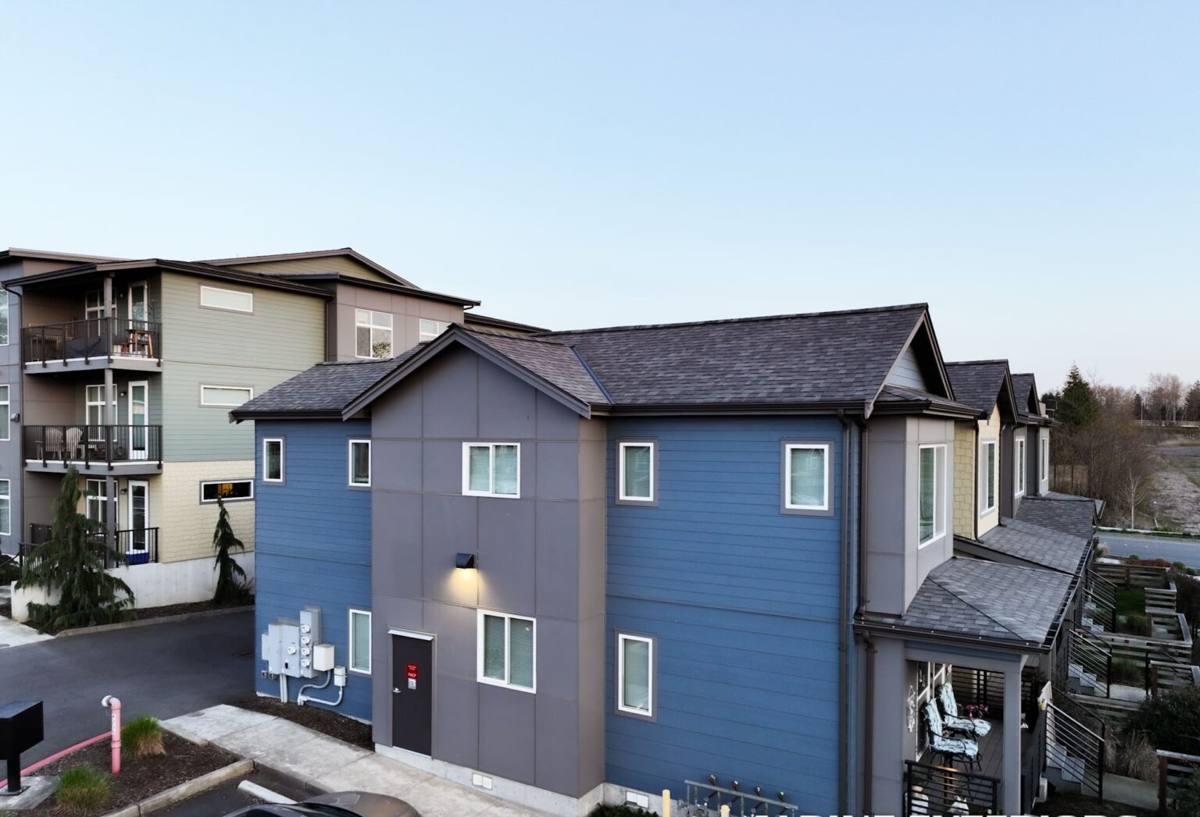
Why Blaine's Climate Pushes Us Toward One Product
Salt Air Off Semiahmoo Bay
Homes near the water in Blaine take on salt-laden air as a constant, not a seasonal event. That accelerates corrosion on fasteners and exposed metal trim, and it breaks down lower-quality finishes faster than a dry inland climate ever would. A siding product with even a little surface porosity, or a finish that isn't factory-cured, tends to show wear here years ahead of the same product installed twenty miles south.
Rain That Doesn't Fall Straight Down
Storm systems coming ashore near the border push rain sideways into wall assemblies instead of dropping it straight down, and that wind-driven load finds gaps in flashing, trim, and panel joints that ordinary rainfall would never reach. It's a harder test of a siding system's water-shedding design than most manufacturers' spec sheets are built around, and it's a big part of why we won't put a moisture-sensitive product on a Blaine wall.
A Moss Season That Runs Most of the Year
Mild temperatures and near-constant humidity give moss and mildew a growing season that barely pauses on shaded or north-facing walls. Any material that traps moisture against the substrate, rather than shedding and drying quickly, becomes a growth surface over time — and once moss establishes on a wall, it holds moisture against the siding even longer, compounding the problem.
The James Hardie Product Lineup We Install in Blaine
James Hardie makes more than one siding profile, and matching the right one to a Blaine home is part of getting the job right, not just a style choice.
HardiePlank Lap Siding
The most common choice on Blaine homes, HardiePlank comes in several width and texture options — smooth or cedar-textured — and gives the traditional horizontal lap look most homeowners in the area expect. It's the workhorse of the lineup: straightforward to detail correctly around windows and trim, and available in the widest range of ColorPlus finishes.
HardieShingle
For homes that want a shingle-style look, either as a full exterior or as an accent on gables and dormers, HardieShingle gives that staggered or straight-edge shingle appearance without the maintenance burden of real wood shingles sitting in this much moisture. It's a common accent choice on Blaine homes that want some texture variation without going to a full board-and-batten look.
HardiePanel and Board-and-Batten Looks
HardiePanel gives a vertical board-and-batten appearance, often used on gable ends, entry features, or as a full-home look on more modern designs. Vertical panel siding sheds wind-driven rain differently than horizontal lap, and detailing the battens and seams correctly matters even more on a wall that catches direct exposure off the water.
HardieTrim
Trim boards around windows, corners, and fascia take some of the worst moisture exposure on a house, since they sit at the transitions where water is most likely to find a way in. HardieTrim is fiber cement built specifically for that role, and pairing it with the field siding rather than mixing in a wood or composite trim product keeps the whole wall assembly behaving the same way over time.
HZ5: Hardie's Engineering for This Exact Climate
James Hardie manufactures its siding in different formulations depending on regional climate, sold under the HardieZone system. HZ5 is the formulation engineered for regions with sustained moisture and freeze-thaw cycling, which describes coastal Whatcom County accurately, and it's the product line we specify for Blaine projects. The difference isn't cosmetic — it affects how the board is engineered to resist moisture absorption and hold dimensional stability through repeated wet-dry cycles, which matters more on a wall facing the bay than it does on a home in a drier inland climate. Specifying the wrong HardieZone formulation for the region is a mistake that doesn't show up on install day; it shows up years later.
ColorPlus Finish and Choosing a Color for a Blaine Home
Most James Hardie siding we install in Blaine comes with the ColorPlus finish — a coating applied and baked on under controlled factory conditions rather than brushed on in the field. That matters in a salt-air climate specifically, because factory-cured finishes hold their color and resist chalking and fading longer than field-applied paint does when it's fighting constant humidity and UV exposure off the water. ColorPlus also carries its own finish warranty, separate from the substrate warranty on the board itself.
Color selection on a waterfront-adjacent home is worth some thought beyond personal preference. Darker colors absorb more heat and can show fading differences over time more visibly than lighter tones, and homes with heavy tree cover or shaded north walls tend to show moss and mildew growth more readily against certain finishes. We bring physical ColorPlus samples to a Blaine estimate rather than relying on a printed card or a screen, because color reads differently under this region's grey, diffuse light than it does in a showroom or a sunnier climate.
What a Correct Installation Looks Like on a Blaine Wall
The product only performs as engineered if the installation follows Hardie's published spec, and in Blaine the details that get skipped on a rushed job are exactly the ones this climate exploits fastest.
- Rainscreen drainage gap: A ventilated cavity behind the siding lets any moisture that gets past the outer surface drain and evaporate instead of sitting against the sheathing.
- Correct fastener type and spacing: Hardie specifies corrosion-resistant fastener types and exact spacing by product line and exposure; loose spacing or the wrong fastener is one of the more common causes of early failure we find on Blaine tear-offs.
- Proper clearance at grade and roof lines: Siding installed too close to the ground, a deck, or a roof surface holds moisture against the bottom edge of the board far longer than spec allows.
- Fully lapped and sealed flashing: Every window, door, and penetration needs flashing that sheds wind-driven rain outward and downward, not just straight-down rainfall.
None of this is unusual or exotic — it's the manufacturer's own installation manual, followed consistently on the parts of the job that are hardest to inspect once the siding is up and the crew has left.
How a Blaine James Hardie Project Runs, Start to Finish
A Blaine siding project generally moves through the same stages, though the pace and detail depend on the home's exposure and existing condition.
- Walkthrough and assessment: We look at the home's exposure to wind and water, existing siding condition, and any signs of moisture already behind the walls before quoting anything.
- Tear-off and sheathing check: Removing old siding is also when hidden moisture damage or rot in the sheathing turns up. We address what we find rather than covering it over with new siding.
- Water-resistive barrier and flashing: The house wrap and flashing go on and get inspected before a single piece of siding does, since this layer matters more than the visible surface once the job is done.
- Installation to spec: HardiePlank, HardieShingle, or HardiePanel goes on following Hardie's fastening, spacing, and clearance requirements for the HZ5 product line.
- Final walkthrough: We go over the finished job with the homeowner, including warranty registration paperwork, before calling it complete.
James Hardie Product Line Comparison for Blaine Homes
| Product | Best Use on a Blaine Home | Climate Consideration |
|---|---|---|
| HardiePlank Lap | Full-home siding, traditional look | Widest ColorPlus range; proven performance in sustained wind-driven rain |
| HardieShingle | Full exterior or gable/dormer accents | Low-maintenance alternative to real wood shingle in constant moisture |
| HardiePanel | Gable ends, entries, modern vertical look | Batten and seam detailing critical on water-facing walls |
| HardieTrim | Window, corner, and fascia trim | Matches field siding's moisture behavior at the most exposed transitions |
These are general guidelines, not a quote. The right mix of products for a given Blaine home depends on its exposure, existing trim condition, and the look the homeowner wants, which is why we walk the property before putting a real number on the work.
Signs Your Blaine Home's Siding Is Overdue for Attention
- Fading or chalking that looks noticeably uneven compared to other walls, which can point to a non-factory finish struggling against the sun and salt air
- Soft or spongy panels, especially near the bottom of the wall or around window trim
- Moss or dark staining that returns quickly after cleaning, particularly on shaded or north-facing walls
- Cracking or gaps at butt joints and trim transitions where panels meet
- Rust streaking below fasteners or trim hardware
- Visible warping, cupping, or buckling anywhere on the wall
Why Hiring a Crew That Already Works Blaine Matters
A crew that only occasionally works this far north tends to treat Blaine like any other Whatcom County job — same fastener spacing, same clearance details, same generic approach regardless of how close a house sits to the water. We work in Blaine regularly enough to know which walls take the worst of the wind-driven rain, where moss establishes first, and which installation details are worth the extra time on a house this exposed. That familiarity doesn't come from a spec sheet; it comes from being back in this area often enough to see how the last job we did here is actually holding up.
If your Blaine home needs new siding or you're deciding between repair and replacement, we're happy to take a look and walk you through what James Hardie would actually involve for your specific property. Reach out using the form below to schedule a free, no-pressure estimate.