 Ferndale Siding
 Why Point Roberts Homes Need Siding Built for the Water
Point Roberts sits on its own peninsula at the southern tip of a larger landmass that's otherwise part of Canada, which means nearly every home here lives close to open water. That proximity is the whole appeal of the place, but it's also why siding fails faster on Point Roberts than it does a few miles inland in Ferndale or elsewhere in Whatcom County. Salt-laden air, wind-driven rain coming off the Strait of Georgia, and long stretches of overcast, moisture-heavy weather put a different kind of stress on exterior materials than a typical inland lot sees.
Board and batten siding is a popular choice out here because the vertical lines suit the area's coastal and cabin-style homes, and the deep shadow lines hold up visually against gray skies. But board and batten is also one of the least forgiving siding profiles to install poorly. Get the batten spacing, fastening, or moisture management wrong, and you're looking at cupping, fastener bleed, and rot at the battens years before it should show up. This page covers what a correct board and batten job looks like on a Point Roberts home, what material we use and why, and how our process accounts for the realities of building in this particular corner of the county.
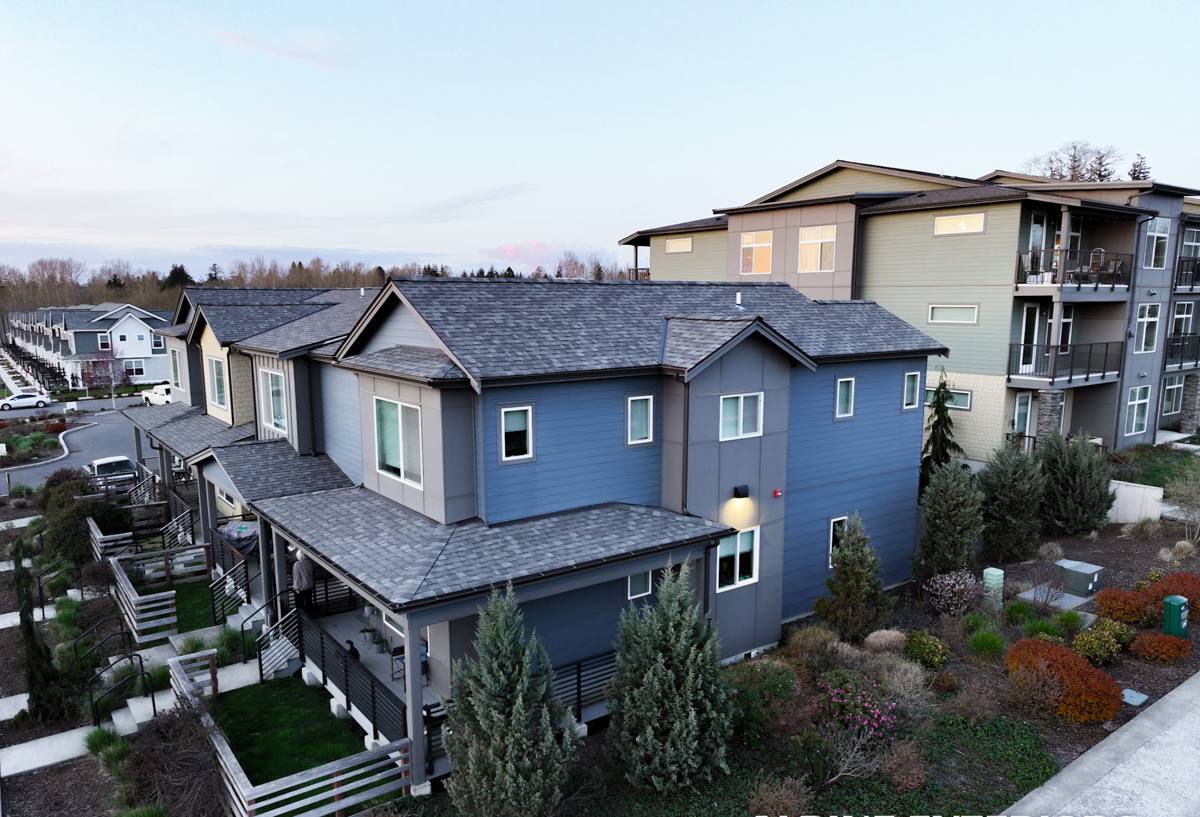
Board and Batten's Fit for Point Roberts' Homes
Board and batten is a vertical siding pattern: wide flat panels or boards installed with narrower strips (battens) covering the seams between them. It reads as a clean, simple, slightly rustic look that fits the mix of waterfront cottages, remodeled cabins, and newer builds you find around Point Roberts. It's also a practical profile for homes with tall gable ends or a lot of vertical wall space, since the lines emphasize height rather than fighting it.
None of that changes the physics, though. Vertical siding sheds water differently than horizontal lap siding, and every seam under a batten is a place where water can get trapped if the assembly isn't built correctly. On a property that's catching salt spray and driving rain off the water for a good part of the year, those details aren't optional extras — they're the difference between siding that looks good for decades and siding that needs board replacement in year eight.
What a Correct Board and Batten Installation Actually Involves
Rainscreen and Drainage
Vertical siding should be installed over a drainage gap — often called a rainscreen — rather than flat against the house wrap. That gap lets any water that gets behind the panels drain out and lets the wall assembly dry. Skipping the rainscreen is one of the most common shortcuts on board and batten jobs, and it's the one that causes the most damage down the road, especially in a climate that stays damp for months at a stretch.
Fastening and Batten Spacing
Battens need consistent spacing and fastening that accounts for both the panel and the batten expanding and contracting slightly with moisture and temperature. Fasteners that are overdriven, spaced wrong, or placed too close to panel edges create stress points where cracking and water intrusion start. This is one of the areas where fiber cement and softer materials behave very differently, and it's a big part of why product choice matters as much as workmanship.
Flashing and Trim Details
Every window, door, and roof-to-wall transition on a board and batten wall needs flashing that directs water out and away from the seams below it. On a marine-exposed property, we treat these transitions as the highest-priority part of the job, because a flashing mistake at a single window can quietly feed water into a wall cavity for years before anyone notices a problem.
Where Board and Batten Installations Commonly Go Wrong
- No drainage gap behind the siding, so trapped moisture has nowhere to go
- Battens face-nailed with the fastener spacing too tight or too close to the edge
- Missing or undersized flashing at window heads and roof intersections
- Panels butted tight against trim with no expansion gap, causing buckling
- Bottom edge of the siding installed too close to grade, decks, or roof lines, holding moisture against the material
- Caulk used to "solve" a flashing problem instead of actually flashing it
Why We Only Install James Hardie for Board and Batten
We install James Hardie fiber cement exclusively — we don't offer vinyl, LP SmartSide, primed wood, cedar, or other fiber cement brands for board and batten or any other profile. That's a deliberate standard, not a sales pitch, and it's worth explaining honestly.
Board and batten in particular exposes the weaknesses of softer or moisture-sensitive materials. Wood battens and boards can look great going up, but they absorb and release moisture with the seasons, which is exactly the kind of movement that causes seams to open and paint to fail. Vinyl board and batten profiles are lightweight and can rattle or bow over time, and their color is baked into thin plastic that fades and becomes brittle with years of UV and salt exposure. Engineered wood products have improved their moisture resistance, but they still rely on a factory coating and careful field sealing of every cut edge to hold up — miss one cut edge on a wet property like this and that's where the failure starts.
James Hardie fiber cement doesn't swell, rot, or support the kind of moss and algae growth that thrives in a shaded, damp climate the way wood does. It's non-combustible, holds paint and factory finish far longer than wood-based sidings, and is engineered specifically for wet climates through Hardie's HZ5 product line, which is built for exactly the freeze-thaw, high-moisture conditions found in the Pacific Northwest. That's the material we stand behind for board and batten on a property that's going to spend its life a short distance from saltwater.
Salt Air, Driving Rain, and Moss: How the Climate Factors In
Point Roberts deals with all of the moisture challenges that come with living on Whatcom County's coastline, plus the added factor of near-constant salt exposure that inland Ferndale properties don't see nearly as much of. The table below breaks down what that means for board and batten siding specifically, and how the material and installation choices we make respond to each factor.
| Climate Factor | Effect on Board and Batten Siding | How We Address It |
|---|---|---|
| Salt-laden marine air | Accelerates corrosion of fasteners and metal flashing; degrades paint film on wood and vinyl faster than inland exposure | Corrosion-resistant fasteners and flashing, factory ColorPlus finish that isn't a field-applied paint film |
| Wind-driven rain | Pushes water sideways into seams and battens rather than letting it simply run down the wall | Rainscreen gap, correctly lapped house wrap, and flashing detailed at every horizontal transition |
| Long moss and algae season | Shaded, damp walls stay wet longer, encouraging growth that holds moisture against the surface | Fiber cement doesn't feed organic growth the way wood does; proper drainage keeps the wall drying instead of staying saturated |
| Freeze-thaw swings | Trapped moisture that freezes can crack seams and force joints open | HZ5 fiber cement engineered for wet, freeze-prone climates; correct gapping at panel and batten joints |
Our Process for Point Roberts Projects
Point Roberts is a U.S. exclave — the only land route in and out runs through Canada — and that geography shapes how we plan a job out there compared to a project in Ferndale proper. We schedule material delivery and crew logistics ahead of time rather than treating it as a same-day, drop-everything trip, and we plan the job in phases that minimize how many separate crossings are needed. None of that changes the standard we build to; it just means the planning happens before the crew ever shows up with material.
On site, the process for a board and batten replacement generally runs:
- On-site assessment of the existing siding, wall assembly, and any moisture or rot already present, with photos and a written scope
- Removal of failing siding and inspection of the sheathing and framing underneath before anything new goes up
- Repair of any water-damaged sheathing or framing found during tear-off — this gets addressed before new siding goes on, not covered up
- Installation of house wrap, rainscreen furring, and flashing at every penetration and transition
- Installation of James Hardie panels and battens per manufacturer fastening and spacing specifications
- Final trim, caulking at appropriate joints only, and a walk-through of the finished work
Maintenance That Actually Matters on a Property Like This
Fiber cement is low-maintenance compared to wood or vinyl, but "low-maintenance" doesn't mean "no maintenance," especially with the amount of salt and moisture Point Roberts sees. A short annual check catches small problems before they become expensive ones.
- Rinse salt residue off the siding once or twice a year, especially on walls facing the water
- Check caulking at window and door trim annually and re-caulk any joints that have opened up
- Keep gutters clear so overflow isn't running down the wall face during heavy rain
- Trim back vegetation that's shading a wall and keeping it damp longer than the rest of the house
- Look at the bottom edge of the siding near grade, decks, and roof lines for any staining or soft spots
- Address any small moss growth on the siding promptly rather than letting it establish
Why Hiring a Crew That Already Works in Point Roberts Matters
A lot of siding contractors are willing to quote a Point Roberts job but aren't set up to actually run one efficiently — the border crossing, the logistics of getting material and equipment out there, and the exclave's small, tight-knit community all favor a crew that's done it before. We work throughout Whatcom County, including Ferndale and Point Roberts, and we plan our Point Roberts projects around the realities of the location rather than treating it as an afterthought tacked onto a mainland schedule.
That local familiarity also means we know what this specific climate does to siding over time, because we've seen it firsthand on other homes in the area. That's part of why we install one material, to one standard, everywhere we work — it's easier to guarantee a result when you're not juggling five different products with five different failure points.
If your Point Roberts home needs new siding or you're planning ahead for a remodel, we're happy to take a look and give you a straightforward, no-pressure estimate. Use the form below to get started.