 Ferndale Siding
 Why Sandy Point's Shoreline Climate Wears Out Decks Faster
Sandy Point sits right up against the water, and that changes what a deck has to deal with compared to a deck a few miles inland in Ferndale. Salt-laden air off the water accelerates corrosion on anything metal — fasteners, joist hangers, railing hardware — long before it would fail on a typical inland lot. Add in wind-driven rain that comes in sideways during a fall or winter storm, and you've got moisture finding its way into every gap, seam, and fastener hole a deck has.
Then there's the moss. Whatcom County's wet season runs long, and a waterfront lot with tree cover or northern exposure can stay damp for weeks at a stretch. Untreated or poorly ventilated wood decking becomes a moss and algae magnet under those conditions, which makes the surface slick and starts breaking down the wood fibers from the top down. None of this is unique to Sandy Point, but the combination — salt air, near-constant wind-driven moisture, and a long moss season — hits waterfront properties here harder than it hits a deck built a mile or two inland.
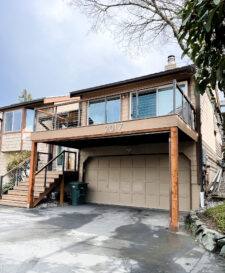
What a Deck Built for This Environment Actually Needs
A deck that holds up at Sandy Point isn't about buying the most expensive product on the market — it's about matching the material and the build to the specific stresses of a shoreline lot. That means:
- A decking surface that doesn't absorb water into its fibers, so it can't rot, cup, or feed mold and moss growth
- Fasteners and structural hardware rated for coastal or marine-adjacent exposure, not standard interior-grade galvanized
- A substructure that's ventilated and detailed to shed water instead of trapping it against framing
- Flashing at the ledger board and any wall connection that actually keeps wind-driven rain out of the structure behind it
- A surface texture that stays reasonably slip-resistant even when it's damp for days at a time
Composite decking checks most of these boxes better than dimensional wood does, which is why it's become the default recommendation for waterfront and near-shore properties in this area — but the decking board is only part of the equation. A composite deck built on a poorly detailed substructure will still have problems, just in different places than a wood deck would.
Composite Decking vs. Wood vs. PVC for a Waterfront Lot
There's no single "best" decking material for every situation, but for a Sandy Point property, the trade-offs line up differently than they would for a dry inland yard. Here's how the common options actually compare under this climate:
| Material | Moisture Behavior | Moss/Algae Resistance | Hardware Needs | Typical Upkeep |
|---|---|---|---|---|
| Pressure-treated wood | Absorbs water, prone to cupping and checking near saltwater | Low — needs regular cleaning and re-sealing | Standard, but corrodes faster in salt air | Annual cleaning, periodic sealing/staining |
| Capped composite | Water-resistant cap sheds moisture, core doesn't rot | High with proper ventilation underneath | Should be corrosion-resistant hidden fastener systems | Periodic washing, no sealing or staining |
| PVC decking | Fully synthetic, doesn't absorb water at all | Highest — least organic content for moss to grip | Corrosion-resistant fasteners recommended | Lowest — occasional washing |
Wood isn't a bad material on its own, but on a shoreline lot it asks for more maintenance than most homeowners are realistic about keeping up with — and skipped maintenance is exactly what lets moss and rot get ahead of you. That's our honest read as installers, not a knock on wood as a product.
Board Selection: Capped Composite vs. PVC
Capped Composite
Capped composite boards have a wood-fiber and plastic core wrapped in a protective polymer shell. That shell is what does the real work of keeping water and moss out of the board — it's a significant step up from older uncapped composite products, which could still absorb moisture at cut ends and fastener holes. For most Sandy Point homes, capped composite offers the best balance of appearance, cost, and durability.
PVC Decking
PVC boards are fully synthetic, with no wood content at all. That makes them the most moisture-proof option on the market, which matters most on decks that get direct salt spray or sit low to the ground with limited airflow underneath. PVC costs more than capped composite and has a different look and feel, so we typically recommend it for the most exposed sections of a property rather than as a blanket choice.
Whichever board you choose, we cut and cap all exposed ends and drill only where the manufacturer's fastening system specifies — exposed core material at a cut edge is one of the most common places we see moisture problems start on composite decks that weren't installed carefully.
The Substructure Is Where Coastal Decks Actually Fail
Most deck problems we get called out to fix on waterfront properties aren't failures of the decking boards — they're failures underneath, where nobody sees them until something feels soft or a railing post starts to wobble. On a Sandy Point build, we pay particular attention to:
- Ledger board flashing — the connection where the deck meets the house is the single most common point for wind-driven rain to work its way into the wall assembly if it isn't flashed correctly
- Joist protection — a moisture-resistant tape over the top of each joist keeps rain from soaking into the framing lumber through fastener holes
- Hardware grade — joist hangers, structural screws, and post hardware need a coating rated for the corrosive exposure a near-shore lot deals with, not the standard-grade galvanized used on typical inland jobs
- Airflow underneath — enough clearance and ventilation so the space under the deck can actually dry out between storms instead of staying damp and feeding moss and mildew growth on the underside of the boards
None of this shows up in a quick look at a finished deck, which is exactly why it matters who's doing the framing work, not just who's snapping in the top boards.
Our Installation Process
- On-site assessment — we look at sun and wind exposure, drainage, existing structure (if it's a replacement), and how close the deck sits to the water, since that changes our hardware and flashing choices
- Material selection — we walk through composite and PVC options with you, including color and board profile, based on your budget and how exposed the location is
- Substructure build or repair — framing, ledger flashing, joist protection tape, and corrosion-resistant hardware installed to spec before a single board goes down
- Decking installation — boards fastened per the manufacturer's system, with proper gapping for drainage and expansion, and all cut ends capped
- Railing and trim — matched fascia, railing, and stair components installed and checked for level and secure attachment
- Final walkthrough — we go over the finished deck with you, including what maintenance actually looks like for the specific material you chose
Maintenance in Sandy Point's Salt Air and Moss Season
Composite and PVC decking cut maintenance way down compared to wood, but "low-maintenance" isn't "no-maintenance," especially this close to the water. A simple seasonal routine keeps a deck looking and performing the way it should:
- Sweep off debris, needles, and leaves regularly — trapped organic material is what gives moss a foothold, even on composite
- Wash the deck surface a couple of times a year with a soft-bristle brush and mild soap and water; a pressure washer on the wrong setting can damage the cap layer, so keep it on a low, wide setting if you use one
- Rinse salt residue off railings and hardware after wind events that bring spray up off the water
- Check that gaps between boards stay clear so water can actually drain through rather than pooling on the surface
- Keep the area underneath the deck clear of debris so airflow can keep doing its job
- Inspect visible fasteners and hardware once a year for early signs of corrosion, especially on older installs that may not have coastal-rated hardware to begin with
Cost Factors for a Composite Deck in Sandy Point
Every deck is priced around its own size, layout, and site conditions, so we won't quote a number without seeing the property — but these are the factors that actually move the price up or down on jobs like this:
| Factor | Why It Matters Here |
|---|---|
| Board material (capped composite vs. PVC) | PVC typically costs more upfront but needs the least long-term upkeep in salt air |
| Substructure condition | Replacing corroded hardware or repairing water-damaged framing adds cost but isn't optional on an older waterfront deck |
| Height and railing requirements | Elevated decks need more substantial railing and support, which affects both material and labor |
| Access to the site | Waterfront lots can have tighter or steeper access than a typical inland yard, which affects labor time |
| Deck size and layout complexity | Curves, multiple levels, and built-in features all add labor beyond a simple rectangular deck |
Why Hire a Crew That Already Works Sandy Point
A contractor who's only worked inland Whatcom County jobs isn't necessarily going to think about ledger flashing, hardware corrosion resistance, or ventilation the same way — because those things don't cost them a callback on a dry inland lot the way they will here. We've built and repaired decks for properties dealing with this exact combination of salt air, wind-driven rain, and moss, and we frame every job around what that specific exposure demands, not a one-size-fits-all approach pulled from an inland job site.
That local familiarity also means we're straightforward about what a given site actually needs versus what's optional upsell — some Sandy Point lots are far more exposed than others even within the same neighborhood, and the right build for a wide-open waterfront spot isn't always necessary for a more sheltered lot nearby.
If you're planning a new composite deck or replacing one that's showing its age, we're happy to come take a look and walk you through your options. The estimate is free, there's no pressure, and you'll get a straight answer about what your specific property needs — just fill out the form below to get started.