 Ferndale Siding
 Cordata's Climate Puts Real Stress on Exterior Siding
Homes in and around Cordata sit in the same tough coastal-Whatcom weather pattern as the rest of the Ferndale area: damp air moving in off Bellingham Bay and the Salish Sea, long stretches of driving rain from fall through spring, and a moss season that can run most of the year on shaded north- and west-facing walls. None of this is dramatic, storm-driven damage. It's slow, cumulative wear — the kind that shows up as soft trim boards, dark streaking, and paint that won't hold no matter how many times it's redone.
Siding in this part of Whatcom County has to manage moisture for months at a stretch, not just survive an occasional downpour. Salt-tinged marine air accelerates corrosion on fasteners and metal flashing, and constant dampness gives moss, algae, and mildew everything they need to take hold on any surface that doesn't dry out quickly between rain events. A siding system that works fine in a drier climate can struggle here, and a siding job that's installed even slightly wrong tends to show it faster in Cordata than it would somewhere with less rain.
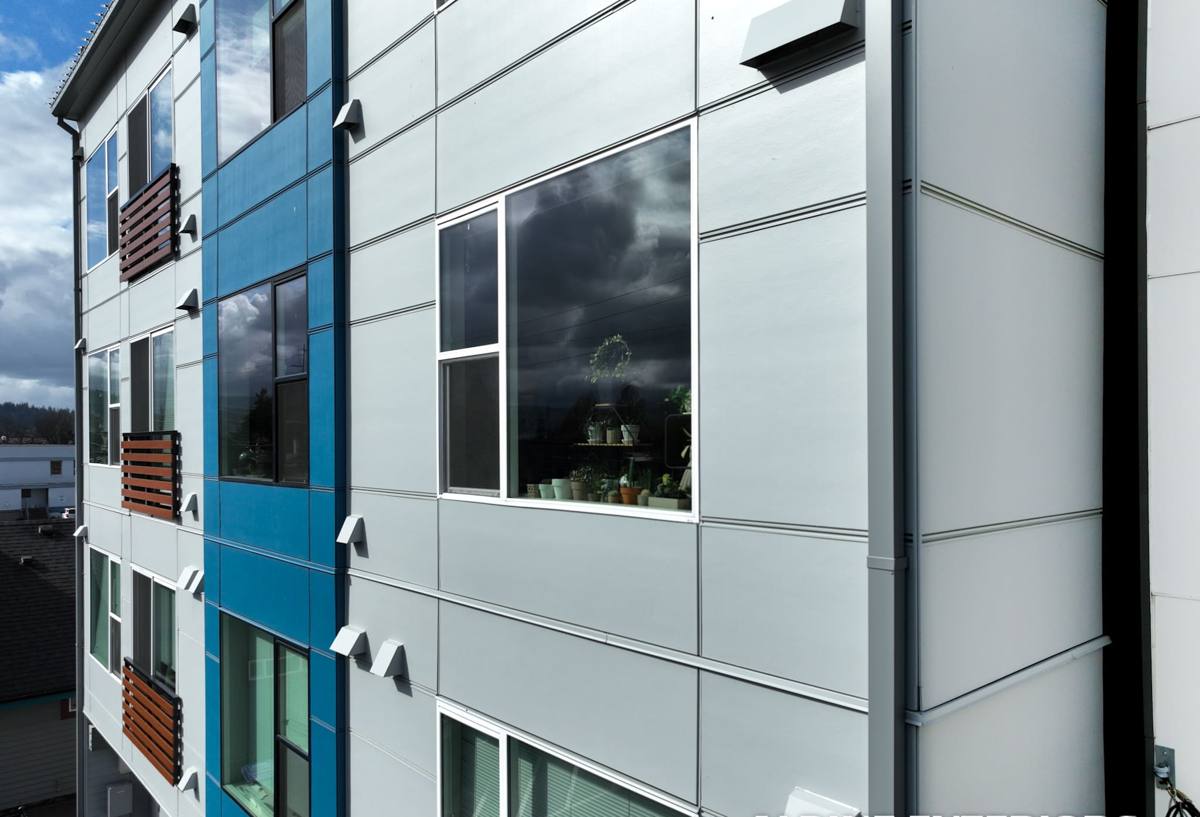
What This Means for a Siding Replacement Done Right
Replacing siding on a Cordata home isn't just a cosmetic swap. It's a chance to correct whatever moisture path has been feeding problems underneath the old siding, and to put a system in place that's actually built for this climate going forward. That means paying attention to what's happening behind the siding, not just what color goes on the outside.
Common Issues We Find When We Pull Old Siding Off
- Missing or failed weather-resistive barrier (house wrap) that let moisture reach the sheathing
- Rotted sheathing or framing near window and door openings where flashing was skipped or installed backward
- Rusted or undersized fasteners that have started to bleed through the old siding
- Moss and algae staining concentrated on north-facing and shaded walls, with softer material underneath
- Caulk used in place of proper flashing at trim and penetrations — a shortcut that fails quietly over years
These aren't unusual findings — they're what you'd expect to see on a home that's been through a couple decades of Whatcom County weather with a siding system that wasn't detailed for it. Finding them during a replacement, before new siding goes back on, is the whole point of doing the job properly instead of a quick re-side.
What a Correct Siding Replacement Involves
Tear-Off and Inspection
We remove the old siding down to the sheathing and take the time to actually look at what's underneath — soft spots, water staining, and any framing that needs to be dried out or replaced before new siding goes on. Covering up existing damage with new siding just delays a bigger repair.
Moisture Barrier and Flashing
A new weather-resistive barrier goes on with proper overlaps, and flashing is installed at every window, door, and horizontal trim transition so water is directed out and away from the wall assembly rather than trapped behind it. In a climate that sees as much sustained rain as this one, flashing details matter more than almost anything else in the job.
Siding Installation to Manufacturer Spec
Correct fastener type and spacing, correct nailing zones, proper clearance at grade and roof lines, and gaps at butt joints sized the way the manufacturer specifies for expansion. Skipping these details is often invisible on installation day and only shows up years later as cracking, buckling, or moisture intrusion.
Trim, Caulking, and Finish Work
Factory-finished siding needs far less field caulking than site-primed products, but the caulking that is used has to be a quality sealant applied at the right joints — not as a substitute for flashing, but as a final line of defense.
Why We Install Only James Hardie Fiber Cement
We standardized on James Hardie fiber cement for every siding replacement we do, including in Cordata, and we don't install vinyl, LP SmartSide, or primed wood siding. That's not a marketing position — it's a decision based on what actually holds up in this climate over the long run.
Fiber cement is non-combustible and dimensionally stable, so it doesn't expand and contract with moisture the way engineered wood products can, and it doesn't soften or warp the way vinyl can under sustained damp conditions. James Hardie's ColorPlus finish is baked on at the factory rather than field-applied, which matters a lot in a climate where a field-applied paint job is fighting rain and humidity almost year-round. And James Hardie engineers specific HZ product lines for different climate zones, including the wetter Pacific Northwest — the product itself is built with this kind of weather in mind, not adapted after the fact.
We're not going to tell you every other product on the market is junk — vinyl and engineered wood both have a place, and plenty of homes have them. But when we're the ones putting our name behind the installation, we want a product that's proven to hold up to salt air, sustained rain, and heavy moss pressure without the maintenance burden or moisture sensitivity that comes with the alternatives.
Our Process, Start to Finish
- Free on-site estimate — we walk the exterior with you, look at trouble spots, and talk through what we expect to find once siding comes off
- Written scope and quote — clear about materials, siding line and profile, color, and what's included
- Tear-off and inspection — old siding removed, sheathing and framing assessed, any necessary repairs identified before we proceed
- Weather barrier and flashing installation — the moisture-management layer that determines how the job performs over time
- James Hardie siding installation — installed to manufacturer spec for fastening, clearances, and joint treatment
- Final walkthrough — we go over the finished exterior with you before calling the job done
Cost Factors for a Cordata Siding Replacement
Every home is different, but the main variables that move the price on a siding replacement in this area are fairly consistent. The table below is a general guide, not a quote — actual pricing depends on what we find once we're on site and behind the old siding.
| Factor | Why It Matters |
|---|---|
| Home size and wall complexity | More square footage, corners, and roof lines mean more material and labor time |
| Condition of sheathing underneath | Hidden rot or moisture damage found during tear-off adds repair work before new siding can go on |
| Siding profile and accessories | Lap width, trim details, and accent features affect material cost and install time |
| Access and site conditions | Steep grades, tight lot lines, or limited staging area can affect labor time |
| Existing moisture barrier condition | A failed or missing house wrap means more prep work before siding installation begins |
Why It Matters to Hire a Crew That Already Works in This Area
A siding crew that regularly works Ferndale and the surrounding Whatcom County neighborhoods, including Cordata, has already seen how this specific climate treats different siding systems and installation shortcuts over time. That familiarity shows up in small but important ways — knowing which wall orientations tend to hold moisture longest, being conservative with flashing details because we've seen what happens when they're skipped, and not being surprised by what's usually found once old siding comes off a home that's weathered this many wet seasons.
It also matters for accountability. A local crew is easy to reach if a question comes up after the job is done, and has a reputation in the area worth protecting — not just a job number on a spreadsheet.
Maintaining Your New Siding
James Hardie siding is low-maintenance compared to the alternatives, but "low-maintenance" doesn't mean "no maintenance" in a climate this wet. A simple annual routine keeps it performing the way it's designed to:
- Rinse siding gently once a year to keep moss and algae from establishing on shaded walls
- Keep gutters clear so overflow doesn't run down the siding face
- Trim back vegetation and shrubs so walls can dry out between rain events
- Check caulking at trim joints periodically and touch up if it's cracked or pulling away
- Address any impact damage promptly rather than letting moisture find its way in
If your Cordata-area home has siding that's staining, softening, or just past its service life, we're happy to take a look and walk you through what we find. Reach out for a free, no-pressure estimate using the form below.