 Ferndale Siding
 Why Decks in Custer Wear Out Faster Than People Expect
Custer sits close enough to the water and open farmland that its decks take a different kind of beating than decks in drier parts of the state. It's not one dramatic storm that does the damage — it's the accumulation. Whatcom County gets long stretches of steady rain from fall through spring, the air carries a fair amount of salt off the nearby Puget Sound waters, and shaded, damp yards give moss and algae months at a time to get established on any horizontal wood surface. A deck that would last two decades in eastern Washington often needs real structural attention here in half that time if it wasn't built or maintained with this climate in mind.
The result we see most often isn't a deck that looks bad — it's a deck that looks fine on top while the framing underneath has been quietly absorbing moisture for years. Boards cup, fasteners corrode, and ledger connections that were never flashed properly start letting water into the house framing itself. By the time it's visibly a problem, you're usually not looking at a repair anymore.
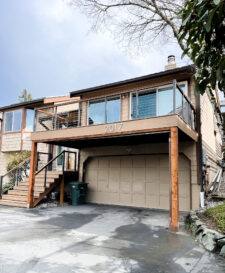
Signs Your Deck Needs Replacing, Not Just Patching
A lot of Custer homeowners call us for a repair and end up needing a replacement once we're actually under the structure. Here's the honest checklist we use to tell the difference:
- Soft, spongy, or springy spots when you walk across the deck
- Visible rot or dark staining at the ledger board where the deck meets the house
- Rust streaks running down from fasteners or joist hangers
- Persistent moss or green-black algae film that comes back within weeks of cleaning
- Gaps opening up between boards, or boards that have visibly cupped or crowned
- Posts or footings that show cracking, heaving, or noticeable movement when the deck is loaded
- A deck older than 15–20 years that has never had the substructure inspected
One or two of these on their own might mean a repair is enough. Rot at the ledger board combined with soft framing almost always means replacement — that's the connection point where structural failure actually happens, and it's not something to patch around.
What a Correct Deck Replacement Actually Involves
Framing and Footings
Everything starts below the decking. Footings need to be sized and set to current code for the loads involved, and in this soil and moisture environment, drainage around those footings matters as much as the footing itself. Joists and beams need to be spec'd for the span and, in our climate, treated or protected in a way that actually holds up to sustained wet conditions rather than just meeting a minimum rating on paper.
The Ledger Connection
This is the single most common failure point on decks we replace. The ledger board bolts to the house, and if it isn't flashed correctly — with proper flashing tucked behind the house's water-resistive barrier, not just caulked and hoped for — water works its way behind it every wet season. We treat ledger flashing as a siding and moisture-management detail, not just a deck detail, because that's really what it is.
Decking Material and Fasteners
The visible boards get the attention, but the hardware holding them down matters just as much in a salt-air environment. Standard fasteners corrode faster here than in inland climates; we use hardware rated for coastal exposure so you're not dealing with rust streaks and popped screws within a few seasons.
Choosing a Decking Material for Custer's Climate
There's no single "best" decking material — there's a best material for your budget, your maintenance appetite, and how exposed the deck is to weather and salt air. Here's how the common options actually compare in this climate:
| Material | Moisture Behavior | Maintenance | Typical Lifespan Here |
|---|---|---|---|
| Pressure-treated wood | Absorbs and releases moisture; prone to cupping if not sealed regularly | Needs cleaning and resealing every 1–2 years to resist moss and rot | 10–15 years before major boards need replacing |
| Cedar | Naturally rot-resistant but still needs sealing in a wet climate | Annual cleaning, periodic sealing to hold color and resist moss | 15–20 years with consistent upkeep |
| Capped composite | Doesn't absorb water like wood; resists rot at the board level | Occasional washing; no sealing or staining required | 25+ years, though board ends and cuts still need to be handled correctly |
| PVC decking | Fully synthetic, essentially impervious to moisture | Lowest maintenance of the group; simple washing | 25–30+ years, typically the longest warranty structure |
Wood costs less up front and has a real, honest place on plenty of projects — especially where a homeowner wants a traditional look and is comfortable with the upkeep. Where we steer people toward composite or PVC is on decks with heavy shade, low airflow, or close proximity to the water, because those conditions are exactly where wood's maintenance demands go up fastest. It's a trade-off, not a verdict — we'll walk through what fits your specific lot and budget rather than push one product across the board.
Our Deck Replacement Process
- On-site assessment. We get under the existing deck, check the framing, ledger connection, footings, and drainage — not just the surface.
- Honest scope and estimate. You get a clear breakdown of what's structural, what's material choice, and what the real cost drivers are, with no surprise change orders for things we could have caught up front.
- Permitting. Whatcom County requires permits for most deck replacement work involving structural changes; we handle that process so you're not the one navigating it.
- Demo and disposal. Old decking and framing removed and hauled off — we don't leave debris piled on the property.
- Rebuild from the ground up. Footings, framing, flashing, and decking installed in that order, each step inspected before the next covers it up.
- Final walkthrough. We go over the finished deck with you, including what maintenance (if any) your chosen material needs going forward.
Permits and Code in Whatcom County
Deck replacement isn't always a simple swap of old boards for new ones — if the footings, framing, or size of the deck change, or if the existing structure doesn't meet current code, permitting comes into play. Whatcom County's process covers structural review for decks attached to a home, and it exists for a good reason: an under-built deck is a safety issue, not just a cosmetic one. We build to pass inspection the first time and handle the paperwork so it's not one more thing on your plate.
Why a Crew That Already Works Custer Makes a Difference
Custer isn't a dense subdivision — it's a mix of larger rural lots, older farmhouses, and newer builds spread across a community that doesn't get the same contractor traffic as Bellingham or Ferndale proper. That matters in a few practical ways. We already know how drainage tends to behave on the soil types out here, what kind of moss and algae pressure to expect based on tree cover and sun exposure, and how salt-influenced air off the Sound factors into hardware and finish choices. We're not learning your neighborhood on your project — we've already built and replaced decks in it.
It also means faster response for follow-up questions or seasonal maintenance advice, because we're not driving in from out of the area for every visit. As a siding and exteriors crew, we also look at how your deck ties into the rest of the house's water management — the ledger flashing, the siding above it, the drainage path underneath — instead of treating the deck as an isolated project.
Keeping a New Deck Looking Right Through the Wet Season
Whatever material you choose, a few habits go a long way in this climate:
- Sweep debris and fallen leaves off the deck regularly — trapped organic matter is what feeds moss growth
- Keep nearby gutters clear so runoff isn't draining directly onto or under the deck
- Trim back overhanging branches to cut down on shade and improve airflow, both of which slow moss growth
- Wash the surface at least once a year with a deck-safe cleaner, more often in heavily shaded areas
- If you chose wood, stick to a resealing schedule rather than waiting until it visibly needs it
- Check the ledger board area annually for any early staining or soft spots
None of this is complicated, but skipping it is exactly how a well-built deck ends up needing early attention in a climate like ours.
Get a Straight Answer on Your Deck
If your deck is showing soft spots, persistent moss, or you're just not sure whether it needs a repair or a full replacement, we're glad to take a look. We'll give you a straightforward assessment and a free, no-pressure estimate — use the form below to get started.