 Ferndale Siding
 Why Custer's Climate Is Hard on Siding
Custer sits close enough to the Strait of Georgia and Birch Bay that homes here take a different kind of weather beating than siding just a few miles inland. Salt-laden air off the water works on fasteners, trim, and any exposed wood far faster than dry-side climates ever see. Add the wind-driven rain that comes through Whatcom County in the fall and winter, and you get water finding its way sideways into seams and laps that were never designed to handle it. Then there's moss. In this part of western Washington, moss and algae season isn't a few weeks — it's most of the year. Anything shaded, north-facing, or tucked under trees stays damp long enough for growth to take hold and stay there.
None of this means Custer homes need constant repair. It means the repairs they do need are usually driven by moisture, not cosmetics, and a fix that doesn't address the underlying water path just buys a homeowner a year or two before the same spot fails again.
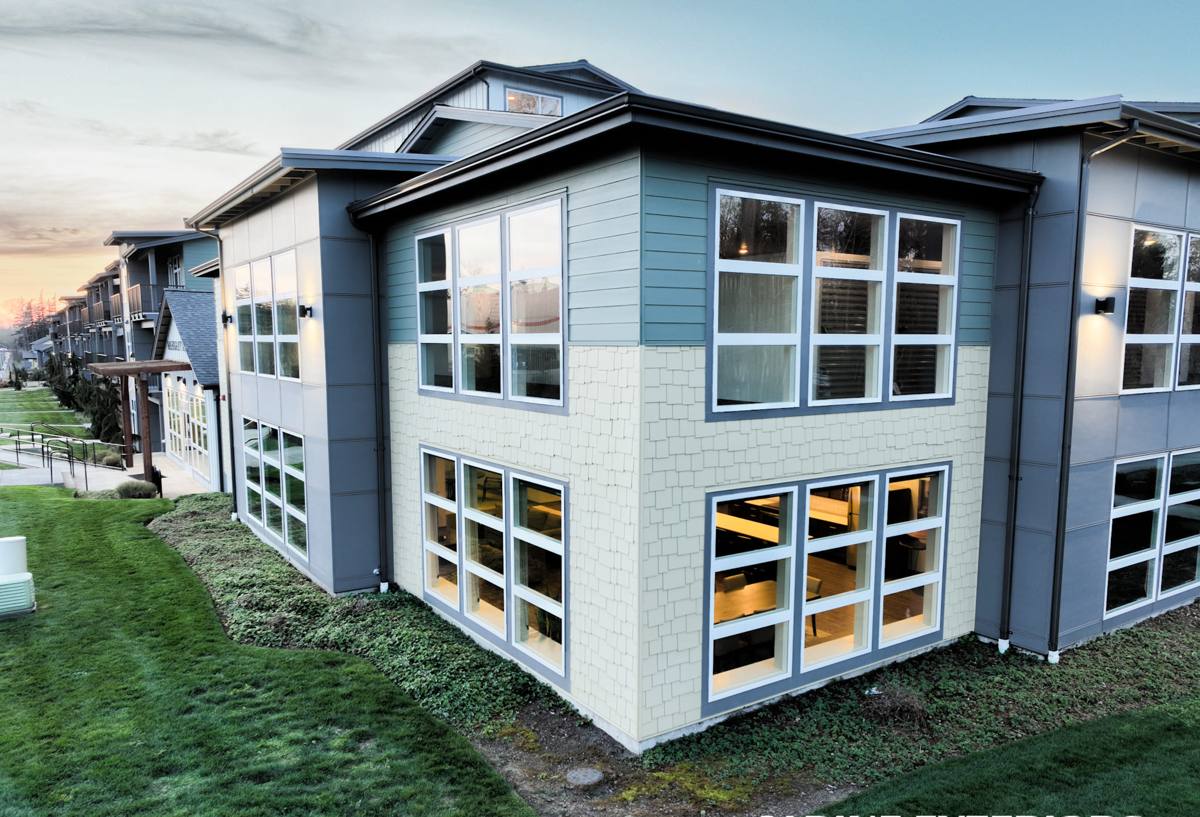
Recognizing When Repair Is the Right Call
Most siding problems we see in Custer show up in a handful of predictable ways. Catching them early is the difference between a targeted repair and a much bigger job.
- Soft or spongy spots when you press on a siding panel or trim board
- Visible cracking, buckling, or separation at seams and corners
- Dark streaking, green or black growth, or a persistently damp look in shaded areas
- Paint that's bubbling or peeling in one localized area rather than across the whole wall
- Gaps opening up around windows, doors, or where siding meets trim
- Rust streaks below fasteners or visible corroded nail heads
- An interior wall or ceiling stain that lines up with an exterior wall
Any one of these on its own is usually a repair, not a tear-off. Several of them together, especially spread across more than one wall, is worth a closer look before deciding.
What's Actually Happening Behind Damaged Siding
Siding failure is almost never just a surface problem. Water gets behind a lap or through a compromised seam, and from there it travels — following the sheathing down, wicking into trim, or sitting against the back of a panel that never gets a chance to dry out between storms. In a climate like ours, with rain returning every few days for months at a stretch, that cycle repeats itself before the wall assembly ever fully dries.
Moss compounds the problem in a way people don't always expect. It's not just an appearance issue — a mat of moss or algae holds moisture directly against the siding surface, keeping that section wetter, longer, than open unshaded wall. Over time that constant dampness accelerates whatever the underlying material is prone to: swelling, delamination, or rot, depending on what's actually installed on the house.
Salt air adds a slower, quieter failure mode. Metal fasteners and flashing corrode faster near the coast, and once a fastener starts to go, the seal it was providing goes with it — which opens a new path for water to get in behind the siding.
Repair or Replace? How We Make That Call
We don't default to "replace everything" just because a homeowner called about a repair, and we don't patch something that's structurally beyond saving just to make a smaller sale. The honest answer usually comes down to how much of the wall is affected and what's causing the damage.
| Factor | Points toward repair | Points toward replacement |
|---|---|---|
| Extent of damage | Isolated to one section or a few boards | Spread across multiple walls or the whole elevation |
| Underlying sheathing | Dry and sound once siding is removed | Soft, rotted, or water-stained |
| Age of existing siding | Recently installed, still within its expected service life | Original siding well past typical lifespan |
| Material match | Compatible replacement material available | Discontinued profile or color, or original material we don't install |
| Root cause | A single flashing or fastener failure | Systemic moisture intrusion from poor original installation |
We open up the damaged area before making a recommendation either way. Guessing from the outside about what's happening behind the siding is how homeowners end up paying twice.
What a Correct Siding Repair Actually Involves
Diagnosing the Real Problem First
Before any board comes off, we trace where water is actually getting in. That might be a failed caulk joint, a piece of trim that was never flashed correctly, or a seam that's simply opened up with age. Removing siding without knowing this just risks repeating the same mistake.
Matching Material and Finish
A repair only looks right if the new section matches the old — same profile, same reveal, same color. This is one of the reasons material choice matters even on a repair: a factory-finished product with a documented color system is far easier to match years later than something field-painted, where the original tint has already weathered and shifted.
Flashing and Water Management
Any repair around a window, door, or wall penetration gets proper flashing and correctly lapped house wrap before new siding goes back on. Skipping this step is the single most common reason a "repaired" spot fails again within a couple of seasons.
Fastening for Coastal Wind and Salt Exposure
We use corrosion-resistant fasteners set to the manufacturer's specification, not just whatever's on the truck. Near the coast, that detail has a real effect on how long a repair actually holds.
Why We Repair — and Replace — With James Hardie Fiber Cement Only
Ferndale Siding Company installs James Hardie fiber cement siding exclusively, and that standard applies to repair work too. We don't install LP SmartSide, vinyl, Cemplank, Allura, or primed wood siding, because we've made a professional judgment that Hardie's fiber cement system holds up better to the specific conditions Whatcom County throws at it — sustained moisture, salt air, and long stretches of shade and moss growth.
Two things matter specifically for repair work. First, Hardie's ColorPlus factory finish is a controlled, documented color system, which makes matching a repaired section to existing siding far more consistent than trying to color-match a field-applied paint job. Second, Hardie's HZ5 product line is engineered for our climate zone, meaning the moisture and freeze-thaw performance of a new patch is built for the same conditions the surrounding siding has already been living in — not a generic product pressed into service here.
If a home currently has a different siding material and it's failing, we'll say so plainly rather than trying to force a Hardie patch onto incompatible existing material. In some cases that means a broader conversation about replacement rather than repair.
Our Siding Repair Process in Custer
- On-site inspection, including removing a section of siding if needed to see what's happening underneath
- Honest assessment of repair versus replacement, with the reasoning explained, not just a recommendation
- A written estimate covering material, labor, and expected timeline
- Removal of damaged siding and any compromised sheathing, trim, or house wrap
- Correction of the underlying cause — flashing, sealant, or fastening — before anything new goes up
- Installation of matched James Hardie material to manufacturer spec
- Final check of the surrounding area to confirm the repair ties in cleanly with existing siding
Why a Crew That Already Works in Custer Matters
Siding repair done wrong is worse than no repair at all, because it traps moisture behind a wall that now looks fine from the outside. A crew that regularly works this part of Whatcom County has already seen how salt air ages fasteners, how far wind-driven rain travels up a wall during a fall storm, and which shaded sides of a house stay damp long enough to grow moss year-round. That familiarity shows up in small decisions — where to flash more carefully, which fastener spec to use, how long to expect a section to take to dry before closing it back up — that a crew unfamiliar with local conditions might not think twice about.
It also means a straightforward relationship if a question comes up after the work is done. We're not driving in from out of the area for a single job; Custer and Ferndale are part of the territory we work regularly.
Keeping Repaired Siding Sound Going Forward
A good repair should be close to the last time that section needs attention, but a little ongoing care goes a long way in this climate.
- Keep gutters clear so water isn't overflowing down the siding face
- Trim back vegetation that's shading a wall and keeping it damp
- Rinse moss and algae growth off gently at least once a year, before it has a chance to hold moisture against the siding
- Check caulking around windows and trim annually, especially after a hard winter
- Have any soft spots or new staining looked at promptly rather than waiting for the next dry season
If you're dealing with damaged, aging, or moss-stained siding on a Custer property, we're happy to take a look and give you a straight answer on what it actually needs. Reach out for a free, no-pressure estimate using the form below.