 Ferndale Siding
 Building a Deck That Holds Up in the Fairhaven Area
A deck in the Fairhaven area of Ferndale lives a harder life than a deck built fifty miles inland. Between the salt-laden air coming off Bellingham Bay and the Strait of Georgia, the driving rain that blows in sideways during winter storms, and a moss season that can stretch from October well into spring, this part of Whatcom County asks more of every board, fastener, and footing than most decking materials were designed for. A deck that would coast through a dry inland summer can start showing corrosion, soft spots, or slick green growth here within a season or two if it wasn't built with this specific climate in mind.
We build and replace decks throughout Ferndale and the surrounding Whatcom County communities, and the Fairhaven-area jobs get the same starting question every time: what is this deck actually going to be fighting, year-round, in this exact spot? The answer shapes everything from the decking material we recommend to how we frame underneath it.
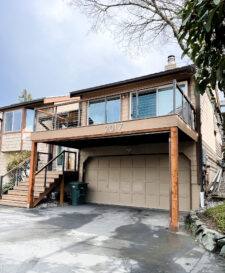
What Salt Air, Rain, and Moss Actually Do to a Deck
Fasteners and Hardware
Salt air accelerates corrosion on anything less than fully rated stainless or coated fasteners. Screws, joist hangers, post bases, and structural bolts that would last decades in a dry climate can start rusting and staining the decking around them within a few years near the water. Once a fastener starts to corrode, it loses holding strength before it ever looks obviously bad, which is part of why deck failures in this area tend to show up as a surprise.
Framing and the Ledger Board
The ledger board — where the deck attaches to the house — and the framing underneath the decking are the parts nobody sees after the build is done, and they're also the parts that take the most punishment. Trapped moisture at the ledger connection is the single most common cause of serious deck failures we get called out for, and driving rain that pushes water sideways under flashing makes this worse here than in calmer climates.
The Decking Surface Itself
Constant damp shade, common on north- and east-facing decks or under mature tree cover, is exactly what moss and algae need to take hold. Beyond looking bad, a mossy deck surface holds moisture against the boards continuously and gets genuinely slippery — a real fall hazard on stairs and near door thresholds during the wetter months.
Choosing a Decking Material for This Climate
There's no single "best" decking material — there's a best material for a given budget, sun exposure, and how much upkeep a homeowner actually wants to do. Here's how the common options stack up specifically against salt air, rain, and moss:
| Material | Moisture & Rain Behavior | Moss/Algae Resistance | Salt Air Durability | Upkeep |
|---|---|---|---|---|
| Pressure-treated wood | Good if sealed and maintained; swells/shrinks with seasons | Low — needs regular cleaning and treatment | Fine with stainless fasteners | Annual cleaning, periodic sealing |
| Cedar | Naturally moisture-resistant; still needs sealing near the coast | Moderate — better than PT wood untreated | Good with proper fasteners | Sealing every 1-2 years |
| Capped composite | Excellent — won't rot or swell | Good on textured/capped boards; still needs periodic washing | Excellent | Occasional washing, no sealing |
| PVC decking | Excellent — fully moisture-proof core | Good, similar to capped composite | Excellent | Occasional washing, no sealing |
Wood decking isn't a wrong choice — plenty of homeowners in the Fairhaven area want the look and are willing to do the upkeep. But we're honest about the trade-off going in: wood in this climate is a maintenance commitment, not a one-time purchase, and skipping a year of sealing shows up fast as graying, cracking, or moss taking hold in shaded sections.
Fastening for the Coast
Whatever material goes on top, the fasteners underneath matter just as much. We use stainless steel or coastal-rated coated fasteners and hardware on every deck we build near the water — it costs more up front than standard hardware, but it's the difference between hardware that lasts the life of the deck and hardware that's staining and weakening the structure within a handful of years.
What's Underneath Matters More Than What's on Top
Ledger Flashing
Correct ledger flashing — installed so water sheds away from the house rather than behind the flashing — is non-negotiable on every deck we attach to a home. This is the single detail most responsible for preventing rot at the point where the deck meets the wall, and it's also the detail that's easiest to get away with skipping, because nobody sees it once the decking goes down.
Joist Protection
Joist tape or an equivalent moisture barrier over the top of every joist keeps rain from soaking directly into end grain and fastener holes, which is where framing rot typically starts. It's a small material cost relative to the whole project and a meaningful difference in how long the frame lasts.
Airflow and Spacing
Board spacing and clearance underneath the deck both need to account for drainage and airflow, not just appearance. A deck built too tight to the ground, or with boards gapped too close together, holds moisture longer after every rain — which is exactly the environment moss and rot both prefer.
Design Choices That Fit a Fairhaven-Area Property
Beyond the structural side, a few design decisions tend to matter more here than they would inland:
- Orientation and shade — north- and east-facing decks and any section under tree cover need extra attention to drainage and material choice, since they stay damp longest
- Railing and guard height — code-compliant railing height and baluster spacing, especially on elevated or multi-level decks common on sloped Whatcom County lots
- Stair footing — non-slip surface treatment or material choice on stairs and landings, where moss buildup turns a minor inconvenience into a real fall risk
- Wind exposure — railing and structural bracing sized for the steadier wind load that comes with proximity to the water
- Multi-level layouts — sloped lots near Fairhaven often call for a deck that steps down in sections rather than one large flat platform, which changes framing and footing requirements
Our Process, Start to Finish
On-Site Assessment
We walk the property, look at sun and shade patterns, existing drainage, and how the deck ties into the house, and talk through what the homeowner actually wants to use the space for.
Design and Material Selection
We lay out the deck footprint, railing style, and material options with honest cost and maintenance trade-offs for each — no upselling toward a product that doesn't fit the budget or the site.
Permitting
Most new decks and many deck replacements in Ferndale and unincorporated Whatcom County require a building permit, particularly for elevated structures or anything attached to the house. We handle the permit process as part of the job.
Framing and Flashing
This is where the climate-specific details go in: proper ledger flashing, joist protection, correct fastener spec, and footings sized for the soil and load on site.
Decking, Railing, and Finish
Decking material goes down with the fastening method appropriate to that product — hidden fasteners for most composite and PVC boards, or correctly spaced screws for wood — followed by railing, stairs, and any trim or skirting.
Final Walkthrough
We walk the finished deck with the homeowner, cover basic care for whatever material was installed, and make sure everything meets what was agreed to at the estimate.
Keeping a Fairhaven-Area Deck in Good Shape
Even a well-built deck needs some seasonal attention in this climate. A simple maintenance routine goes a long way toward avoiding the moss buildup and slow rot that shorten a deck's life here:
- Sweep leaves and debris off the deck surface regularly in fall, especially in shaded corners where they trap moisture
- Wash the surface at least once a year with a deck-safe cleaner to remove early moss and algae before it takes hold
- Check railings, stair connections, and any visible fasteners annually for rust staining or looseness
- Reseal wood or cedar decking on the manufacturer's recommended schedule — don't wait until it visibly grays
- Keep gutters and downspouts near the deck clear so runoff isn't dumping extra water onto or under the deck
- Trim back overhanging branches where practical to reduce shade and debris on north- and east-facing sections
Why Local Experience in This Area Matters
A deck built to a generic national spec sheet and a deck built for the Fairhaven area's actual conditions can look identical on installation day and age completely differently five years later. The difference comes down to fastener choice, flashing detail, material selection for shaded and exposed sections, and framing decisions that account for salt air and sustained rain — none of which show up in a quick walkthrough, only in how the deck holds up over time. Working with a crew that already builds regularly in Ferndale and the surrounding Whatcom County coastline means those decisions are baked in from the start, not added as afterthoughts.
If you're planning a new deck or need to replace one that's showing its age, we'd be glad to take a look and put together a free, no-pressure estimate — no obligation, just an honest read on what your property and budget call for.