 Ferndale Siding
 What Kendall's Climate Does to Exterior Siding
Homes in and around Kendall sit inside Whatcom County's marine-influenced climate — Pacific storms roll through loaded with moisture, salt-tinged air pushes inland off the Strait of Georgia and Bellingham Bay, and the tree cover that makes this part of Washington attractive also keeps siding shaded and damp for long stretches of the year. That combination is hard on exterior materials that weren't engineered for it. Add in a moss season that can run nine or ten months instead of just late fall through spring, and you get conditions that expose every weakness in a siding product or an installation shortcut fairly quickly.
Wood-based sidings absorb that moisture and start to swell, cup, or rot from the inside, often before any problem is visible on the surface. Vinyl doesn't rot, but it expands and contracts with temperature swings, and gaps that open at seams and trim become ready-made channels for wind-driven rain. Whatever goes on a Kendall home needs to survive repeated wet-dry cycling, resist moss and mildew growth on shaded walls, and hold its finish without needing repainting every few years — because repainting siding on a house surrounded by mature trees and damp weather is not a job most homeowners want to repeat often.
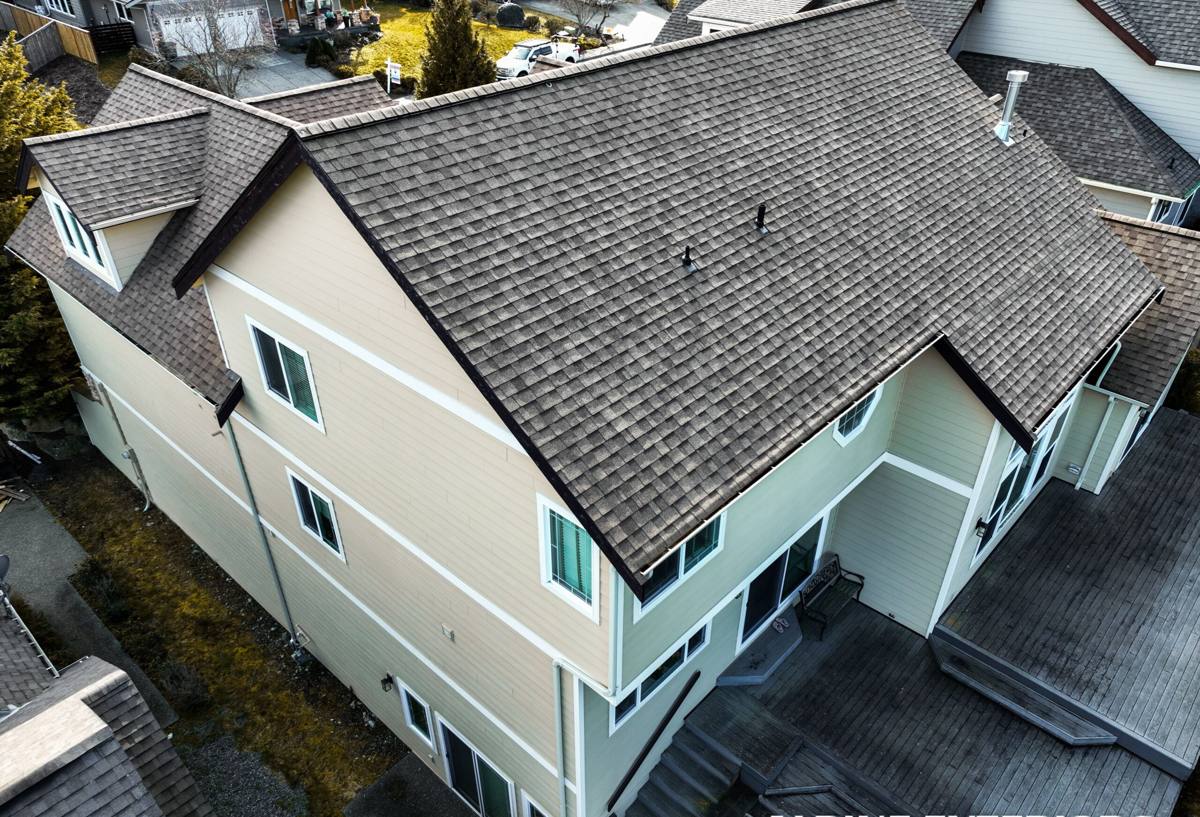
Why We Only Install James Hardie Fiber Cement
Ferndale Siding Company installs one siding system: James Hardie fiber cement. We don't offer vinyl, LP SmartSide, Cemplank, Allura, primed spruce, or cedar, and that's a deliberate standard, not a lack of options. Each of those products has real strengths in the right application. But in a climate like Kendall's — sustained moisture, filtered sun on wooded lots, steady moss pressure — the trade-offs built into wood-based cores, seam-dependent vinyl systems, or field-applied finishes are the kind of long-term problems we'd rather not build into a home we're putting our name on.
A Material That Doesn't Feed Moisture Problems
James Hardie siding is fiber cement — a mix of portland cement, sand, and cellulose fiber pressed and cured into a dense, stable board. It has no wood substrate to swell, delaminate, or rot, and it's non-combustible, which matters given how much wildfire smoke has become a regular part of Pacific Northwest summers. In a climate that stays damp for much of the year, a material that resists moisture at its core — rather than relying entirely on a surface coating to keep water out — is the difference between siding that lasts decades and siding that quietly fails behind a coat of paint.
A Factory Finish Built for This Weather
James Hardie's ColorPlus finish is baked on in a controlled factory environment, not brushed or sprayed on-site. That matters here because field-applied paint has to cure under the right conditions to perform, and curing conditions in Whatcom County — high humidity, frequent rain, limited direct sun on shaded lots — aren't always cooperative. A factory finish goes on before weather is ever a variable, and it carries its own finish warranty, separate from the substrate warranty, backing both the color and the coating itself.
What a Correct Installation Involves in This Climate
James Hardie siding performs the way it's rated to perform only when it's installed to the manufacturer's specification — and in a wet climate, the details that get skipped on a rushed job are exactly the ones that cause problems down the line.
Clearance and Flashing
Hardie's installation instructions set minimum clearances from grade, roofing, decks, and other siding-to-trim transitions specifically so water has somewhere to drain instead of wicking into a board's edge. Every window, door, and wall penetration needs proper flashing integrated with the weather-resistive barrier underneath — not caulk substituting for flashing, which is a common shortcut and one of the first things that fails in a climate that gets this much rain.
Fastening for the HZ5 Zone
Kendall falls within the region James Hardie engineers its HZ5 product line for — the version of its siding formulated for wetter, harsher climates rather than the milder HZ10 zones used in the southern half of the country. Fastener type, spacing, and placement follow Hardie's published requirements for HZ5 installations. Guessing at a nailing pattern, or using the wrong fastener, is one of the more common ways an otherwise good product ends up with buckling, popped nails, or cracked boards within a few years.
Field Cuts and Sealed Edges
Any factory edge that gets cut on-site exposes raw fiber cement that needs to be sealed before installation, and any butt joints need to be caulked with a product rated for the application — not a general-purpose caulk that shrinks and cracks within a season or two of Whatcom County's weather.
Choosing the Right Hardie Product for a Kendall Home
James Hardie makes several siding profiles, and the right one depends on the home's architectural style, its exposure, and how much of each wall sits in shade versus direct sun.
| Product | Look | Best For |
|---|---|---|
| HardiePlank lap siding | Traditional horizontal lap | Most home styles; the most common choice and widest ColorPlus color selection |
| HardieShingle | Staggered or straight-edge shingle profile | Craftsman and cottage-style homes, accent gables |
| HardiePanel | Vertical panel, often with battens | Modern builds, accent walls, board-and-batten looks |
Color choice is a design decision, not a defense against moss — darker, saturated ColorPlus colors don't attract moss any more than lighter colors do, and lighter colors don't hide it any better. The real defense against moss and mildew staining is proper drainage detailing where the site calls for it, gutters that keep water off the wall face, and the periodic light cleaning covered below.
Our Installation Process, Start to Finish
- On-site inspection — we check the existing siding, sheathing, and trim for hidden moisture or rot before quoting anything.
- Detailed, line-item estimate — you see exactly what's included, not a vague allowance figure.
- Tear-off and substrate check — old siding comes off, sheathing gets inspected, and any rot found gets repaired before it's covered up again.
- Weather-resistive barrier and flashing — installed or verified at every window, door, and penetration before the first board goes up.
- Hardie installation to spec — correct clearances, HZ5 fastening, and sealed cut edges throughout.
- Trim, caulking, and touch-up — factory-matched touch-up paint where needed, never a mismatched field color.
- Final walkthrough — we go over the finished work with you before calling the job done.
What It Costs — and What Actually Drives the Price
We don't publish a flat per-square-foot price because Hardie siding costs vary house to house, but a handful of factors consistently move the number more than anything else.
| Cost Factor | Why It Matters |
|---|---|
| Home size and wall complexity | More corners, gables, and trim details mean more labor hours and cut waste |
| Condition of existing sheathing | Rot repair discovered during tear-off adds cost but isn't optional to skip over |
| Siding profile and accessories | Lap, shingle, and panel profiles carry different material and labor pricing |
| Story height and site access | Second-story and steep-lot work takes more time, staging, and equipment |
| Color and trim package | Premium ColorPlus colors and upgraded trim details price differently than standard selections |
The only way to get an accurate number for a specific house is a walk-through of that house — anyone quoting a whole-home price over the phone without seeing it is guessing.
Living With Hardie Siding in Kendall's Climate
Hardie siding is genuinely low-maintenance compared to wood or field-painted materials, but "low-maintenance" isn't "no-maintenance," especially under the kind of tree cover and rainfall this area gets.
- Rinse siding gently once or twice a year to keep moss and pollen from building up, especially on north-facing and shaded walls
- Keep gutters clear so overflow doesn't run down the siding face and streak it
- Trim back vegetation and tree limbs that keep a wall shaded and slow to dry out
- Check caulking at trim, corners, and penetrations annually, and touch up before winter rains set in
- Watch for any section of siding that stays visibly wet longer than the rest of the house — that usually points to a clearance or flashing issue, not a failure of the siding material itself
Why a Crew That Already Works in Kendall Matters
Installation quality is what determines whether Hardie siding actually delivers on its warranty and its expected lifespan, and installation quality depends on a crew that understands the specific conditions of the area they're working in — HZ5 fastening requirements, how much clearance a shaded, moss-prone wall actually needs beyond the manual's bare minimum, and how local weather windows affect sequencing a tear-off so a house isn't left exposed to rain overnight. A crew that regularly works Whatcom County also knows what local building departments look for during inspection and isn't relearning the region on your house.
If your Kendall home's siding is showing its age, or you'd rather plan ahead than deal with it as an emergency, we're glad to walk the house, tell you honestly what we see, and put together a straightforward, no-pressure estimate for a correct James Hardie installation. The form below gets that conversation started.