 Ferndale Siding
 Storm Damage Roof Repair Built for Sandy Point's Exposure
Sandy Point sits out on open water, and that location changes what "storm damage" actually means compared to a roof a few miles inland. A wind event that just knocks a few branches down in sheltered Ferndale neighborhoods can lift shingles, tear flashing loose, or drive rain sideways under roof edges on a Sandy Point property with a clear line to the water. We work storm damage calls in this area regularly, and the pattern is consistent: the homes that come through a winter storm season with the least damage are almost always the ones where the roof was already sound going in, with fastening, flashing, and ventilation done right the first time.
This page is specifically about storm damage roof repair for homes in Sandy Point — what makes storm damage here different from a typical inland repair call, what a correct repair actually involves, how we handle the process from the first call to the finished roof, and why a crew that already works this stretch of coastline matters when the next system rolls through.
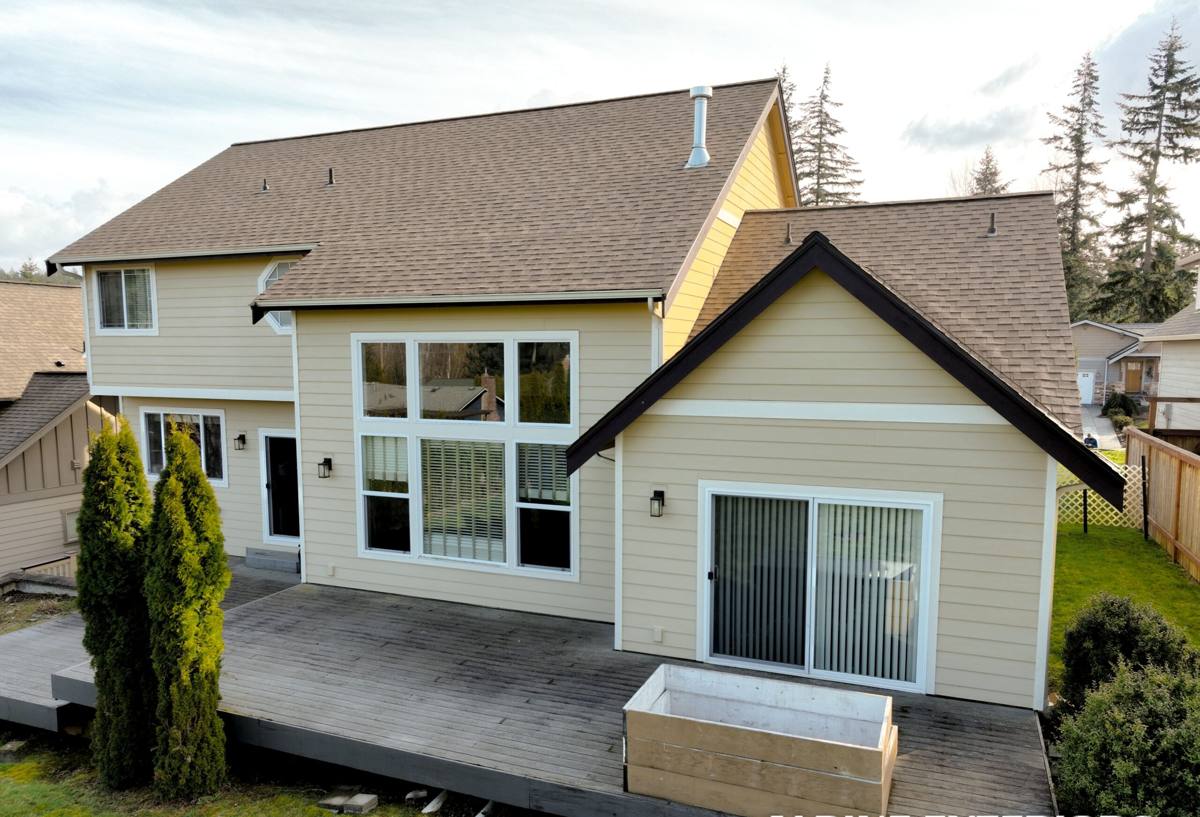
Why Storm Damage Hits Sandy Point Roofs Differently
Salt Air and Metal Fatigue
Salt-laden air moving off open water accelerates corrosion on flashing, fasteners, and any exposed metal on a roof, and that process doesn't announce itself. A flashing detail that's been quietly corroding for a few years has far less holding strength when a storm actually tests it, which is why storm damage on a Sandy Point roof sometimes traces back to a weak point that had nothing to do with the storm itself — the wind just found it.
Driving Rain, Not Straight-Down Rain
Open water exposure means fewer windbreaks, and fewer windbreaks means rain arrives sideways more often than it falls straight down. Driving rain gets pushed up under shingle tabs and into flashing laps that would shed water fine in a calmer rainfall, which is why leaks after a storm often show up somewhere different from where the visible damage is.
A Long Moss Season That Weakens the Roof Over Time
Whatcom County's damp climate keeps moss and algae active on shaded or north-facing roof planes for most of the year, and Sandy Point's marine humidity extends that season further than drier inland lots see. Moss holds moisture against the roof surface, and a roof that's been carrying sustained moss growth is already weaker at the point a storm hits it, since trapped moisture works against shingles and decking from underneath at the same time wind is working against them from above.
Wind Load With Nothing to Slow It Down
A roof on a sheltered inland lot has trees and neighboring structures breaking up wind before it reaches the roofline. A waterfront lot with open exposure doesn't get that benefit, so wind loads on a Sandy Point roof during a winter storm system are routinely higher than what the same roof would see just a few miles inland. That matters directly for fastening pattern, shingle wind rating, and how much flashing is really doing the work of keeping water out.
Common Storm Damage We See on Sandy Point Roofs
Not every storm-damaged roof looks dramatic from the ground, and some of the most costly damage is the kind that's easy to miss without getting up on the roof or into the attic.
- Lifted or missing shingles: Wind gets under a shingle edge and either breaks the seal or tears the shingle off entirely, most often starting at ridges, edges, and corners where uplift is strongest.
- Torn or bent flashing: Valleys, chimneys, skylights, and wall intersections are the most common failure points, especially where flashing was already thin, undersized, or corroded before the storm.
- Damaged ridge and hip caps: These sit at the highest wind-exposure points on the roof and are frequently the first pieces to go in a strong system.
- Punctures and impact damage: Branches and wind-blown debris can crack or puncture shingles even when the surrounding roof looks intact.
- Underlayment exposure: Once shingles are gone, the underlayment beneath is directly exposed to weather and typically isn't built to handle sustained exposure on its own for long.
- Hidden deck moisture: Water that gets past a compromised shingle or flashing detail can track along the roof deck before it ever shows up as a ceiling stain inside the house, which is why a surface-only look after a storm can miss real damage.
What a Correct Storm Damage Repair Involves
A Full Roof and Attic Inspection, Not Just the Obvious Spot
The damage you can see from the ground or the driveway is rarely the whole picture. A proper storm damage inspection covers the entire roof plane, not just the area where a neighbor or an insurance adjuster pointed, and includes a look in the attic for water staining, damp insulation, or daylight coming through where it shouldn't. Skipping this step is how a homeowner ends up back on the phone a few months later for damage that was actually there the whole time.
Matching Materials, Not Just Patching
A storm repair that uses mismatched shingles or the wrong flashing profile might solve the immediate leak but creates a weak point that fails again in the next storm. Matching shingle type, color, and profile as closely as possible, and rebuilding flashing to the same standard as the surrounding roof, keeps a repair from becoming a repeat visit.
Underlayment and Deck Repair Where Water Got In
If water tracked past the shingle layer, the underlayment and roof deck underneath need to be checked and repaired before new shingles go back down. Covering damaged decking with fresh shingles just hides the problem under a new surface instead of fixing it.
Flashing Rebuilt to Spec
Since flashing failure is one of the most common sources of storm damage on exposed lots, a repair that doesn't address the flashing itself, and just patches around it, tends to fail again at the same spot. Valleys, penetrations, and wall transitions get flashing that's properly lapped and integrated with the underlayment, not caulked over as a shortcut.
Documentation for Insurance
Photos of the damage before and after repair, a written scope of work, and a clear description of cause help support an insurance claim if one is being filed. We document what we find and what we do, which gives homeowners something concrete to hand to their adjuster rather than a verbal summary.
Repair vs. Full Roof Replacement
| Situation | Repair Usually Makes Sense | Replacement Usually Makes Sense |
|---|---|---|
| Extent of damage | Isolated to one section or a few areas of the roof | Widespread across multiple roof planes |
| Roof age | Roof is mid-life and otherwise in good condition | Roof was already near the end of its expected service life |
| Underlying condition | Deck and underlayment are sound apart from the storm damage | Inspection finds rot, chronic moisture, or prior repairs stacked on repairs |
| Material match | Matching shingles are readily available | Discontinued or badly weathered shingles make a clean match unrealistic |
| Storm history | First significant damage in several years | Repeated storm damage calls on the same roof over a short span |
We'll tell you honestly which category your roof falls into after we've actually inspected it. A repair that's realistically going to hold is the right call far more often than not, but there are situations where continuing to patch an aging or already-compromised roof just delays a bigger job while letting hidden damage keep spreading underneath.
How Our Storm Damage Process Works
- Same-week inspection call: We get out to look at the roof promptly after a storm, rather than putting Sandy Point homeowners on a long general waitlist.
- Temporary protection if needed: If there's active exposure, we can get a tarp or temporary covering on the affected area to stop water from getting further into the home while repairs are scheduled.
- Full inspection and documentation: We check the whole roof and attic, not just the visibly damaged section, and photograph what we find.
- Written estimate: You get a clear, itemized scope covering shingle, flashing, underlayment, and deck work, so you know exactly what's being repaired and why.
- Repair work: Damaged materials come off, any hidden deck or underlayment issues get addressed, and new materials go on matched to the existing roof and fastened to spec for this area's wind exposure.
- Final walkthrough: We review the finished repair with you and do a site cleanup, including a magnetic sweep for stray fasteners, before considering the job done.
Cost Factors for Storm Damage Repair
| Factor | What It Affects |
|---|---|
| Extent of shingle and flashing damage | How much material needs to be removed and replaced |
| Hidden deck or underlayment damage | Whether repair costs stay limited to the surface or extend into deck-level work |
| Roof pitch and access | Labor time, staging, and safety equipment needed on a waterfront lot |
| Material availability | Whether an exact shingle match is on hand or needs to be sourced |
| Scope of flashing work | How many valleys, penetrations, or wall transitions need to be rebuilt, not just patched |
| Insurance involvement | Documentation and scope alignment needed to support a claim, if one is being filed |
We give a real, itemized number after walking the roof in person, not a phone estimate based on a description of the damage. On a waterfront property, access and exposure can add real cost that isn't obvious from a generic price sheet.
Checklist Before You Call a Roofer After a Storm
- Have you looked in the attic for staining, dampness, or daylight, not just checked the roof from the ground?
- Has any active leak been photographed and, if needed, temporarily covered to limit further water intrusion?
- Does the roofer perform a full-roof inspection, not just a look at the obviously damaged section?
- Does the estimate specify shingle match, flashing scope, and any deck repair separately, not just "storm repair"?
- Do they carry current Washington contractor licensing and liability insurance?
- Can they provide photo documentation you can use for an insurance claim if you're filing one?
Why a Crew That Already Works Sandy Point Matters
A crew that regularly handles storm damage calls on this stretch of waterfront knows how salt air corrodes flashing before it becomes visible, how wind-driven rain finds its way past a repair that looks fine from the ground, and which roof orientations hold moss and moisture longest through the wet months. That experience shows up in practical decisions during a repair — how much flashing actually needs to be rebuilt versus patched, and what fastening pattern actually holds on a lot with this little wind protection.
It also matters for response time. Storm damage that sits exposed for weeks tends to get worse, not stay the same, and a contractor with an established presence in the Ferndale and Whatcom County area is one you can reach quickly after a storm rather than waiting behind a much longer regional queue.
Signs Your Sandy Point Roof Has Storm Damage
- Shingles missing, curled, or visibly lifted after a wind event
- Granules collecting in gutters or downspouts following a storm
- Bent, torn, or missing flashing at valleys, chimneys, or wall intersections
- Water staining on interior ceilings, walls, or in the attic that appeared after a storm
- Daylight visible through the roof deck from inside the attic
- Debris embedded in or resting on the roof surface after high winds
If any of this sounds familiar, it's worth having the roof looked at before the next system moves through rather than waiting for a small leak to become a bigger one.
If your Sandy Point home has storm damage, or you just want an honest inspection to confirm the roof came through a recent storm in good shape, we're glad to take a look. Use the form below to request a free, no-pressure estimate.