 Ferndale Siding
 Semiahmoo's Climate Is Harder on Siding Than Most Homeowners Realize
Semiahmoo sits right where marine weather meets exposed shoreline, and that combination is tough on exterior building materials. Homes here deal with three things at once: salt-laden air coming off the water, driving rain pushed sideways by wind rather than falling straight down, and a long moss season that runs from fall through spring across most of Whatcom County. Any one of those is manageable on its own. Together, they wear down siding that wasn't designed for coastal exposure faster than most homeowners expect.
Salt air is corrosive to exposed metal fasteners and trim, and it accelerates the breakdown of finishes that aren't formulated to resist it. Driving rain doesn't just wet the surface of a wall — it gets pushed up under laps and around penetrations if the siding and flashing details aren't installed correctly. And moss doesn't just grow on roofs. On shaded, north-facing walls and anywhere siding stays damp longer than it should, moss and algae take hold and hold moisture against the material, which is a problem for anything that can absorb water and rot.
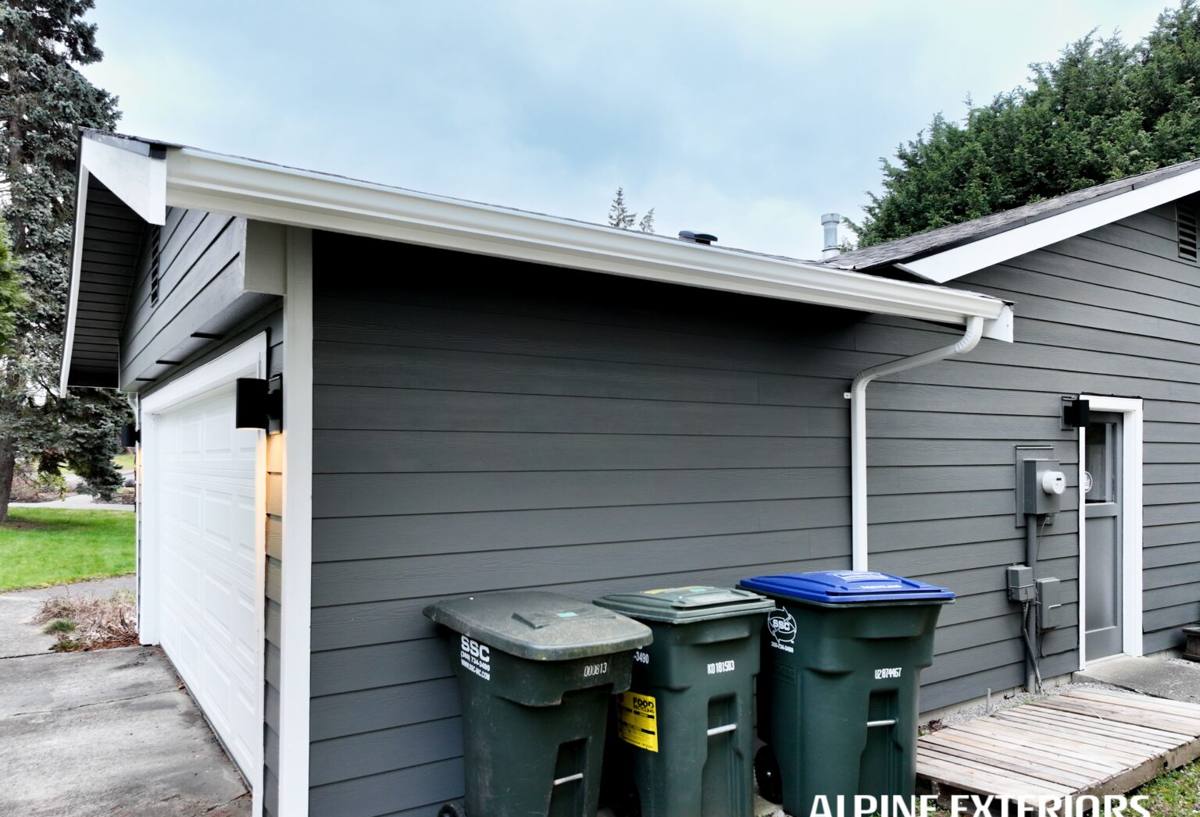
Why Fiber Cement Holds Up Where Other Materials Struggle
Fiber cement is cement, sand, and cellulose fiber — there's no wood core to rot and no vinyl to become brittle and crack under UV exposure and temperature swings. That matters directly for a property like a Semiahmoo home that's getting hit with salt air and wind-driven rain on a regular basis. It won't absorb water and swell the way wood siding does, and it holds paint and factory-applied finish far better over time than raw wood ever will.
That doesn't mean any fiber cement product performs the same way in this environment. Installation quality, the specific product line, and how the job handles moisture management at the wall assembly level all matter more here than they would on a home in a dry, inland climate. This is exactly why we install James Hardie fiber cement exclusively — its HZ5 product line is engineered specifically for climates with heavy moisture exposure, and it comes with a factory-applied ColorPlus finish that's baked on under controlled conditions rather than field-applied, which holds up better against salt air and UV than site-painted finishes.
What We Don't Install, and Why It Matters Here
We don't install vinyl, LP SmartSide, Cemplank, Allura, or raw cedar/spruce siding. Vinyl expands and contracts more than fiber cement and can warp under sustained wind exposure near the water. Wood-based products, even engineered ones, depend heavily on perfect caulking and paint maintenance to keep moisture out — a maintenance burden that's higher in a climate with this much sustained dampness. Other fiber cement brands may be reasonable products, but we've standardized on one system, one warranty structure, and one set of installation specs so we can guarantee the work rather than mixing product lines and accountability.
What a Correct Fiber Cement Install Actually Involves
Fiber cement siding is only as good as the wall assembly underneath it. A huge share of siding failures — on any brand — trace back to installation shortcuts, not the material itself. On a coastal property, the margin for error is smaller.
The Details That Matter Most in a Marine Climate
- Weather-resistive barrier: A continuous, properly lapped water barrier behind the siding, with every penetration (pipes, vents, fixtures) flashed and sealed before a single piece of siding goes up.
- Drainage plane: A gap or drainage mat between the siding and the wall so any water that does get behind the cladding can drain and dry out instead of sitting against the sheathing.
- Correct fastening: Corrosion-resistant fasteners driven at the right spacing and depth — critical in salt air, where the wrong fastener can rust and streak or fail years before the siding itself would.
- Proper clearances: Siding held off the roofline, decks, and grade by the manufacturer's minimum clearances so splash-back and standing moisture don't sit against the bottom edge.
- Sealed joints and butt seams: Caulked and, where called for, flashed rather than just butted together — the detail that most often lets driving rain in over time.
- Factory-finish handling: Cut edges and any field-touched areas properly sealed so the ColorPlus finish's protection isn't compromised at the cut.
None of this is exotic. It's just detail work that takes longer to do right, and it's the difference between siding that looks good for a couple of years and siding that performs for decades in a place like Semiahmoo.
Our Process on a Semiahmoo Project
We run the same disciplined process on every job, but a coastal property gets extra attention at the moisture-management stage specifically because of the exposure.
- On-site assessment: We look at wind and rain exposure on each elevation, existing moisture damage, moss and staining patterns, and the condition of the sheathing underneath the current siding.
- Tear-off and substrate check: Old siding comes off and we inspect the sheathing for rot or soft spots before anything new goes up. Problems found here get addressed, not covered over.
- Water barrier and drainage installation: New weather-resistive barrier and drainage plane installed per manufacturer spec, with special attention to window, door, and penetration flashing.
- Hardie installation to spec: Siding installed following James Hardie's published fastening, clearance, and joint-treatment requirements for our climate zone — not shortcuts, not "close enough."
- Trim, flashing, and caulking: All transitions sealed correctly, with corrosion-resistant materials used throughout given the salt air.
- Final walkthrough: We inspect the completed exterior with the homeowner before calling the job done, and clean up the site fully.
How Fiber Cement Compares for a Property Like This
Homeowners weighing siding options for a coastal Whatcom County property are usually comparing fiber cement against vinyl, cedar, or engineered wood. Here's how they stack up against the specific conditions Semiahmoo homes face.
| Factor | James Hardie Fiber Cement | Vinyl | Cedar / Wood | Engineered Wood (LP-type) |
|---|---|---|---|---|
| Salt air resistance | Strong — non-organic material, factory finish | Moderate — can chalk and become brittle over time | Weak — needs frequent refinishing | Moderate — depends on sealed edges and coatings |
| Moisture / rot risk | Very low when installed to spec | Low, but seams can trap moisture | High if maintenance lapses | Moderate — vulnerable at cut edges and seams |
| Moss and algae resistance | Good — dense, non-porous surface | Fair — can still host growth in shaded areas | Poor — porous surface holds moisture | Fair — similar exposure risk to fiber cement |
| Fire resistance | Non-combustible | Combustible | Combustible | Combustible |
| Typical maintenance | Occasional wash, minimal touch-up | Occasional wash | Regular refinishing/sealing | Regular inspection and sealing |
Living With the Moss Season
Even the best siding needs some upkeep in a climate that stays damp this much of the year. Fiber cement doesn't feed moss and algae growth the way wood does, but anything on an exterior wall can accumulate surface growth in shaded, poorly ventilated spots. The good news is that maintenance on correctly installed Hardie siding is straightforward — periodic gentle washing keeps growth from taking hold, and because the material itself isn't absorbing moisture, there's no race against time the way there is with wood.
The bigger maintenance factor is usually what's around the siding, not the siding itself: gutters that overflow onto walls, vegetation growing too close to the house, and sprinkler heads that spray directly onto lower courses all create the kind of sustained dampness that shortens the life of any exterior finish. We flag these during our assessment because they're often easier and cheaper to fix than people assume, and fixing them protects the siding investment.
Why It Matters That We Already Work in This Area
A crew that's worked coastal Whatcom County properties knows things a general contractor from further inland might not think to check: which elevations take the worst wind-driven rain, how much clearance really matters near a shoreline compared to an inland lot, and where moss tends to establish first on a given orientation. That local pattern recognition shows up in the details — flashing choices, fastener selection, where we spend extra time sealing.
It also matters for something more basic: showing up when we say we will and standing behind the work afterward. A Semiahmoo property isn't a one-off job for us; it's the same climate and the same kind of exposure we plan for on every coastal project we take on out of Ferndale.
What to Expect From a Correctly Done Job
- A written scope that specifies the Hardie product line, not just "fiber cement siding"
- Sheathing inspected and any rot or damage addressed before new siding goes up
- Weather-resistive barrier and drainage plane installed, not skipped to save time
- Manufacturer-spec fastening, clearances, and joint treatment throughout
- Corrosion-resistant fasteners and trim materials given the salt air exposure
- A final walkthrough where you can ask questions before the crew leaves
- Clear information on the manufacturer's transferable warranty coverage
If you're planning a siding project on a Semiahmoo property, we're happy to walk the exterior with you, point out what your specific elevations are dealing with, and give you a straightforward, no-pressure estimate for doing it right. Use the form below to get started.