 Ferndale Siding
 Why Fairhaven Homes Need Siding Built for This Climate
Homes in the Fairhaven area sit close to the water, and that proximity shapes everything about how exterior siding performs here. Salt-laden air off the Salish Sea works differently on a house than dry inland wind does — it carries moisture into every seam, fastener, and joint, and it does it year-round, not just during storms. Add Whatcom County's driving rain, which tends to come in sideways off the water rather than straight down, and you have a climate that punishes any siding product with weak points at the laps, corners, and trim.
Then there's moss. Ferndale and the surrounding coastal communities stay cool and damp for much of the year, and that combination of shade, humidity, and mild temperatures is exactly what moss and algae need to take hold. On the wrong siding material, moss isn't just a cosmetic problem — it holds moisture against the wall system, and over years that trapped moisture is what causes rot, delamination, and paint failure. Siding installation done right in this area has to account for all three of these factors together: salt exposure, wind-driven rain, and a moss season that can run eight or nine months out of the year.
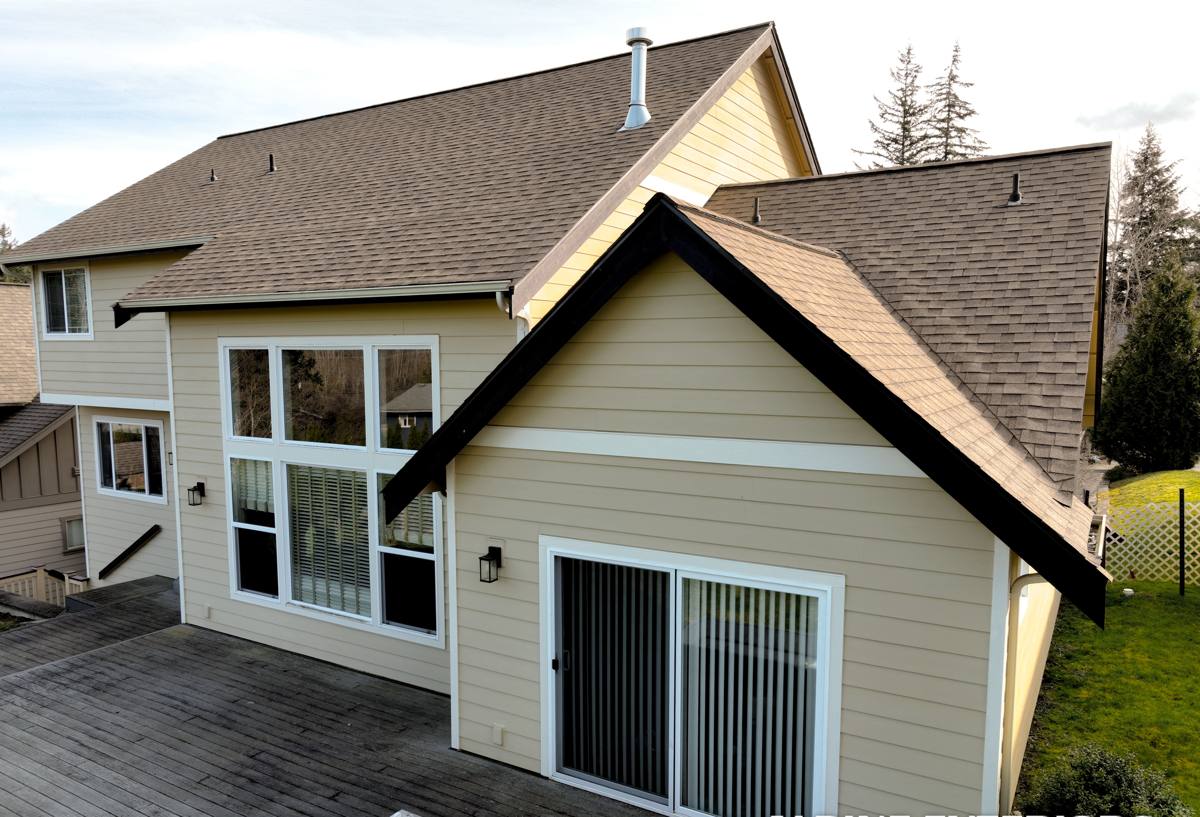
What Correct Siding Installation Actually Involves
Siding is a system, not just a set of boards nailed to a wall. A house can be clad in the best material available and still fail early if the installation misses the details underneath. For Fairhaven homes, we treat the following as non-negotiable parts of every job, not upgrades.
Water-Resistive Barrier and Flashing
Every wall gets a continuous water-resistive barrier before a single piece of siding goes up, with all penetrations — windows, doors, hose bibs, vents — properly flashed so water is directed out and down, never trapped behind the cladding. In a climate with this much wind-driven rain, flashing details at window heads and horizontal trim are usually where a poor installation fails first.
Fastening, Clearances, and Ventilation
Fiber cement siding needs to be fastened per the manufacturer's specified pattern and depth — over- or under-driven nails are a common source of early failure and aren't always visible from the ground. We also hold correct clearances from grade, roof lines, and decks, and make sure there's an air gap behind the siding where the wall assembly calls for one. That gap matters more here than in a dry climate, because it lets any moisture that does get behind the cladding dry out instead of sitting against the sheathing.
Caulking and Joint Treatment
Butt joints, corners, and trim intersections get treated according to manufacturer specification, using sealants rated for exterior use in a wet, temperature-swinging climate. Skipping or rushing this step is one of the most common ways a siding job looks fine at completion and starts failing within a couple of winters.
Why We Install Only James Hardie Fiber Cement
We made the decision to standardize on James Hardie fiber cement siding and stop installing vinyl, LP SmartSide, primed spruce, cedar, and other fiber cement brands. That's not a marketing position — it's a response to what we see happen to siding on coastal Whatcom County homes over ten, twenty, and thirty years.
James Hardie fiber cement is non-combustible, holds paint and factory finish far longer than wood-based or vinyl alternatives, and doesn't warp, crack, or become brittle the way vinyl can when it's exposed to constant marine moisture and UV. Hardie's HZ5 product line is engineered specifically for climates like this one — cold, wet, humid — with a formulation designed to resist moisture-related damage better than the standard HZ10 formulation used in drier regions. The ColorPlus factory finish process bakes color onto the board under controlled conditions before it ever reaches the jobsite, which gives a more consistent, longer-lasting finish than field-applied paint, and it's backed by a real transferable warranty.
None of that means other products are without merit — vinyl is inexpensive and low-maintenance in mild climates, wood has genuine appearance advantages, and other fiber cement brands have their own track records. But when we weigh moisture behavior, fire resistance, long-term appearance retention, and warranty strength against what this climate actually does to a house over decades, Hardie is what we're willing to put our name behind and install on our own customers' homes.
Signs Your Siding Is Already Struggling
Coastal homes often show siding problems earlier than homeowners expect, because the damage starts behind the surface before it's visible from the curb. Watch for these:
- Soft or spongy spots when you press on the siding, especially near the bottom courses and around window trim
- Persistent moss or algae growth that returns within a season of cleaning
- Paint that's peeling, bubbling, or chalking heavily, rather than just fading
- Visible gaps, warping, or buckling at joints and corners
- Musty odors or moisture staining on interior walls that back up to exterior siding
- Nail heads popping or streaking with rust
Any one of these on its own might be minor. Several together usually mean the water-resistive barrier or flashing has already been compromised, and the fix is more than cosmetic.
Our Installation Process
Every Fairhaven-area project follows the same sequence, regardless of house size:
- Assessment and measurement — we inspect the existing wall assembly, check for hidden moisture damage, and take precise measurements before ordering material.
- Tear-off and sheathing check — old siding comes off and the sheathing underneath is inspected and repaired as needed; this is where problems from a prior poor installation usually surface.
- Water-resistive barrier and flashing installation — a continuous barrier goes on with all penetrations flashed before any siding is hung.
- Hardie board installation — panels or lap siding are installed to manufacturer fastening specification, with correct clearances and ventilation gaps maintained throughout.
- Trim, caulking, and touch-up — joints and corners are sealed, factory finish touch-up is applied where needed, and the site is cleaned up.
- Final walkthrough — we go over the completed work with the homeowner before calling the job done.
What Affects the Cost of a Fairhaven Siding Project
Every home is different, but the same handful of factors drive most of the variation in siding project cost in this area:
| Factor | Why It Matters |
|---|---|
| Extent of hidden moisture damage | Rotted sheathing found during tear-off has to be repaired before new siding goes on, which isn't always visible until the old material comes off |
| Siding profile chosen | Lap siding, panel siding, and shingle-style Hardie products differ in material and labor cost |
| Home size and complexity | Cut-up walls with lots of corners, dormers, and trim take more labor per square foot than simple wall planes |
| Access and site conditions | Steep lots, limited driveway access, or tight setbacks near neighboring homes can affect staging and labor time |
| Full replacement vs. partial repair | Replacing only damaged sections can cost less upfront but may not match color or last as long as a full re-side |
Maintaining Hardie Siding in a Marine, Mossy Climate
Fiber cement siding installed correctly needs far less upkeep than wood or vinyl, but "less" isn't "none" in a climate this wet. A yearly rinse to knock down algae and moss buildup, especially on north-facing and shaded walls, keeps growth from getting established. It's worth walking the exterior once a year to check caulking at joints and trim for cracking or separation, since sealant is the one component that wears out faster than the siding itself. Beyond that, ColorPlus finish is designed to hold up without repainting for a long time — the main job is just staying ahead of moss and catching sealant issues before they let water in.
Why Hiring a Crew That Already Works This Area Matters
Siding installation done to a manufacturer's written specification looks the same on paper everywhere in the country. What changes is how much margin for error the local climate allows. A flashing detail that's "good enough" in a dry inland region can be the exact detail that lets water in on a home exposed to salt air and driving rain off the water. A crew that regularly works Fairhaven, Ferndale, and the rest of Whatcom County has already seen where local homes tend to fail — which wall orientations take the worst weather, where moss establishes fastest, and which older installation shortcuts are causing problems on houses in this specific area today. That local pattern recognition is hard to substitute for, no matter how good a crew's general craftsmanship is.
If you're weighing a siding project on a Fairhaven-area home, we're happy to take a look and give you a straightforward, no-pressure estimate — no obligation, just an honest read on what your home actually needs.