 Ferndale Siding
 Why Birch Bay's Waterfront Exposure Is Harder on Siding Than Most of Whatcom County
Homes along Birch Bay sit in a different weather zone than houses a few miles inland. Being this close to open water means three things are working against your siding at the same time, year-round: salt-laden marine air, wind-driven rain, and a moss season that runs longer than most homeowners realize. None of these are dealbreakers for a well-built home, but they do mean the margin for error on a siding installation is smaller here than it is in a more sheltered part of Ferndale or elsewhere in the county.
Salt air carries fine particulate that settles on exterior surfaces and accelerates corrosion on anything metal — fasteners, flashing, trim edges — especially where a finish has been scratched or a fastener wasn't properly seated. Wind coming off the water also doesn't just fall straight down; it drives rain sideways into walls, seams, and trim joints that a calmer inland site would never test. And because so many Birch Bay lots carry tree cover or sit in the shade of neighboring structures for part of the day, moisture lingers on siding surfaces longer before it dries — which is exactly what moss and algae need to take hold.
None of this means siding fails quickly here. It means the installation details that get treated as optional in easier climates — correct flashing, correct fastening, correct drainage behind the cladding — are not optional in Birch Bay. They're the difference between siding that looks the same in year fifteen and siding that's already showing streaking, soft spots, or open seams by year eight.
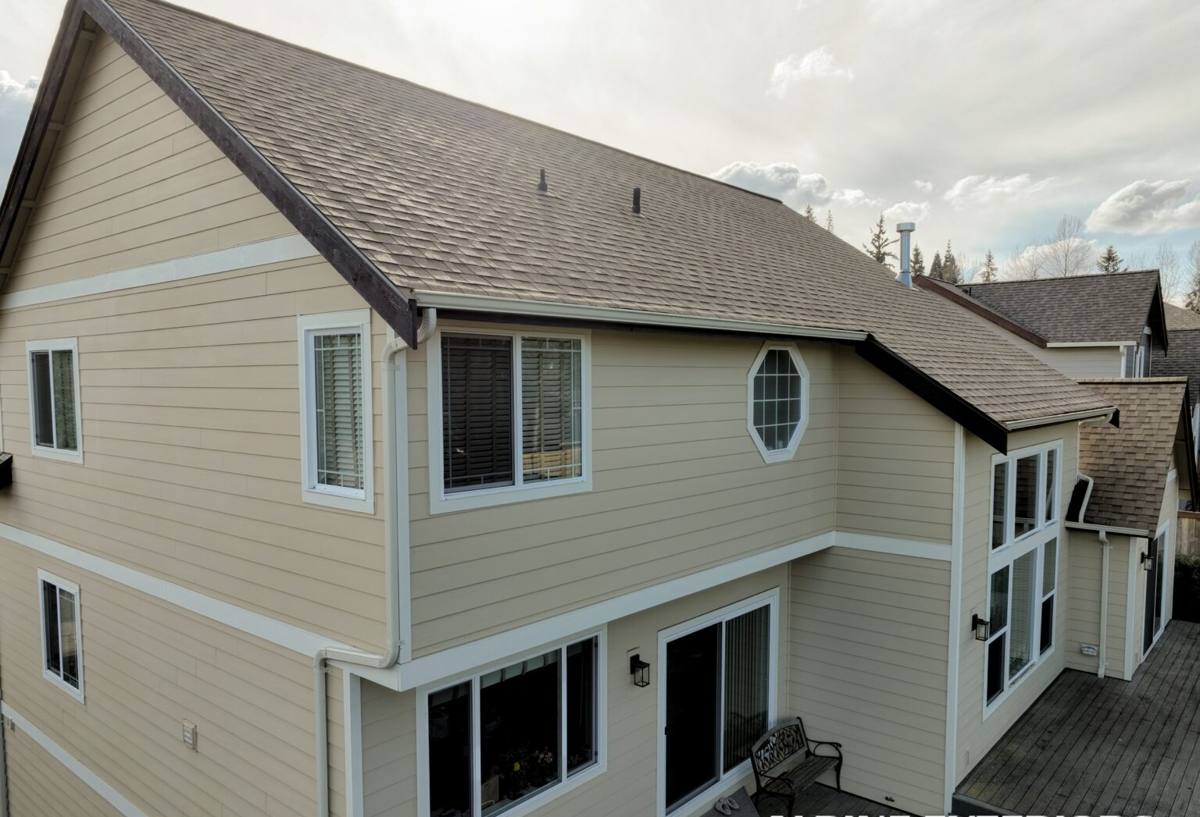
What a Correct Installation Actually Has to Get Right Here
Water Has to Have a Way Out
Every siding system, no matter the material, will let some moisture get behind it eventually — through a nail hole, a hairline seam, or wind-driven rain finding its way past a joint. The question isn't whether water gets behind the cladding; it's whether the wall assembly is built to let that water drain and dry out instead of sitting against the sheathing. That starts with a correctly lapped weather-resistive barrier underneath the siding, installed shingle-style so every course sheds water downward and outward rather than trapping it.
Flashing at Every Penetration, No Exceptions
Windows, doors, deck ledgers, hose bibs, light fixtures — anywhere something penetrates the siding is a place water will try to get in, and it's the single most common point of failure we find on older installations. In a driving-rain environment like Birch Bay's waterfront, skipped or undersized flashing isn't a minor shortcut; it's the reason a wall starts rotting from the inside while the siding on the surface still looks fine.
Fasteners and Fastening Pattern
How siding is nailed matters as much as what it's nailed with. Fasteners driven too deep crush the material and create a path for water to track in; fasteners driven too shallow leave the board loose enough to work and crack over time. In a salt-air environment, the corrosion resistance of the fasteners themselves matters too — the wrong fastener can bleed rust streaks down the face of the siding within a few seasons.
Caulking Where It Belongs, Nowhere Else
A common mistake we see corrected during re-siding jobs is over-caulking — sealing joints that are supposed to be left open to drain. Caulk belongs at specific transitions (trim-to-window, corner boards, penetrations), not smeared across every seam as a catch-all. Sealing the wrong joints traps water behind the siding instead of keeping it out.
Why We Install Only James Hardie Fiber Cement — Especially on Homes Like These
We made a decision as a company to install one siding system: James Hardie fiber cement. We don't install vinyl, LP SmartSide, Cemplank, Allura, primed spruce, or cedar, and on a site like Birch Bay that decision matters more than it might inland.
- It's non-combustible. Fiber cement doesn't contribute fuel to a fire the way wood-based siding products can, which matters for both safety and, increasingly, insurance considerations.
- It doesn't absorb and swell like wood-based siding. Products with a wood or wood-fiber base can take on moisture at cut edges and joints, swell, and lose their shape over repeated wet-dry cycles — exactly the cycle a coastal climate puts a wall through constantly.
- The factory finish is baked on, not brushed on. James Hardie's ColorPlus finish is cured onto the board at the factory under controlled conditions, which gives it better fade and chip resistance than a field-applied paint job — and means far less repainting down the road, in a climate where scheduling exterior paint work around the rain is its own headache.
- It's engineered for the moisture load of a climate like this. James Hardie builds different product formulations for different climate zones specifically because a siding system that performs fine in a dry inland climate can underperform in a consistently wet, marine one. We install the formulation built for wetter, harsher conditions — not a one-size-fits-all product.
- The warranty is a real, transferable one. That matters on a family home you may sell down the road, and it matters because it reflects the manufacturer standing behind the product's long-term moisture and fade performance.
We're not going to tell you every other siding product on the market is junk — that's not honest and it's not our call to make about someone else's product. What we will say is that after years of installing and repairing siding on homes exposed to conditions like Birch Bay's, fiber cement is the material we're willing to put our name behind here, and it's the only one we install.
How the Common Siding Options Actually Compare in This Climate
| Material | Moisture/Rot Resistance | Salt Air Durability | Moss/Algae Resistance | Maintenance Burden |
|---|---|---|---|---|
| James Hardie Fiber Cement | Does not rot or swell from moisture | Factory finish resists salt-driven fading and chalking | Dense surface resists moss anchoring; cleans up well | Low — occasional rinse, no repainting cycle |
| Vinyl Siding | Won't rot, but can warp or buckle with heat/cold cycling | Can chalk and fade faster under sustained UV and salt exposure | Seams and laps can trap grime and moss growth | Low upfront, but panels can't be spot-repainted or easily repaired |
| Cedar/Wood Siding | Absorbs moisture; prone to rot without diligent upkeep | Salt air accelerates weathering of the wood surface | Organic surface is highly hospitable to moss and mildew | High — regular staining, sealing, and repair |
| Primed Wood-Fiber/Engineered Panels | Vulnerable at cut edges and joints if not perfectly sealed | Moisture intrusion risk compounds in marine air | Moderate to high, depending on finish quality | Moderate to high — repainting and edge-sealing over time |
Every material on this list has a place somewhere. Our position is simply that for the moisture load, salt exposure, and moss pressure a Birch Bay home deals with, fiber cement gives homeowners the best long-term balance of durability and low maintenance — which is why it's the only thing we put on a wall.
Our Installation Process for Birch Bay Homes
The steps don't change dramatically from house to house, but the attention paid to moisture management at each step is what separates a job that holds up here from one that doesn't.
- Inspection first. Before we quote or plan an installation, we look at the existing wall assembly — siding condition, visible moisture staining, soft spots, and how the home is oriented relative to prevailing wind and rain.
- Tear-off and sheathing check. Once old siding comes off, we inspect the sheathing underneath. Any rot or moisture damage gets addressed before a single new board goes up — covering a compromised wall with new siding just hides the problem.
- Weather-resistive barrier, installed correctly. Properly lapped and sealed so water is directed down and out, not trapped against the sheathing.
- Flashing at every window, door, and penetration. This is where most long-term failures start on other jobs, and it's where we spend the most careful attention.
- Hardie installation to manufacturer specification. Correct fastener type, spacing, and depth; correct clearances at grade, trim, and roof lines; correct gapping where the product calls for it.
- Caulking and finish work. Sealing the joints that should be sealed, leaving drainage paths where the system is designed to breathe.
- Final walkthrough. We go over the finished job with the homeowner before calling it done.
What a homeowner should expect to see — and can reasonably ask a contractor about — on any siding job in this area:
- Sheathing inspected and any rot repaired before new siding goes on, not covered up
- Flashing installed at every window, door, and wall penetration
- Weather-resistive barrier lapped correctly, top over bottom, at every seam
- Manufacturer-specified fastener type, spacing, and clearance followed, not "close enough"
- Caulking used only where the system calls for it, not as a blanket fix
- Clearance maintained between siding and grade, decks, and roof lines to prevent wicking
Signs Your Current Siding Is Already Losing the Fight
If your Birch Bay home still has its original siding, or siding that's more than a couple decades old, a few warning signs are worth walking around the house to check for:
- Moss or algae staining that comes back within a season or two of being cleaned
- Soft or spongy areas, especially low on the wall, under windows, or near ground contact
- Paint that's peeling, bubbling, or chalking heavily on wood-based or engineered siding
- Boards that have started to cup, warp, or pull away from the wall at the edges
- Gaps opening up at seams, corner trim, or around window and door casings
Any one of these on its own isn't necessarily an emergency. Several of them together, especially on walls that take the brunt of the wind and rain, usually means moisture has been getting behind the siding for a while — and that's worth having looked at before it becomes a sheathing or framing problem.
Why Hiring a Crew That Already Works Birch Bay Matters
Siding installation isn't identical from house to house, and a crew that mostly works sheltered, inland sites doesn't necessarily bring the same instincts to a waterfront job. Knowing which walls on a Birch Bay home take the worst of the wind-driven rain, how much additional attention flashing and drainage details need this close to the water, and how the local moss and moisture cycle behaves through a Whatcom County winter isn't something you get from a spec sheet — it's something you get from doing the work here repeatedly.
There's also a practical, boring-but-important side to local experience: familiarity with Whatcom County permitting and inspection expectations, and simply knowing how to sequence a job around this region's weather windows so the wall isn't left exposed to open rain longer than it has to be. A crew that treats a Birch Bay home the same as a job forty miles inland is more likely to miss the details that actually matter here.
Keeping New Siding Performing Long-Term in This Climate
Correctly installed fiber cement siding is low-maintenance, not zero-maintenance. A few habits go a long way in a climate like Birch Bay's:
- Rinse siding down periodically, especially on shaded or north-facing walls, to keep moss and algae from getting a foothold
- Do a visual check of caulked joints once a year and have any cracked or separated caulk redone
- Keep gutters and downspouts clear so water isn't sheeting down the wall face
- Address any impact damage — a ladder bump, a branch strike — promptly rather than letting a small crack become an entry point for moisture
None of this is heavy upkeep. It's the same kind of periodic attention you'd give any part of a home exposed to salt air and coastal rain, and it's a lot less than what wood or engineered wood-fiber siding demands over the same years.
Get a Straight Answer on What Your Birch Bay Home Needs
If you're weighing a siding replacement on a Birch Bay home, or you're just not sure whether what you're seeing — moss coming back, a soft spot near a window, paint that won't hold — is a small fix or a sign of something bigger, we're happy to come take a look. We'll give you a straightforward, no-pressure estimate and an honest read on what your siding actually needs, with no obligation to move forward. Use the form below to get in touch.