 Ferndale Siding
 Why Birch Bay Siding Wears Differently Than Inland Homes
Birch Bay sits right on the water, and that changes the math on siding maintenance. Homes a few miles inland in Ferndale deal with Whatcom County's rain and humidity, but Birch Bay properties add salt-laden air on top of it. Salt air accelerates corrosion on fasteners, trim flashing, and any exposed metal, and it works into seams and butt joints faster than plain moisture does. Combine that with driving rain off the water — wind-driven rain doesn't just wet the surface, it pushes water sideways into laps, corners, and penetrations that were never designed to shed water horizontally.
Then there's moss. Whatcom County's long wet season, shaded lots, and mild temperatures make for a moss season that runs longer here than in drier parts of the state. Moss on siding isn't just cosmetic — it holds moisture against the surface for weeks at a time, which is exactly the condition that causes rot, paint failure, and substrate breakdown, especially on older wood-based products. A repair job in Birch Bay has to account for all three of these stressors at once, not just patch the visible damage and move on.
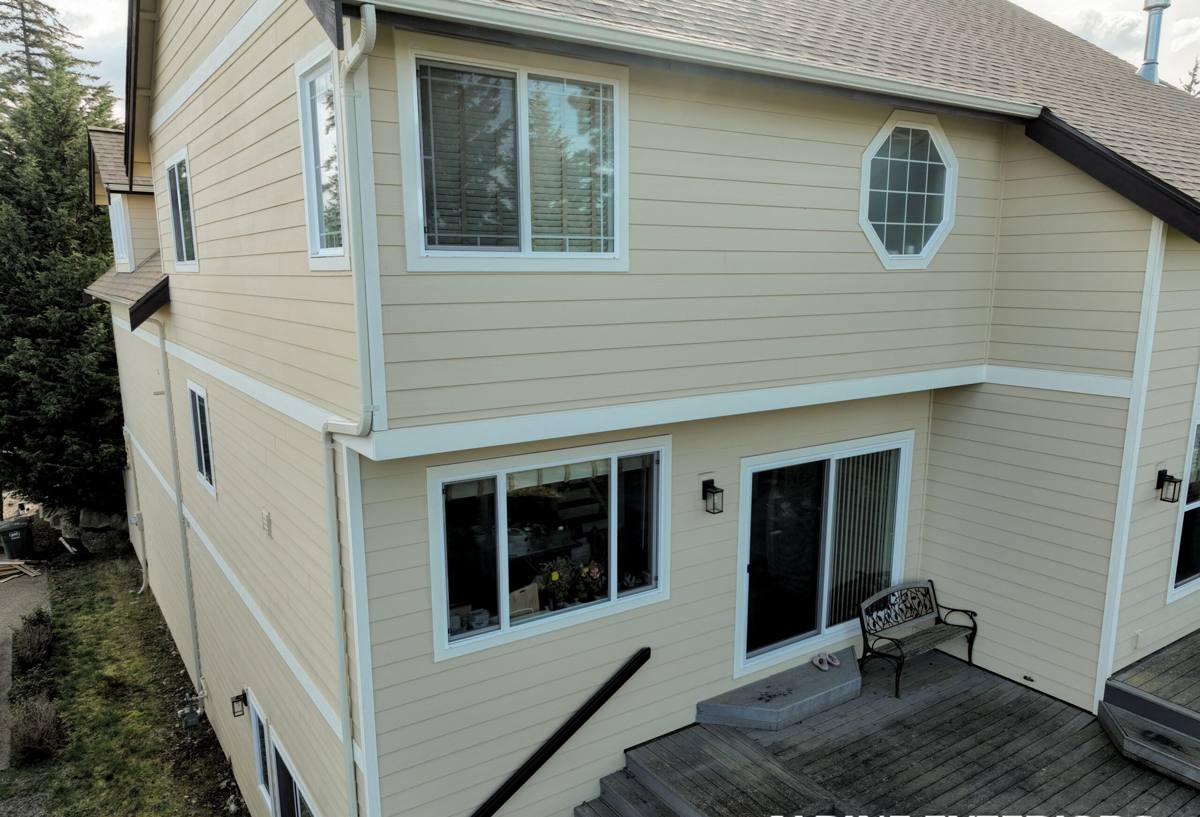
Signs Your Siding Needs Repair, Not Just a Cleaning
Homeowners often call us for a wash or a paint touch-up and find out the underlying siding is already compromised. Here's what tells us a section needs actual repair work:
- Soft or spongy spots when you press on the siding, especially near the bottom courses or under windows
- Paint that's bubbling, peeling, or won't hold no matter how many times it's redone
- Visible gaps at seams, corners, or trim where caulking has failed or shrunk away
- Persistent moss or dark staining that keeps coming back within a season of cleaning
- Warping, cupping, or delamination on individual boards or panels
- Rust streaks below nail heads or metal trim pieces
- Musty smell or visible staining on interior walls that back up to exterior siding
If you're seeing more than one of these, especially on the sides of the house that face the water or prevailing wind, it's worth having someone look at what's happening behind the siding, not just at the surface.
What a Correct Repair Actually Involves
It's Not Just Swapping a Board
A patch job that only replaces the visibly damaged piece often fails again within a year or two, because it doesn't address why that section failed in the first place. A correct repair starts by pulling back enough surrounding material to see the condition of the water-resistive barrier, the flashing at that location, and the sheathing underneath. If moisture has been getting behind the siding, the siding itself is usually a symptom, not the root cause.
Matching Material and Movement
New siding material has to match the existing product's thickness, exposure, and expansion behavior, or you end up with visible lines, uneven weathering, or joints that open up over time. This matters even more in a marine environment, where thermal cycling and moisture cycling are both more pronounced than inland.
Flashing and Sealant Details
Most siding failures we find in Birch Bay trace back to a flashing detail, not the siding material itself — a missing kick-out flashing over a window, a butt joint that was caulked instead of properly lapped, or house wrap that wasn't integrated with window flanges correctly. Repairing the siding without correcting the underlying detail just resets the clock on the same failure.
Repair Materials We Work With, and Their Trade-offs
Birch Bay homes have a mix of siding types on them, often depending on when the house was built or last re-sided. Here's how the common ones hold up to repair in this specific climate:
| Material | Repairability in a marine climate | Common failure point |
|---|---|---|
| Cedar / wood lap | Repairable, but new boards weather differently than aged ones and need diligent repainting | Moisture absorption, rot at butt joints and bottom courses |
| Vinyl | Individual panels can be swapped if a matching profile and color still exist, but older colors fade unevenly | Cracking in cold snaps, warping near reflective heat sources, color mismatch on repairs |
| LP SmartSide (engineered wood) | Repairable if caught early, but edges are especially sensitive to sustained moisture | Swelling and delamination at cut edges and unsealed penetrations |
| Fiber cement (James Hardie) | Repairable and dimensionally stable; factory-finished color makes patch sections easier to match | Failures are almost always installation-related, not material-related |
We'll repair what's already on your home when a repair is the right call, regardless of brand. But when a section is too far gone to patch and needs to be replaced outright, we replace it with James Hardie fiber cement — more on why below.
Repair or Replace: How We Make That Call
Not every damaged section needs full replacement, and we're not going to tell you it does just to sell a bigger job. The honest factors we weigh are the extent of moisture intrusion, how much of the wall is affected versus a localized spot, the age and condition of the surrounding siding, and whether the underlying sheathing is sound. A single rotted board near a downspout is usually a straightforward repair. Widespread cupping and soft spots across an entire elevation, especially the water-facing side of the house, usually means the whole elevation needs to come off so we're not chasing the same problem section by section over the next few years.
Why We Only Replace With James Hardie Fiber Cement
When a repair calls for new material rather than a patch of the existing product, we install James Hardie fiber cement — that's the only siding system we install, full stop. We made that call because fiber cement is non-combustible, dimensionally stable in wet-dry cycling, and holds a factory-applied ColorPlus finish that doesn't rely on field painting to perform. In a place like Birch Bay, where salt air and driving rain are working against the siding every day of the year, those properties matter more than they would on a sheltered inland lot.
We don't install vinyl, LP SmartSide, primed wood, or cedar as new material, even though all of those products have legitimate uses and loyal customers elsewhere. Vinyl can crack and fade in temperature swings and doesn't hold paint if you ever want to change the color. Engineered wood products are sensitive to cut-edge and seam moisture exposure, which is exactly the failure mode a marine climate encourages. Cedar looks great but demands a maintenance schedule most homeowners don't keep up with, and once it falls behind, moss and rot move in fast in this climate. James Hardie's HZ5 product line is specifically engineered for the kind of freeze-thaw and moisture exposure the Pacific Northwest coast sees, which is why it's what goes back on the house when a full section needs replacing.
Our Repair Process for Birch Bay Homes
- On-site inspection — we look at the damaged area and the surrounding siding, flashing, and trim, not just the spot you called about
- Diagnosis — we identify whether the cause is a flashing failure, a caulking failure, material fatigue, or moss-related moisture retention
- Scope and estimate — a clear breakdown of what needs to be repaired versus what's still sound, with an honest recommendation on repair versus replacement
- Repair work — removal of compromised material, correction of the underlying flashing or moisture issue, and installation of matching or Hardie replacement material
- Finish and seal — proper caulking at transitions, touch-up finish work, and a final check of surrounding areas for anything that might fail next
Why Hiring a Crew That Already Works Birch Bay Matters
Siding repair in a marine environment isn't the same trade as siding repair on a dry inland lot, even though it looks identical from the street. A crew that regularly works Birch Bay knows which elevations take the worst of the wind-driven rain, how much faster moss builds up on shaded, water-facing walls here compared to homes a few miles inland, and where salt air tends to eat away at fasteners and flashing first. That local pattern recognition is the difference between a repair that gets it right the first time and one that has you calling again in two winters.
Keeping Your Siding in Good Shape After the Repair
A good repair buys you time, but a few habits stretch that out further in this climate. Rinse salt residue off siding periodically, especially after windy weather off the water. Keep an eye on moss growth each fall and address it early, before it has a full winter to hold moisture against the wall. Trim back vegetation that's shading and dampening any section of the house, and check caulking at trim and penetrations once a year, since that's usually the first thing to give out under repeated wet-dry cycling.
If you're seeing soft spots, peeling paint, or recurring moss on your Birch Bay home's siding, we're happy to take a look and give you a straight answer on what it needs — no pressure, no upsell. Reach out for a free estimate using the form below.