 Ferndale Siding
 Board & Batten Siding, Built for Cordata's Weather
Homes in and around Cordata sit in a stretch of Whatcom County that takes a steady beating from the weather nine months out of the year. You're close enough to the water to pick up salt-laden air, far enough into the Pacific Northwest storm track to get long stretches of driving, wind-blown rain, and shaded enough by mature conifers and cloud cover to grow moss on anything that stays damp for more than a day or two. Board and batten siding is one of the most requested looks in this area right now — the vertical lines read as clean and modern on newer builds, and as classic farmhouse or craftsman on older ones. But the look only holds up if the material underneath it is chosen and installed for this specific climate, not for a catalog photo taken somewhere dry.
This page is about that one job, done right, in this one area: what board and batten siding needs to survive a Ferndale-area winter, what a correct installation actually involves, and why we install it exclusively in James Hardie fiber cement rather than the wood, engineered wood, or vinyl alternatives that get pitched for this style.
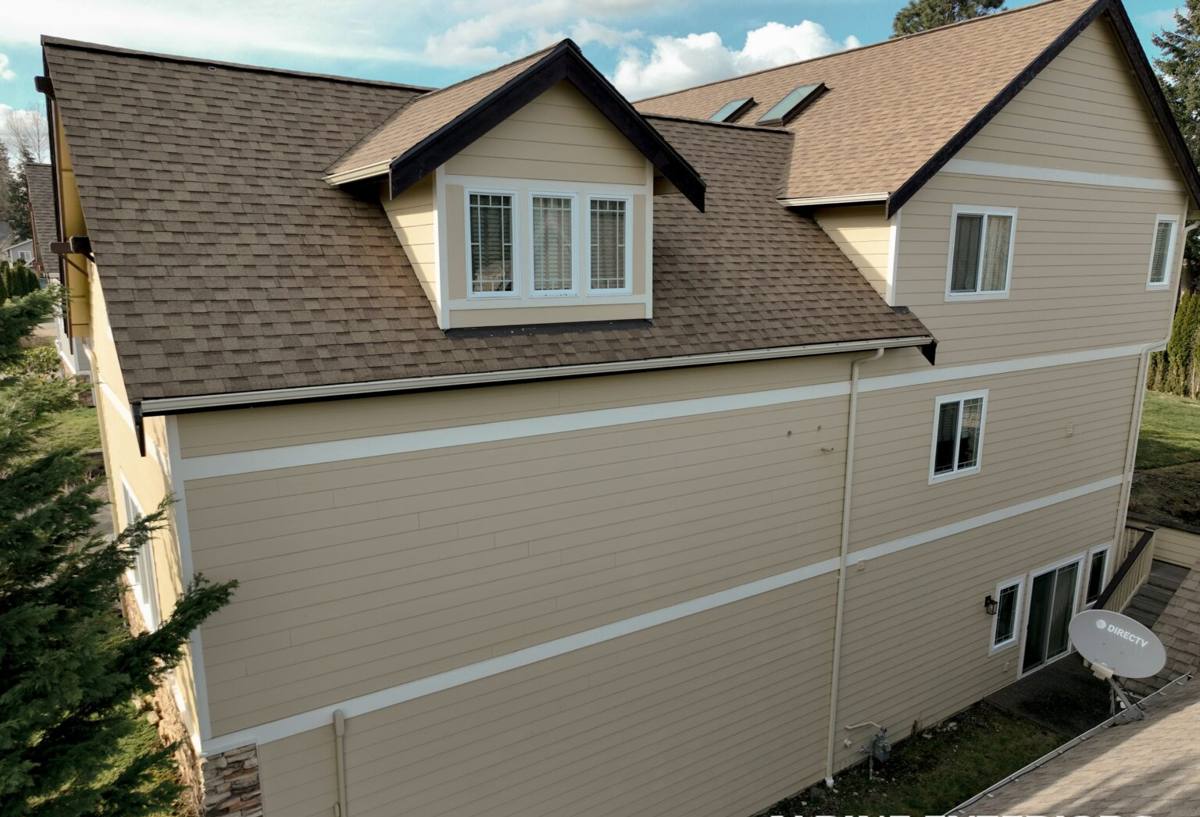
Why Board & Batten Is a Harder Style to Get Right Here
Board and batten isn't just a pattern — it's a different water-management problem than lap siding. Instead of overlapping horizontal boards that shed water down and away by design, you have vertical panels with battens covering the seams. Every seam is a potential path for water to find its way behind the cladding, and every batten is a place where moisture can sit against the substrate if the materials and gaps aren't right.
In a climate with Cordata's rain volume and duration, that matters more than it would somewhere dry. A few specific local conditions push the difficulty up:
- Salt air corrosion: Proximity to Puget Sound and the Strait of Georgia means airborne salt reaches fasteners, flashing, and trim faster than it would inland — cheap or exposed fastener heads corrode and stain the face of the siding.
- Driving rain: Wind-driven storms push water sideways into vertical seams and batten edges, not just straight down, which is exactly where a board and batten system is most vulnerable if it isn't detailed correctly.
- Long moss season: Shaded north walls and tree-lined lots stay damp for extended stretches. Any siding material that absorbs moisture or lacks a factory-sealed finish becomes a host surface for moss and algae, especially at the base of battens and window returns.
- Temperature swings: Cool nights and warmer days cause repeated expansion and contraction. Materials that move a lot with moisture and temperature — like some engineered wood products — put ongoing stress on caulked seams and fastener holes.
None of this makes board and batten a bad choice for this area. It makes material selection and installation detail the whole game.
What a Correct Board & Batten Installation Involves
Water Management Behind the Panel
The single most important part of the job isn't visible once it's done. A correct install starts with a drainable weather-resistant barrier, properly lapped and taped, with a rainscreen gap or furring strategy where the wall assembly calls for it. That gap lets any incidental moisture that does get past the siding face drain and dry instead of sitting against the sheathing. Skipping this step is the most common shortcut we see on board and batten jobs done wrong, because it's the one step nobody can check after the siding is up.
Panel and Batten Layout
Panel joints need to land on framing, be properly flashed, and be spaced to allow for material movement — not just butted tight for a clean look on install day. Battens need consistent reveal and fastening that doesn't rely on caulk alone to stay watertight over time. We plan the layout around window and door openings so trim details are consistent and water is directed away from every penetration, not toward it.
Fasteners and Flashing
Given the salt air in this part of Whatcom County, fastener choice isn't optional detail — it's a durability decision. Corrosion-resistant fasteners and properly integrated flashing at every window, door, and roof-wall intersection are what keep rust streaks and hidden leaks from showing up in year three or four instead of never.
Finish and Caulk Strategy
A factory-applied finish that's already cured and baked on before the material reaches the wall performs differently than a field-painted or field-primed surface, especially at cut ends and battens, which is one of the biggest reasons we standardized on a factory-finished product for this style.
Why We Only Install James Hardie for This Application
Board and batten siding can be built out of several materials — cedar, engineered wood, vinyl panel systems, or fiber cement. We install James Hardie fiber cement exclusively, and for this specific style in this specific climate, the reasoning is pretty direct.
| Factor | What It Means in a Cordata-Area Climate |
|---|---|
| Moisture absorption | Fiber cement doesn't swell, cup, or rot the way wood-based products can when battens and panel edges stay damp through a long wet season. |
| Factory finish | ColorPlus finish is baked on and warranted against fading and flaking, which matters on battens and panel faces that take direct wind-driven rain. |
| Moss and algae resistance | A dense, factory-sealed fiber cement surface gives moss and algae less to grip and hold onto than a porous or field-finished surface. |
| Dimensional stability | Less expansion and contraction than wood-based panels means seams and caulk lines hold up longer under repeated wet-dry cycling. |
| Fire resistance | Non-combustible material, which is a genuine advantage on a home surrounded by conifers and seasonal dry brush. |
| Warranty | A strong transferable manufacturer warranty backs both the substrate and the factory finish, not just the labor. |
We're not going to tell you cedar looks bad — it doesn't, and plenty of homeowners love it. But cedar board and batten in this climate means an ongoing maintenance relationship: staining or sealing on a recurring schedule, watching for moisture intrusion at battens, and accepting that some movement and weathering is part of the deal. Engineered wood products can look nearly identical to fiber cement on day one, but their long-term performance depends heavily on keeping edges sealed and moisture away from the substrate — a harder standard to hold in a climate this wet, this consistently. Vinyl board and batten systems are lower cost up front but can't match the factory finish durability or the rigid, dimensionally stable panel that a correctly detailed vertical siding job benefits from. We made the call to install one material system so we could get genuinely good at installing it correctly, rather than being average at five.
Our Process for a Cordata Board & Batten Job
- On-site assessment: We look at wall orientation, tree cover, existing moisture damage, and how water currently moves around your home before we ever talk material.
- Water management plan: We map out the weather-resistant barrier, flashing details, and drainage approach specific to your walls — this is decided before a single panel goes up.
- Layout planning: Panel and batten spacing is planned around your actual window, door, and corner locations so the finished look is consistent and every seam is backed by a plan, not improvised on site.
- Installation: Panels, battens, flashing, and fasteners go in to manufacturer specification — the same spec that keeps the warranty valid.
- Final walkthrough: We go over the finished work with you, including care basics specific to a factory-finished fiber cement exterior.
Why a Crew That Already Works Cordata Matters
Board and batten done wrong doesn't usually fail in month one — it fails in year three or four, after enough wet seasons have found every shortcut. A crew that already works this specific area has already seen how water moves on lots with this kind of tree cover, how far salt air travels inland from the Sound, and where moss tends to establish first on a north- or west-facing wall. That's the kind of judgment that doesn't come from a spec sheet — it comes from having installed and then later inspected siding through several Whatcom County winters.
It also means faster, more accurate estimates. We're not guessing at your climate zone or looking up regional rainfall data — we already know what this stretch of Ferndale and the surrounding Cordata area does to an exterior over time, and we build the installation plan around it from the first visit.
Maintenance Realities for This Style, In This Area
Even with the right material, board and batten siding in a wet, shaded climate benefits from a small amount of routine attention:
- Rinse siding periodically to keep organic buildup from establishing, especially on shaded walls.
- Keep gutters clear so overflow doesn't run directly down panel faces and battens.
- Trim back vegetation that keeps a wall shaded and damp longer than the rest of the house.
- Inspect caulking at trim and penetrations every year or two, even with a factory-finished product — sealant is a maintenance item on any siding system.
- Address any impact damage promptly rather than letting a cracked panel sit through a wet season.
None of that is unique to board and batten or to fiber cement — it's just lower-effort and less frequent than the maintenance schedule wood-based board and batten typically asks for.
What This Costs to Do Right
Board and batten pricing depends on wall square footage, the amount of trim and corner detail, tear-off versus new construction, and the condition of the substrate underneath your existing siding. We won't quote a number without seeing the home, but we're happy to walk you through the real cost drivers — including where the water management work adds cost up front and saves money over the life of the siding — during a site visit.
If you're weighing board and batten for a home in the Cordata area and want a straight answer on what your walls actually need, we're glad to take a look. Reach out for a free, no-pressure estimate — we'll walk the exterior with you and tell you exactly what a correct installation looks like for your home.