 Ferndale Siding
 Why Sandy Point's Climate Is Hard on Siding
Sandy Point sits right up against the water, and that location is exactly what makes siding decisions there different from a job three miles inland in Ferndale proper. Homes here take a steady diet of salt-laden air off the Strait of Georgia, wind-driven rain that hits walls sideways instead of running straight down, and a long, damp shoulder season where moss and algae get a real foothold on anything that stays wet. None of that is unusual for Whatcom County's coastline, but it adds up faster on a waterfront lot than most homeowners expect when they're pricing a siding job.
Salt air is corrosive to exposed metal fasteners and trim, and it accelerates the breakdown of paint films and cheaper composite products. Driving rain finds every gap in flashing and caulk that a calmer inland wall would never expose. And moss doesn't just look bad — it holds moisture against the siding surface for weeks at a time, which is a problem for any material that isn't dimensionally stable when wet. Siding chosen and installed without those three factors in mind tends to show its age early on a Sandy Point home, even if it would have held up fine a few miles away.
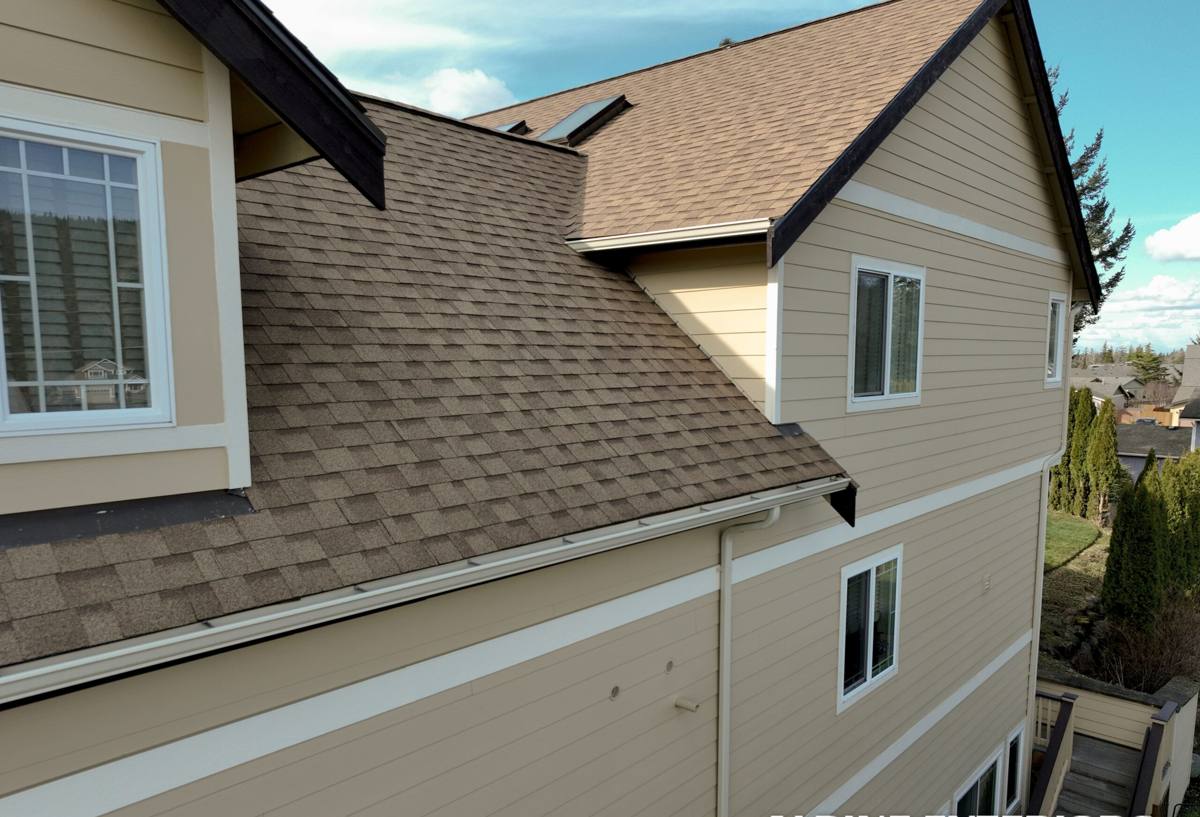
What a Correct Installation Requires Here
Fiber cement is a strong material choice for this exposure, but the material alone doesn't do the work — the installation details do. On a Sandy Point home, we pay particular attention to a handful of things that matter more here than they would on a sheltered inland lot:
Drainage plane and rainscreen gap
Water is going to reach the wall assembly in this environment; the question is whether it can get back out. A proper weather-resistive barrier behind the siding, lapped correctly from the bottom up, combined with a rainscreen gap where the wall assembly calls for it, gives any moisture that gets past the siding a path to drain and dry instead of sitting against the sheathing.
Fastener choice and placement
Salt air is hard on fasteners. We use corrosion-resistant fasteners driven to the manufacturer's spec — not just anywhere that's convenient — because a fastener that starts to corrode can telegraph rust staining through the siding and compromise the hold over time.
Flashing at every penetration
Windows, doors, hose bibs, light fixtures, deck ledgers — every penetration through the siding is a place water wants to get in. Wind-driven rain off the water makes these details less forgiving than they'd be on a calm inland wall, so flashing and sealant work has to be done right the first time.
Caulking and joint treatment
Fiber cement panels and trim need the manufacturer-specified gaps, backer rod, and sealant at joints — not just butted tight and caulked over. Done wrong, joints become the first place moisture intrusion shows up, usually a year or two down the road when it's harder to trace back to the install.
Why We Install Only James Hardie
We standardized on James Hardie fiber cement for every home we side, including here in Sandy Point, and it's a deliberate call, not a default. Hardie's HZ5 product line is engineered specifically for the kind of freeze-thaw, moisture, and moss-prone conditions common to the Pacific Northwest, which lines up directly with what a Whatcom County waterfront home deals with all winter and spring. It's non-combustible, it doesn't rot or delaminate the way wood-based products can, and it holds its dimensions when wet — which matters directly on a lot where moss and standing moisture are part of the yearly cycle, not an occasional problem.
The ColorPlus factory finish is baked on under controlled conditions and backed by its own finish warranty, which means the color coat isn't something we're relying on field-applied paint to hold up against salt air and UV. We don't install LP SmartSide, vinyl, Cemplank, Allura, or primed wood siding, and that's not a knock on every homeowner who has one of those products on their house today — it's that we've chosen to put our name behind one system we trust completely rather than offer a menu of products with different maintenance burdens and moisture behavior. On a Sandy Point home specifically, that consistency matters: we know exactly how the product performs in this exposure because it's what we install everywhere we work.
How Fiber Cement Compares in This Exposure
| Material | Behavior in salt air / driving rain | Moss & moisture resistance | Long-term upkeep |
|---|---|---|---|
| James Hardie fiber cement | Dimensionally stable, factory finish resists salt and UV breakdown | Doesn't rot or swell when moss holds moisture against it | Occasional wash; ColorPlus finish holds color for years |
| Vinyl siding | Can warp or become brittle with temperature swings and impact | Traps moisture behind panels if installed loosely; seams can let water track in | Low cleaning need but limited repair options once faded or cracked |
| Primed wood / cedar | Prone to swelling and checking under repeated wet-dry cycling | Most vulnerable to rot where moss holds moisture long-term | Regular repainting and moisture monitoring required |
| LP SmartSide / engineered wood | Engineered to resist moisture better than raw wood, still wood-based at the core | Edge and cut-end sealing is critical; failure points show at seams over time | Depends heavily on installation quality and touch-up maintenance |
This isn't a claim that every one of those alternatives fails on a coastal lot — plenty perform adequately when installed and maintained well. It's why, given a choice, we've settled on the one system that gives us the most consistent, lowest-maintenance result in this specific climate.
Our Process for a Sandy Point Home
Every siding job starts with a walk-around, not a sales pitch. On a waterfront property we're looking specifically at wall orientation relative to prevailing wind and rain, existing moisture damage around windows and the foundation line, the condition of trim and flashing, and how much shade and moss buildup the north- and west-facing walls are dealing with.
- On-site assessment of the existing siding, sheathing condition, and problem areas specific to the lot's exposure
- Written scope covering tear-off, any sheathing repair, weather-resistive barrier, flashing, and the Hardie product line and profile
- Installation to manufacturer specifications, including fastener schedule, gapping, and caulking at every joint and penetration
- Final walk-through so you know exactly what was done and what maintenance, if any, to expect going forward
We don't rush the flashing and joint details to hit a schedule, and we don't sub out the parts of the job that are easy to get wrong. On a coastal home, those details are the difference between siding that looks good for a photo and siding that's still performing in fifteen years.
Living With Fiber Cement Siding in a Moss-Prone Climate
Fiber cement doesn't rot from moss the way wood can, but that doesn't mean it's maintenance-free on a shaded, damp Sandy Point lot. A little routine care goes a long way:
- Rinse north- and west-facing walls periodically where moss and algae tend to establish first
- Keep shrubs and trees trimmed back from the siding so walls can dry between rain events
- Check caulking at trim and penetrations every couple of years and touch up before gaps open
- Clear debris from any spots where water can pool against the base of the wall
- Watch gutters and downspouts — overflow during heavy rain is one of the most common causes of localized siding staining and damage
None of this is heavy lifting compared to what a wood or engineered-wood product asks for on the same lot, but it's honest to say fiber cement still benefits from basic attention in an environment this wet.
Why Hiring a Crew That Already Works Sandy Point Matters
Siding crews that mostly work sheltered inland neighborhoods don't always adjust their approach for a waterfront exposure — the rainscreen detailing, fastener choice, and flashing sequencing that matter here can get treated as optional on a bid built for a calmer site. We work this stretch of Whatcom County regularly enough to know which walls take the worst of the weather off the water, where moss builds up fastest, and what a correctly detailed installation actually looks like once it's been through a few Pacific Northwest winters.
That familiarity also shows up in smaller, practical ways: knowing typical site access on Sandy Point lots, understanding how wind exposure affects staging and scaffolding, and having a realistic sense of the weather windows that make for a clean, dry install. It's not a substitute for doing the work correctly, but it means less guesswork and fewer surprises once the tear-off starts.
Signs Your Current Siding May Be Struggling
Not every home on Sandy Point needs new siding right now, but a few signs are worth a closer look given the local exposure:
- Soft spots, bubbling, or visible swelling, especially near the ground or around windows
- Persistent moss or algae staining that comes back quickly after cleaning
- Cracked, gapped, or missing caulk at trim, corners, and penetrations
- Fading or chalking that's noticeably worse on the walls facing the water
- Rust streaking near fasteners or trim pieces
- Rising heating bills or drafts that suggest the wall assembly behind the siding isn't sealed the way it should be
Catching these early is almost always cheaper than waiting for visible damage to spread to the sheathing underneath.
Get an Honest Look at Your Home
If you're weighing a siding project on a Sandy Point property, we're glad to come take a look, walk the exposure with you, and give you a straight read on what your home actually needs — no pressure, no upsell. Use the form below to request a free estimate.