 Ferndale Siding
 Why Siding Fails Faster in Marietta Than Most Whatcom County Neighborhoods
Marietta sits right on Bellingham Bay, and that waterfront position is a double-edged sword. It's a beautiful place to have a house, but it's also one of the harder places in Whatcom County to keep siding in good shape. Salt-laden air off the bay works its way into fastener heads, trim seams, and any spot where paint or factory finish has thinned. Add in driving rain that comes off the water sideways rather than straight down, and you get moisture pushed into joints and laps that would stay dry on a more inland lot. Then there's the long moss season that defines this whole corner of the Pacific Northwest — shaded, damp siding stays wet for days at a time between fall and spring, which is exactly the environment moss, algae, and eventually rot need to take hold.
None of this means siding in Marietta is doomed. It means repairs here have to account for causes that a generic "patch and paint" approach often misses. A repair that doesn't address the underlying moisture or corrosion issue tends to fail again within a couple of seasons — we've seen it, and it's the main reason homeowners call us after already trying a quick fix.
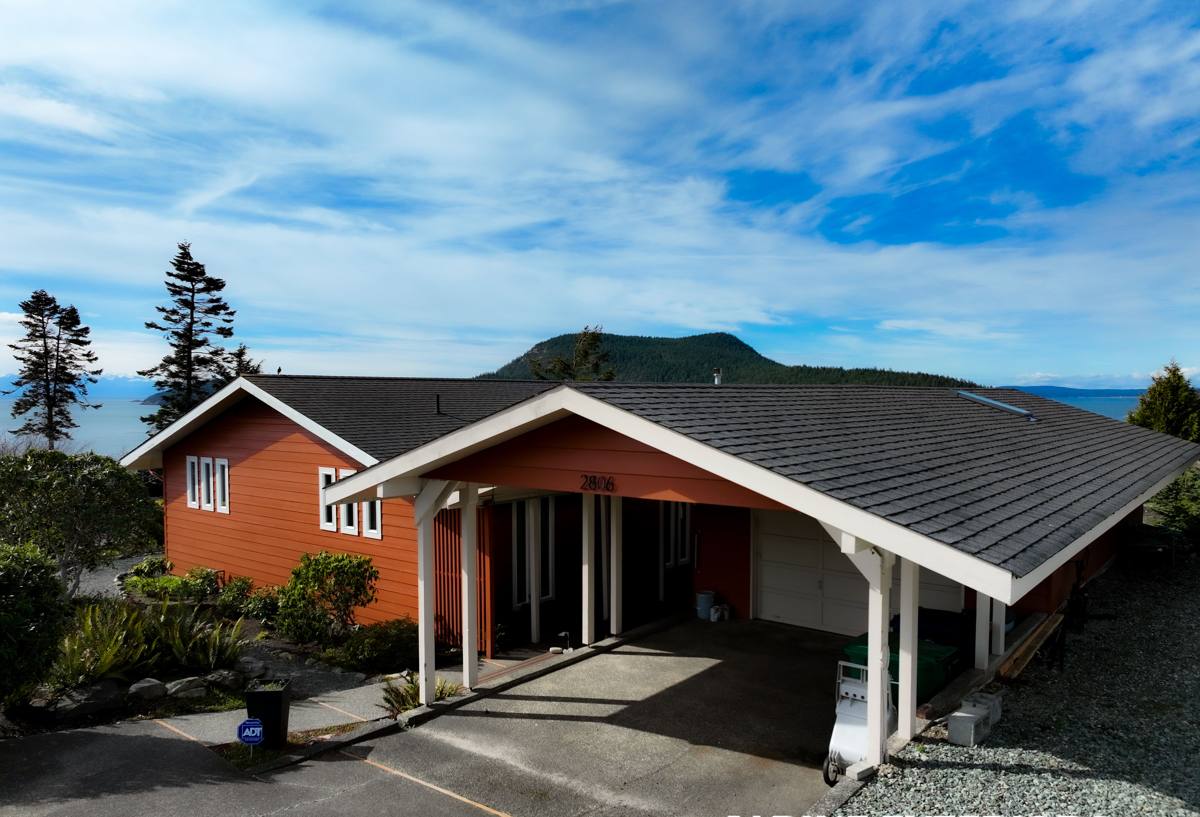
What Actually Damages Siding on a Marietta Home
Salt Air and Corrosion
Salt air doesn't just sit on the surface — it accelerates corrosion of nail heads, flashing, and metal trim pieces. Once a fastener starts to rust, it can weep stains down the face of the siding and eventually lose its grip, which loosens boards and opens gaps for water.
Wind-Driven Rain
Waterfront exposure means rain frequently hits siding at an angle instead of falling straight. That drives water into laps, corner joints, and anywhere caulking has started to crack — areas that would stay protected on a more sheltered inland property.
Moss, Algae, and Trapped Moisture
Whatcom County's wet season runs long, and shaded north and west-facing walls in Marietta rarely get enough sun to dry out between storms. Moss and algae hold moisture directly against the siding surface, which is one of the most common early triggers for rot in wood-based products and finish breakdown in any painted material.
Repair Signs Worth Acting On
- Soft or spongy spots when you press on the siding, especially near the bottom courses or window sills
- Visible cracking, buckling, or separation at panel seams and corners
- Dark streaking or stains running down from nail heads or trim
- Moss or algae buildup that keeps coming back even after cleaning
- Paint or finish that's peeling, chalking, or has gone dull in patches rather than evenly
- Gaps opening up at butt joints or around window and door trim
- Rising interior humidity, musty smell, or peeling interior paint near an exterior wall — often a sign moisture has already gotten behind the siding
Repair vs. Replace: How We Make the Call
Not every damaged section needs a full re-side. But repairing the wrong section — or repairing when the underlying problem is bigger than the visible damage — wastes money. Here's how we generally weigh it:
| Factor | Favors Repair | Favors Replacement |
|---|---|---|
| Extent of damage | Isolated to one or two wall sections | Spread across multiple elevations |
| Water intrusion | Surface-level, caught early | Sheathing or framing already affected |
| Age of existing siding | Under 10-15 years, otherwise sound | Near or past expected service life |
| Material match | Discontinued product still closely matchable | No reasonable color/profile match available |
| Underlying cause | Fixable (caulking, flashing, fastener swap) | Systemic (poor original install, no moisture barrier) |
A short inspection usually tells us which category a house falls into. We'd rather tell you honestly that a targeted repair will hold for years than sell you a full re-side you don't need — or the reverse, tell you plainly when a patch is just delaying a bigger cost.
Same-Product Repair, Not Just "Close Enough"
One issue specific to Marietta's older homes: a lot of siding installed decades ago has weathered unevenly because of the salt and moisture exposure described above, which makes color-matching a repair patch harder than it would be on a drier, more sheltered property. We factor that into the plan up front — sometimes that means matching within a section that reads naturally, other times it means being upfront that a perfect blend isn't realistic and a homeowner should plan for full re-siding sooner rather than patch after patch.
What a Correct Repair Actually Involves
A proper siding repair is more than swapping a damaged board. Done right, it includes:
- Diagnosing the cause — not just the symptom. If a section is soft, we check whether it's a flashing failure, a caulking gap, or moisture wicking up from grade before we touch the siding itself.
- Checking the water-resistive barrier behind the removed section. If it's torn, missing, or improperly lapped, replacing siding over it just resets the clock on the same failure.
- Replacing corroded fasteners, not just the boards they were holding, especially given how salt air accelerates corrosion here.
- Re-flashing window heads, corners, and any penetration points that were compromised.
- Matching material and finish as closely as realistically possible, with an honest conversation about what will and won't blend.
- Sealing and finishing with products rated for the exposure the wall actually sees — a west-facing, waterfront-exposed wall gets treated differently than a sheltered side yard.
Why We Repair (and Recommend) Only James Hardie Fiber Cement
We install and repair exclusively with James Hardie fiber cement siding, and in a place like Marietta that's a deliberate call, not a default. Fiber cement doesn't rot, doesn't feed moss the way some wood-based products can once moisture gets trapped against them, and it stands up to sustained salt-air exposure far better than materials that rely on a thin surface coating for protection. Hardie's ColorPlus factory finish is baked on rather than field-applied, which means the color itself resists the fading and chalking that waterfront UV and salt exposure cause faster here than inland. That finish consistency also makes repair patches easier to match over time compared with field-painted alternatives, where every repaint shifts the color slightly.
We don't install LP SmartSide, vinyl, Cemplank, Allura, or primed wood siding, and that's worth explaining honestly rather than glossing over: those are legitimate products with real strengths, but each comes with a trade-off — moisture sensitivity at cut edges, seam and expansion behavior in temperature swings, or a finish that ages less predictably — that we'd rather not build a repair or a warranty around in a marine-exposed neighborhood like Marietta. Hardie's engineered-for-climate HZ product lines and transferable warranty are why we standardized on it as the one product we stand behind on every home we touch.
Our Process for Marietta Repair Calls
We keep it straightforward:
- On-site inspection — we walk the exterior, check moisture readings where damage is suspected, and look at flashing and trim, not just the siding face.
- Plain-English diagnosis — what caused the damage, whether it's isolated, and what it will take to fix it correctly.
- Written estimate — scope, materials, and a repair-vs-replace recommendation with the reasoning behind it.
- Repair work — done to the same fastening, flashing, and finish standards as new installation, not shortcuts because it's "just a patch."
- Follow-up — a look-back after a wet season if there was any question about whether the underlying moisture source was fully resolved.
Why a Crew That Already Works Marietta Matters
Marietta isn't a huge area, but its exposure is distinct from siding jobs even a few miles inland in Ferndale proper or up toward Lynden. A crew that regularly works this stretch of Whatcom County waterfront knows which elevations take the worst of the wind-driven rain, how fast fasteners corrode this close to the bay, and where moss tends to build up fastest based on tree cover and sun exposure. That local pattern recognition shortens the diagnosis phase and helps avoid a repair that looks fine going in but doesn't hold up through the next wet season. It also means we're not learning the neighborhood's quirks on your dime — we already know them.
A Quick Checklist Before You Hire Anyone for a Repair
- Ask what caused the damage, not just what they'll replace — a contractor who can't explain the "why" is guessing
- Confirm they'll check the water-resistive barrier and flashing, not just the visible siding
- Get the fastener plan in writing, especially for a waterfront property
- Ask how they'll approach color matching honestly, given how uneven weathering can be here
- Confirm licensing, insurance, and whether the repair carries any workmanship guarantee
- Ask whether they're familiar with Marietta's specific exposure, or just Whatcom County generally
If your siding in Marietta is showing damage — or you just want an honest opinion on whether it's a repair or something bigger — we're happy to take a look. Estimates are free, there's no pressure, and you'll get a straight answer about what your home actually needs.