 Ferndale Siding
 Siding Repair in Cordata: A Different Kind of Wear
Homes in Cordata sit in that stretch of Whatcom County where marine air off the Salish Sea meets long, wet winters and a moss season that can run from October well into spring. That combination is hard on siding in ways that don't always show up right away. Salt-laden air accelerates corrosion on fasteners and trim. Driving rain, especially in wind events, finds its way behind poorly sealed joints and butt seams. And moss doesn't just sit on the surface — its root structure holds moisture against the siding face and traps it there, long after the rest of the house has dried out.
We repair siding in Cordata regularly, and the damage we find tends to follow a pattern tied directly to this climate: rot at the bottom courses where splashback and moss collect, failed caulking at trim and window returns, and swelling or delamination on older wood and composite products that were never built to handle this much sustained moisture. Repair work here isn't cosmetic — it's about stopping water intrusion before it reaches the sheathing and framing behind the siding.
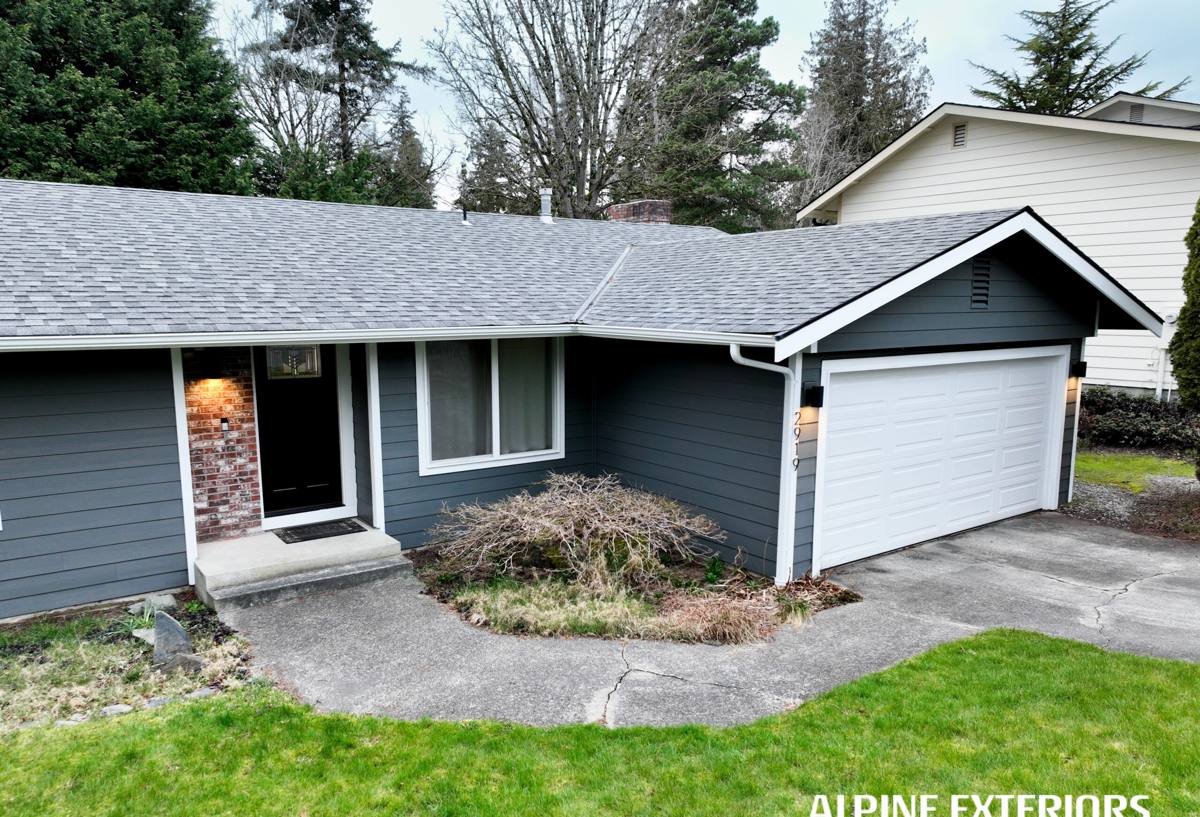
Signs Your Siding Needs Repair
Most siding problems in this area start small and get expensive if they're ignored through another wet season. Here's what we look for on a Cordata service call:
- Soft, spongy, or discolored siding near the bottom of walls, especially close to grade or foundation planting beds
- Persistent green or black staining that comes back within weeks of cleaning
- Cracked, curling, or separated caulk joints at trim, corners, and window and door casings
- Panels or boards that have visibly bowed, cupped, or pulled away from the wall
- Rust streaks below nail heads or fastener lines
- Soft drywall, musty smell, or visible staining on interior walls that back up to exterior siding
- Peeling or bubbling paint on wood or composite siding, which usually means moisture is trapped underneath
Any one of these on its own might be a quick fix. Several together, especially on the same wall, usually mean water has been getting behind the siding for a while and the repair needs to include what's underneath, not just the visible surface.
What a Correct Siding Repair Actually Involves
A repair that only replaces the damaged board and caulks the edges is a temporary fix. Done correctly, siding repair in a climate like ours has a few non-negotiable steps:
1. Find the actual water path
Damaged siding is a symptom. Before we replace anything, we trace how water got in — a failed kick-out flashing, a gap at a window head, a caulk joint that never should have been relied on to keep water out in the first place. Replacing the board without fixing the entry point means the same repair again in a year or two.
2. Check the wall assembly behind the siding
If there's been sustained moisture, we check the water-resistive barrier (house wrap or building paper), the sheathing, and framing in that section. Siding that looks fine on the surface but sits over compromised sheathing isn't a stable repair — it's a patch on a bigger problem.
3. Match materials and fastening correctly
Mixing siding products or using the wrong fastener schedule for the material is a common cause of repeat failures. We match reveal, thickness, and fastening pattern so the repaired section performs the same as the original installation — not as a visible or functional weak point.
4. Reseal and re-flash properly
Every penetration, joint, and trim transition gets flashed and sealed to shed water the way the original assembly was designed to — not just caulked over.
Repair or Replace? What Actually Drives That Decision
| Factor | Leans Repair | Leans Full Replacement |
|---|---|---|
| Extent of damage | Isolated to one wall or a few boards | Recurring damage across multiple walls or elevations |
| Underlying sheathing | Dry, solid, no rot found | Soft sheathing, visible rot, or mold behind siding |
| Age of existing siding | Under 10-15 years, material in generally sound condition | Original siding is at or past its expected service life |
| Cause of damage | One-time event (impact, isolated flashing failure) | Systemic moisture issue tied to the product itself |
| Material match | Discontinued/faded product can still be reasonably color-matched | Product is no longer available or won't match existing panels |
We'll tell you honestly which category your home falls into. If a targeted repair will hold up through another wet season and beyond, that's what we recommend — we don't upsell full replacements that aren't warranted. If the damage points to a bigger moisture problem, we'll walk you through why patching it would just be spending money to delay the real fix.
Why We Repair With James Hardie Fiber Cement
Ferndale Siding Company installs and repairs exclusively with James Hardie fiber cement siding. We don't stock or install vinyl, LP SmartSide, Cemplank, Allura, primed spruce, or cedar. That's not a marketing position — it's a standard we hold because of what we've seen in Whatcom County's climate specifically.
When we're repairing an existing home that already has Hardie siding, matching material and color is straightforward — Hardie's ColorPlus factory finish is formulated for long-term consistency, and Hardie's product lines are engineered for exactly this kind of marine, high-moisture climate. When we're called to repair a home sided in wood, vinyl, or other composite products and the damage points to a systemic moisture problem, we'll be direct about it: patching that material again may not be the long-term answer, and a transition to fiber cement on the affected section (or eventually the whole home) is worth discussing. We won't tell you a wall needs full replacement when a proper repair will genuinely hold — but we also won't pretend a product that keeps failing in this climate is a good long-term bet just to keep a repair simple.
Our Repair Process in Cordata
- On-site inspection. We look at the damaged area and the surrounding wall assembly, not just the obvious spot, to understand scope before we quote anything.
- Moisture and structural check. Where damage suggests water intrusion, we check sheathing condition before finalizing the repair plan.
- Honest scope and estimate. You get a clear explanation of what's damaged, why, and what it will take to fix it correctly — repair or replacement, whichever actually applies.
- Repair execution. Damaged material is removed, any compromised sheathing or framing is addressed, flashing and water-resistive barrier are corrected, and new material is installed and fastened to spec.
- Final seal and finish. Trim, caulk joints, and touch-up finish work are completed so the repaired section blends in and performs as designed.
Repair Mistakes We See — and Fix
A lot of the repair calls we get in Cordata are second repairs, where an earlier fix didn't hold. The common threads:
- Caulk used to bridge a gap that should have been flashed instead
- New siding fastened directly over damp or compromised sheathing without addressing the moisture source
- Mismatched fastener types that corrode faster than the surrounding hardware, especially given the salt content in coastal air here
- Repairs that ignored moss and organic buildup at the base of the wall, so the same conditions that caused the original damage were left in place
- Patch repairs on a wall where the real problem was a missing or undersized kick-out flashing at a roofline intersection
Fixing the underlying cause is what separates a repair that lasts from one you'll be paying for again.
Why Local Experience Matters for This Kind of Work
Siding repair is diagnostic work as much as it is installation work. A crew that works Cordata and the surrounding Ferndale and Whatcom County area regularly has already seen how moss establishes on north- and west-facing walls here, which flashing details tend to fail first in driving coastal rain, and which parts of a wall assembly are most exposed to salt air corrosion. That local pattern recognition is what keeps a repair from becoming a guessing game — and it's the difference between a fix that addresses the actual cause and one that just covers up the symptom for a season.
Get an Honest Assessment
If you're seeing soft spots, staining, or recurring moss on your siding in Cordata, it's worth having someone look at it before another wet season sets in. We'll give you a straight answer on whether it's a repair or something bigger, with no pressure either way — reach out below for a free estimate.