 Ferndale Siding
 Why Everson Decks Take a Beating
Everson sits inland in the Nooksack River valley, but that doesn't spare it from the weather patterns that define Whatcom County. Driving rain off the Sound and the Strait pushes moisture sideways into places a deck was never designed to shed water from — the gap between boards, the seam where a ledger board meets the house, the underside of a rail post. Add in the salt-laden air that moves through this part of Washington and you get a slow, steady corrosion problem on anything metal: nails, screws, joist hangers, bolts. None of it happens overnight, which is exactly why so many decks look fine right up until they aren't.
Then there's moss. Whatcom County's moss season runs long — often from early fall through spring — and it doesn't just grow on roofs. It settles into horizontal deck surfaces, stair treads, and anywhere water sits for more than a day or two. Moss holds moisture against wood far longer than open air ever would, and that constant dampness is what turns a cosmetic nuisance into actual rot underneath.
We're not telling you this to scare you into a replacement you don't need. Most of what we see on Everson decks is repairable. But a repair only holds up if it's built around how a deck actually fails in this climate, not how it fails in a warmer, drier part of the country.
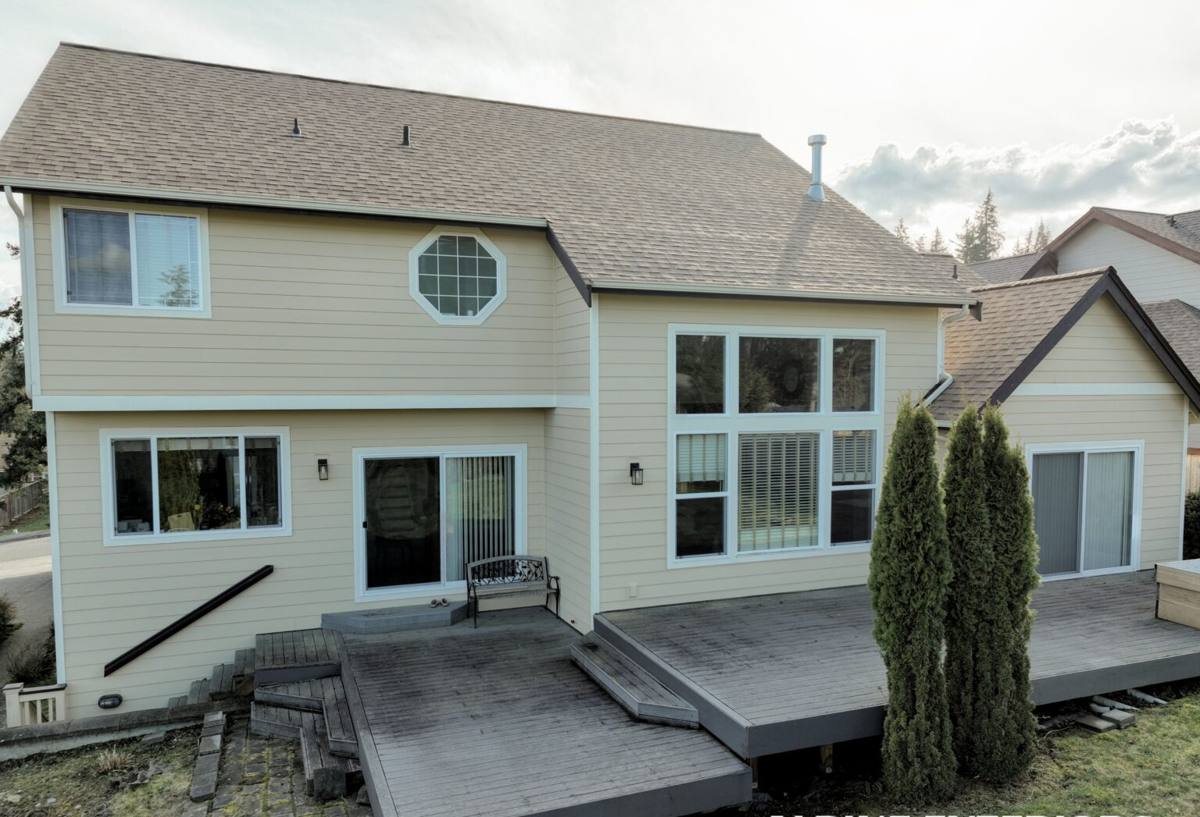
Signs Your Deck Needs Attention Now, Not Later
Deck problems are easiest to fix while they're still small. Once rot reaches structural framing, the job — and the cost — grows fast. Walk your deck and check for these:
- Boards that feel spongy, springy, or noticeably softer underfoot than the rest of the deck
- Persistent moss or dark green-black staining that doesn't dry out between rains
- Rust streaks running down from screws, nails, or joist hangers
- A railing or post that wiggles when you push on it
- Gaps opening up where the deck meets the house, or a ledger board that looks separated from the siding
- Stair stringers that flex or creak more than they used to
- Fasteners backing out of the decking boards on their own
- Standing water that takes more than a day to drain after a storm
Any one of these on its own might be minor. Two or three together, especially near the ledger board or stairs, usually means the damage has moved past the surface.
What a Correct Deck Repair Actually Involves
Structural Framing and the Ledger Board
The ledger board — the piece bolted to your house that the whole deck hangs from — is the single most important connection on the structure, and it's the one most exposed to water intrusion from behind the siding. A correct repair means pulling back enough decking to actually see the ledger, the flashing behind it, and the joists it carries, not just patching what's visible from the top. If flashing is missing, cracked, or was never installed correctly to begin with, that gets addressed as part of the repair — patching boards over a bad ledger connection just hides the problem for another season.
The Decking Surface
Individual boards get replaced on their own merits. A board with surface graying but sound wood underneath doesn't need to go; a board that's soft, cupped, or hosting rot does. We check spacing and fastening at the same time, since gaps that are too tight trap moisture and gaps that are too wide let more rain hit the framing below.
Railings and Stairs
Railings and stair stringers take more direct weather exposure and more physical stress than the deck surface itself, so they often show damage first. Post bases sitting in standing water are a recurring issue — we look at drainage around the base, not just the wood, so the fix doesn't just fail again in a year.
Repair or Replace? A Straight Answer
Homeowners in Everson often assume any visible damage means starting over. That's usually not true, but there's a real point where repair stops making financial sense. Here's how we weigh it:
| Factor | Leans Toward Repair | Leans Toward Replacement |
|---|---|---|
| Ledger board and main framing | Solid, no rot at connection points | Soft, rotted, or improperly flashed |
| Extent of damage | Isolated boards, posts, or fasteners | Widespread across most of the structure |
| Deck age | Under 15-20 years, built to a reasonable standard | Original construction quality was poor, or well past typical service life |
| Rough cost range | Often a few hundred to a few thousand dollars depending on scope | Can approach or exceed the cost of a full rebuild once framing is compromised |
| Longevity of the fix | Solid for years when framing is sound | A full rebuild resets the clock on the whole structure |
We'll give you our honest read on which side of that line your deck falls on. If a repair is going to leave you with a deck that still isn't sound in two years, we'd rather tell you that up front than sell you a patch.
Materials and Fasteners: Our Standard for This Climate
Given the salt air and near-constant moisture cycling in Whatcom County, we don't cut corners on what goes into a repair even when the visible work is small. Standard zinc-coated fasteners can start showing corrosion within a few years out here; we use hot-dip galvanized or stainless fasteners rated for exterior, coastal-adjacent exposure instead. It costs a little more up front and saves you from replacing the same board again once the fasteners fail underneath it.
For framing repairs, pressure-treated lumber rated for ground contact or structural use is our baseline — not because untreated or lower-grade lumber can't work in a dry climate, but because it can't reliably hold up to this one. For decking surfaces, we'll talk through wood versus composite honestly: composite costs more up front and needs less refinishing, but it can still grow moss if it's shaded and doesn't drain, and repairs to composite sometimes mean replacing a whole board rather than sanding or spot-treating a section of wood. Neither option is wrong — it depends on your budget, your deck's sun exposure, and how much upkeep you want to do.
Our Deck Repair Process
- On-site inspection. We look underneath the deck, not just at the surface — checking the ledger, joists, post bases, and any spots you've flagged as soft or unstable.
- Honest scope and estimate. You get a clear breakdown of what actually needs repair, what's cosmetic, and what we'd flag for future attention but isn't urgent yet.
- Repair, not just replacement of what's visible. If we open up an area and find more damage than expected, we tell you before we proceed — no surprise change orders after the fact.
- Proper fastening and flashing. Every connection point gets the corrosion-resistant hardware and flashing detail appropriate for this climate, whether or not it's visible once the job is done.
- Final walkthrough. We check the deck with you before we consider the job finished, including railings, stairs, and drainage at post bases.
Why a Crew That Already Works in Everson Matters
A contractor who mostly works drier inland climates or unfamiliar regions can miss what's routine for us: where moss actually accumulates on a deck built into a shaded slope, how ledger flashing tends to fail on homes built to older code, and which fastener grades hold up versus which ones look fine in the store and corrode within a couple of seasons. We work throughout Ferndale and the surrounding Whatcom County communities, including Everson, so we're not guessing at how this climate treats a deck over time — we've seen the pattern repeat on job after job.
That familiarity also means straightforward scheduling and permitting where required, and a crew that shows up understanding the drainage and moisture challenges specific to this part of the county before we even start the inspection.
Keeping a Repaired Deck Solid After We Leave
A good repair buys you years, but a little upkeep buys you more. A few habits make a real difference in this climate:
- Sweep off leaves and debris regularly, especially in fall — trapped organic matter is what moss and rot both feed on
- Rinse or lightly scrub visible moss before it gets a foothold, particularly on shaded sections
- Check post bases and stair bottoms each spring for standing water or new soft spots
- Reseal or restain wood decking on the manufacturer's recommended schedule — moisture gets in fastest through worn-out finish
- Keep gutters and downspouts clear so runoff isn't dumping directly onto or under the deck
None of this replaces a periodic inspection, but it slows down the damage between them — and it's the difference between a deck that needs a small repair every few years and one that needs a big one.
If your deck in Everson has soft boards, a wobbly rail, stubborn moss, or you just haven't had it looked at in a while, we're glad to come take an honest look. The estimate is free, there's no pressure, and you'll get a straight answer about what your deck actually needs — use the form below to get started.