 Ferndale Siding
 A Shoreline Climate That Doesn't Forgive Cheap Siding
Homes in and around Lummi Nation sit close to saltwater, low tree cover in some spots and heavy shade in others, and a weather pattern that pulls moisture off the Strait and Bellingham Bay for months at a time. That combination is harder on exterior siding than most inland Whatcom County neighborhoods ever see. Salt-laden air accelerates corrosion on fasteners and metal trim. Wind-driven rain finds its way sideways under poorly lapped panels. And a long, damp, low-sun season keeps north- and west-facing walls wet enough, long enough, for moss and algae to take hold and stay there.
None of this is exotic. It's just consistent, and consistency is what wears siding out. A product or installation detail that's marginal in a drier part of the state gets exposed fast out here. That's the lens we use on every Lummi Nation area project: not "will this look good on install day," but "will this still be doing its job in fifteen years of salt, rain, and shade."
Salt Air and Corrosion
Airborne salt doesn't just affect boats and railings. It settles on siding, trim, and especially fasteners, and it accelerates rust and pitting on anything not rated for coastal exposure. Over time that shows up as streaking, fastener bleed-through, and premature failure at the metal accessories most homeowners never think about — flashing, corner trim, and screw heads.
Driving Rain and Wind-Driven Moisture
Storms coming off the water don't fall straight down here — they come in at an angle and push against exposed walls with real force. Siding systems that rely on face-sealing (caulk and paint doing the work that flashing and lap geometry should be doing) tend to let water behind the cladding eventually. Once moisture gets behind siding on a shoreline property, it doesn't dry out quickly.
The Long Moss Season
Shaded, moisture-retentive walls in this part of Whatcom County can stay damp for a good chunk of the year. Moss and algae aren't just cosmetic — they hold water against the siding surface longer than an open, quick-drying wall would, which shortens the life of any coating or finish that isn't built to resist it.
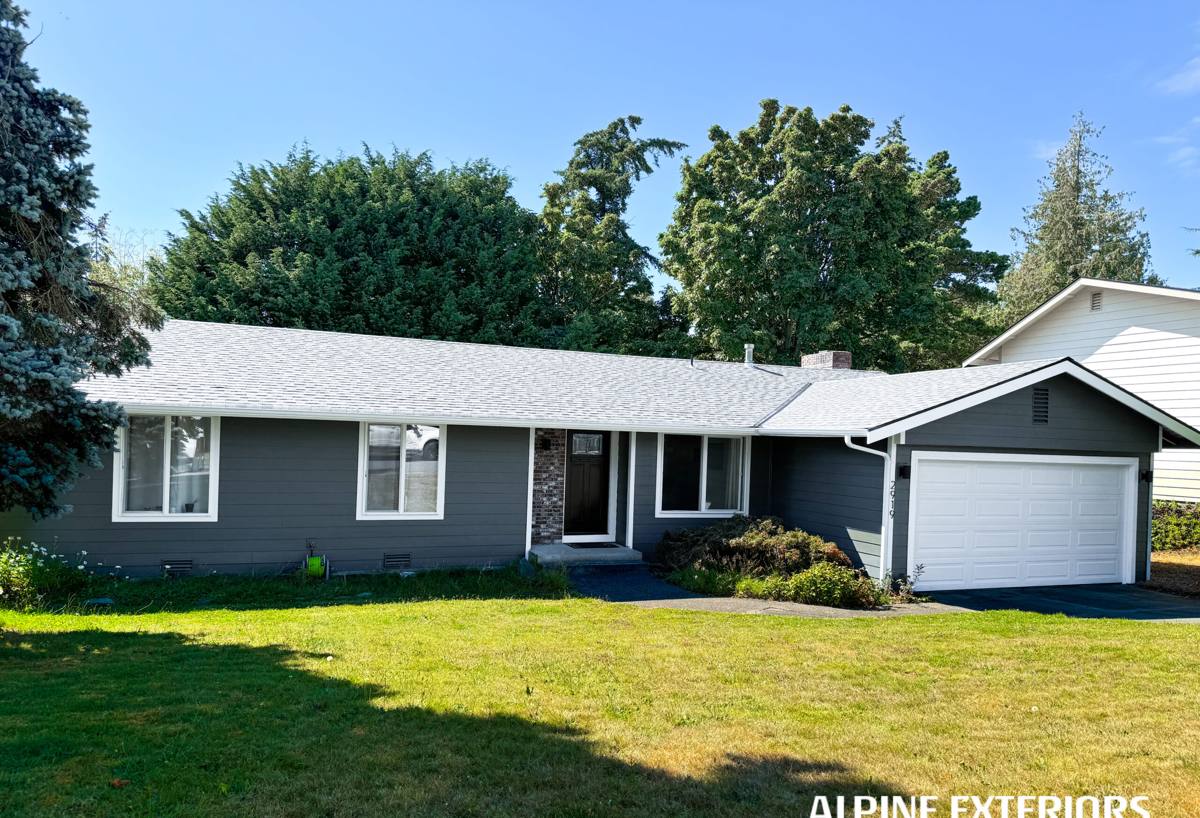
Why We Install James Hardie and Nothing Else
We don't install vinyl, LP SmartSide, Allura, Cemplank, or raw cedar and spruce siding. That's not a marketing position — it's a standard we settled on after weighing how each of those products actually performs against the specific stresses described above.
Vinyl expands, contracts, and can warp or crack in temperature swings, and it offers no real fire resistance. Wood-based products like LP SmartSide use engineered wood strand technology that, however improved, still relies on factory sealing and careful field caulking to keep moisture out of a wood-fiber core — a real liability in a climate that stays wet as long as this one does. Other fiber cement brands may be chemically similar to Hardie in some ways, but Hardie has the longest track record in the Pacific Northwest, climate-specific engineering, and a factory finish warranty that the competition doesn't match line for line. James Hardie fiber cement is non-combustible, dimensionally stable in wet-dry cycling, and backed by both a substantial product warranty and, on ColorPlus finishes, a separate finish warranty — and it holds up to salt, rain, and shade better than anything else we've put on a house.
The HZ5 Product Line: Engineered for This Exact Weather
James Hardie makes region-specific formulations under its HZ (HardieZone) system, and homes in Whatcom County fall into the HZ5 climate zone — the formulation built for wetter, harsher weather patterns. HZ5 boards are engineered with moisture and freeze-thaw resilience in mind, which matters directly for Lummi Nation area homes dealing with salt air and near-constant seasonal dampness.
This isn't a marketing distinction. Installing the wrong HZ formulation for the region is one of the most common corner-cutting mistakes we see from crews that don't specialize in Hardie — and it's invisible until the siding starts failing years later.
What a Correct Installation Actually Involves
Hardie siding is only as good as the installation behind it. The board is engineered correctly; failures almost always trace back to installation shortcuts, not the product itself. On a shoreline-adjacent property, the margin for error is smaller.
| Install Detail | Why It Matters Here |
|---|---|
| Correct nail penetration and fastener spacing | Under- or over-driven fasteners create gaps salt air and wind-driven rain will find |
| Rain screen / drainage gap behind siding | Lets any moisture that gets behind the cladding actually dry out instead of sitting against sheathing |
| Proper flashing at windows, doors, and penetrations | These are the primary entry points for wind-driven rain, not the flat field of the wall |
| Correct lap and clearance from grade, decks, and roof lines | Prevents standing moisture and splash-back in a climate that already stays wet longer |
| Factory-primed cut edges sealed on site | Exposed raw edges are where moisture intrusion and premature wear typically start |
Every one of these is a standard part of manufacturer-specified installation. The difference between a siding job that lasts decades and one that needs attention in five years usually comes down to whether the crew actually followed the spec.
How We Approach a Lummi Nation Area Project
Our process is the same discipline we bring to every job in this region, adjusted for the specific exposure of the property.
- On-site assessment. We look at wall orientation, tree cover, drainage, existing moisture damage, and how exposed each elevation is to wind and salt air off the water.
- Product and detail plan. We confirm HZ5 board selection, plank profile, and trim package, and flag any areas — north walls, shaded corners, low-clearance sections — that need extra flashing or drainage attention.
- Tear-off and substrate check. We remove the old siding and inspect sheathing for rot or hidden moisture damage before anything new goes up — a step that's easy to skip and expensive to regret later.
- Installation to manufacturer spec. Correct fastening, flashing, rain screen, and clearances, not shortcuts that only show up as problems years down the road.
- Final walkthrough. We check laps, trim, caulking, and finish consistency with you before calling the job done.
Color and Finish Considerations for a Coastal Environment
James Hardie's ColorPlus factory finish is baked on and backed by its own warranty, which matters more in this climate than it might elsewhere. Field-applied paint is more vulnerable to the moss, mildew, and salt exposure this area sees, and it puts the burden of repainting on you every several years. A factory finish holds color and resists fading and staining far better under sustained coastal moisture. We'll walk through the ColorPlus palette and help pick a tone and sheen that works with the amount of shade, sun, and moisture exposure your specific walls get.
What Siding Actually Costs Here — and What Drives the Number
We don't publish flat prices because every home's exposure, trim complexity, and existing wall condition are different — but the factors that move the number are consistent.
| Cost Factor | Why It Varies |
|---|---|
| Home size and wall complexity | More corners, gables, and trim detail mean more labor and cut waste |
| Existing substrate condition | Rot or moisture damage found during tear-off adds repair scope before new siding goes up |
| Board profile and trim package | Lap width, shake accents, and trim styles carry different material costs |
| Finish choice | ColorPlus factory finishes vs. primed-for-paint boards affect both material cost and long-term maintenance |
| Site access and exposure | Waterfront or heavily treed lots can affect staging, scaffolding, and drainage detailing |
The only way to get a real number is a walk-around estimate specific to your home — which is exactly what we offer, at no cost and no pressure.
Maintaining Hardie Siding in a Salt-and-Moss Climate
James Hardie siding is genuinely low-maintenance compared to wood or vinyl, but "low-maintenance" isn't "no-maintenance," especially this close to the water.
- Rinse siding once or twice a year to clear salt residue and organic buildup before moss gets a foothold
- Keep gutters clear so overflow doesn't run down the wall face repeatedly
- Trim back vegetation and tree limbs that keep specific wall sections shaded and damp
- Check caulking at trim, window, and door joints annually and re-seal if it's cracked or pulling away
- Address moss or algae growth early with a gentle wash rather than letting it establish and hold moisture against the surface
- Watch for any staining or discoloration near ground level, which can signal drainage or splash-back issues worth correcting
Why Local Experience with This Exact Area Matters
A crew that mostly works drier, inland jobs can still install Hardie siding correctly on paper and still get the details wrong for a shoreline-exposed home — because they're not used to designing for salt air, wind-driven rain, and a moss season that doesn't really end. Working regularly in and around Ferndale and the Lummi Nation area means we already know which elevations need extra flashing attention, which HZ formulation is right for this zone, and what tends to fail first when it's installed wrong. That's the difference between siding that looks right on day one and siding that's still performing in year twenty.
If you're weighing a siding replacement on a home in the Lummi Nation area, we're happy to walk the property, look at your specific exposure, and give you a straight answer on what it needs. Reach out for a free, no-pressure estimate using the form below.