 Ferndale Siding
 Siding Replacement Built for How Kendall Actually Weathers
Kendall sits back from the water, up the Nooksack valley from Ferndale, but that distance doesn't buy the neighborhood much protection from Whatcom County's weather. Moisture-laden air moves inland off the Salish Sea and settles into the valley, and between that, the driving rain off the foothills, and the shade that keeps yards damp well into the season, siding here works harder than it does in drier parts of the state. When we replace siding on a Kendall home, we're not just swapping out old panels for new ones — we're correcting whatever let the old siding fail in the first place, so the new system actually holds up to another few decades of the same conditions.
This page covers what siding replacement looks like specifically for homes in and around Kendall: what the local climate does to siding over time, what a correctly executed replacement involves, how our process runs from first look to final walkthrough, and why hiring a crew that already understands this area matters more than it might seem.
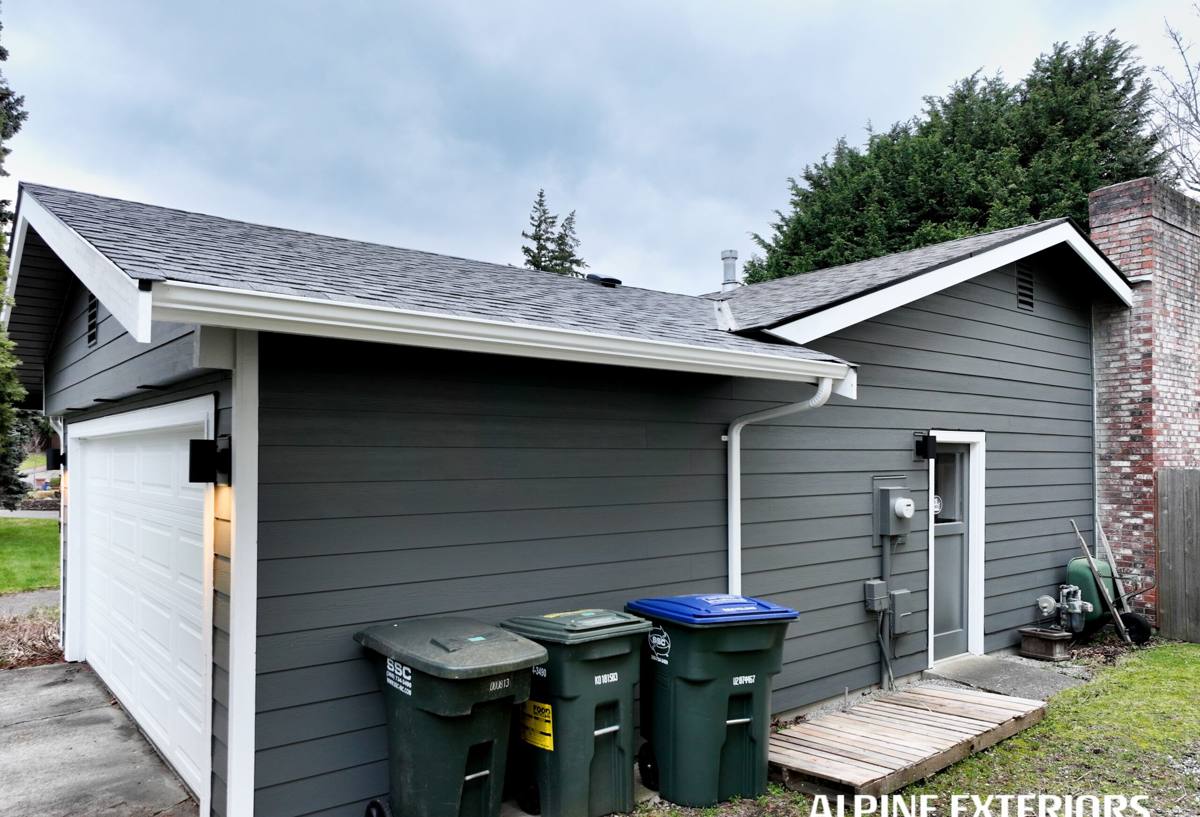
What Kendall's Climate Does to Siding Over Time
Three conditions do most of the damage to siding in this part of Whatcom County, and they compound each other:
- Driving rain. Wind-driven rain doesn't just fall straight down — it gets pushed sideways into laps, seams, and trim joints. Siding and flashing details that would be fine in a calmer climate start leaking here if they weren't installed with that wind-driven moisture in mind.
- Long moss season. Shaded lots, tree cover, and extended damp stretches mean moss and algae get a real foothold on north- and east-facing walls. Moss doesn't just look bad — it holds moisture against the siding surface for weeks at a time, which accelerates rot in wood-based products and paint failure on anything with a factory finish that isn't rated for it.
- Marine-influenced humidity. Even set back from the coast, the ambient humidity here stays high for long stretches of the year. Siding materials that rely on paint film alone to keep water out are under near-constant low-grade moisture pressure, which is exactly the condition that causes swelling, delamination, and edge failure over time.
None of this is unique to Kendall — it's Whatcom County weather in general — but homes on wooded or shaded lots, which describes a lot of properties in this neighborhood, see it more concentrated than homes on open, sun-exposed sites closer to Ferndale proper.
Signs a Kendall Home Needs Siding Replaced, Not Just Patched
Homeowners often call us about a small problem area — a soft spot near a downspout, a section that's bubbled or bowed — and the real question is always whether that's an isolated repair or a sign the whole system is past its service life. A few things tell us it's time to talk replacement rather than patchwork:
- Soft, spongy, or crumbling siding when pressed, especially near the bottom courses and around windows
- Paint that keeps failing within a couple of years of repainting, even on surfaces that were properly prepped
- Persistent moss or algae growth that comes back within a season of cleaning
- Visible gaps, warping, or buckling panels, particularly on the north and shaded sides of the house
- Interior signs — musty smell, staining, or soft drywall near exterior walls — that point to moisture getting past the siding entirely
- Siding that's original to a home built more than 20–25 years ago, especially if it's wood-based or an early composite product
One or two of these on a small section can sometimes be repaired. Several of them together, or any sign that moisture has reached the wall sheathing, usually means the underlying water-management system has failed and repair would just be delaying the same problem in a different spot.
What a Correct Siding Replacement Actually Involves
Siding replacement done right is mostly about what's underneath the siding, not the siding itself. A house can have expensive, good-quality panels on it and still leak if the layer behind them was done wrong. For a Kendall home, given the rain and moisture load discussed above, we treat these steps as non-negotiable:
Full Tear-Off and Inspection
We remove the old siding down to the sheathing so we can actually see what's there — not guess at it. This is where hidden rot, failed old flashing, or past water intrusion around windows and penetrations gets found and dealt with, rather than sealed over.
Weather-Resistive Barrier (WRB)
A properly lapped and taped water-resistive barrier goes over the sheathing before anything else. In a climate with this much driving rain, the WRB is the actual waterproofing layer — the siding is the first line of defense, but the WRB is what keeps a house dry if wind-driven water gets past it.
Flashing and Drainage Plane
Window and door flashing, head flashing above trim, and a drainage plane that lets any moisture that does get behind the siding drain back out — these details matter more in Whatcom County than in drier regions, because they get tested by weather far more often.
Correct Fastening and Clearances
James Hardie siding has specific fastening patterns, nailing zones, and ground/roof clearance requirements. Skipping these — nailing too high, too low, or too tight, or setting siding too close to grade or a roofline — is one of the most common ways an otherwise good installation fails early, and it's not something you can see from the ground once it's painted.
Proper Caulking and Sealant Use
Correct installation actually relies on flashing and lapping to shed water, not caulk to seal it in. Overuse of caulk is a red flag for a rushed installation, since it traps moisture against the siding rather than letting it drain.
Why We Install Only James Hardie Fiber Cement
We don't offer vinyl, LP SmartSide, primed spruce, cedar, or other fiber cement brands — not because there's no market for them, but because we've standardized our crews, our details, and our warranty backing around one product system we trust to hold up in this climate. James Hardie fiber cement is non-combustible, dimensionally stable in wet-dry cycling, and comes with a factory-applied ColorPlus finish that's engineered to resist the fading and peeling that plain-primed products struggle with under sustained coastal-influenced humidity. Hardie's HZ5 product line is specifically engineered for the freeze-thaw and moisture cycling of the Pacific Northwest, which is exactly the profile Kendall sits in.
The other side of that decision is the warranty. Hardie backs its products with a strong, transferable limited warranty when installed to their specification — which is part of why we're strict about installation detail. A warranty is only worth what the installation behind it can support.
Our Siding Replacement Process for Kendall Homeowners
| Step | What Happens |
|---|---|
| 1. On-site assessment | We walk the exterior, check for soft spots and moisture entry points, and look at sun/shade exposure and drainage around the foundation |
| 2. Written estimate | A clear scope covering tear-off, sheathing repair allowance, WRB, flashing, siding line and color, trim, and cleanup |
| 3. Tear-off and sheathing inspection | Old siding comes off, sheathing is inspected and repaired as needed before anything new goes on |
| 4. WRB, flashing, and drainage plane installation | The water-management layer goes in first and is inspected before siding starts |
| 5. Hardie siding and trim installation | Installed to manufacturer nailing, clearance, and lap specifications |
| 6. Final walkthrough | We review the finished job with the homeowner and cover basic care going forward |
We don't skip the assessment step even on homes where the problem looks obvious from the street. What's happening at the sheathing level changes the scope, and homeowners deserve to know that before a number gets attached to the job.
Cost Factors for Kendall Siding Replacement
Every home is different, and we won't put a fake number on this page — but the factors that actually move the cost of a siding replacement in this area are worth understanding before you get quotes:
| Factor | Why It Matters |
|---|---|
| Sheathing condition | Rot found during tear-off adds repair scope that can't be known until the old siding is off |
| Home size and complexity | Dormers, multiple gables, and cut-up wall lines take more labor per square foot than simple rectangular walls |
| Siding profile and line | Lap width, shingle-style siding, and trim complexity all affect material and labor cost |
| Existing moisture damage | Homes with a history of leaks around windows or penetrations often need more flashing repair, not just new siding |
| Site access | Wooded or tight lots, common in Kendall, can slow tear-off and material staging compared to open sites |
| Trim and accent work | Corner boards, window trim, and accent bands add labor beyond the flat wall areas |
Why a Crew That Already Works Kendall Matters
Siding installation isn't one-size-fits-all across Washington. A crew used to installing in a dry, low-wind region will make different (and sometimes wrong) judgment calls about flashing overlap, caulk placement, and clearance than a crew that installs in Whatcom County week in and week out and has seen what actually fails here versus what's just theoretical. Knowing that Kendall's shaded lots hold moss longer, that driving rain hits certain wall orientations harder, and that a house tucked back among trees dries out more slowly after a storm all changes how a job should be detailed — not dramatically, but in the small decisions that determine whether siding lasts 10 years or 40.
There's also a practical side: a contractor who works this area regularly can speak plainly to what's realistic for a given home, without inflating the scope or underselling what a house actually needs.
After Your New Siding Goes On
James Hardie siding is low-maintenance, not no-maintenance. A simple annual routine goes a long way in this climate:
- Rinse siding annually, and more often on shaded north/east walls where moss tends to return first
- Keep gutters clear so overflow doesn't run down the wall surface
- Trim back vegetation and tree limbs that keep siding shaded and damp
- Check caulking at trim joints and penetrations once a year and touch up as needed
- Address any impact damage or chips in the ColorPlus finish promptly to keep the factory warranty intact
If you're weighing a siding replacement for a Kendall home, we're glad to take a look and give you an honest read on what's going on behind the current siding — no pressure, no inflated scope. Reach out for a free estimate using the form below.