 Ferndale Siding
 New Roof Installation for Sumas Homes
Sumas sits in the northeast corner of Whatcom County, tucked against the foothills near the Canadian border, and it gets its own version of Pacific Northwest weather. Winters bring long stretches of steady, driving rain. Spring and fall bring valley fog that keeps roof surfaces damp for hours after the rain stops. And because so many Sumas properties sit near trees, open fields, or shaded lots, moss has a long growing season to work into shingle mat, ridge caps, and north-facing slopes. A roof built for a drier climate, or installed without attention to how water actually moves off a house here, will show problems well before its rated lifespan runs out.
A correctly installed roof in this area isn't just about the shingles on top. It's about the full water-management system underneath and around them — underlayment, flashing, ventilation, and edge details — all working together so that Whatcom County's wet season never gets a foothold. This page covers what that looks like for a new roof installation specifically in Sumas, and what to expect when you hire a crew that already knows this part of the county.
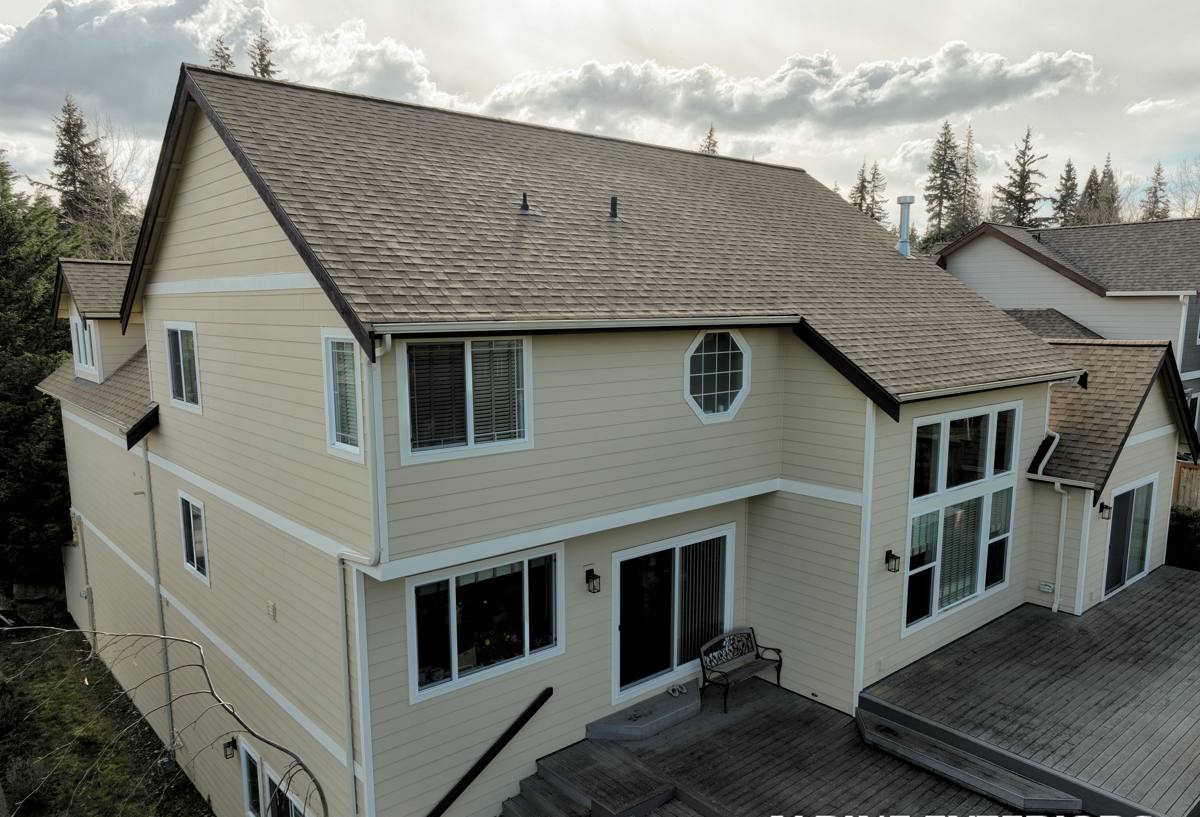
What Sumas's Climate Demands From a Roof
Driving Rain and Wind-Driven Moisture
Rain in this part of Whatcom County rarely falls straight down. Wind pushes it sideways under eaves, around chimneys, and into any gap where flashing wasn't lapped correctly. A roof that looks fine in a light shower can leak in a sustained winter storm if the underlayment and flashing weren't detailed for wind-driven moisture. That's why we don't treat underlayment as an afterthought — it's the actual waterproofing layer, with the shingles as the wear surface on top of it.
Moss and Shaded Roof Sections
Moss doesn't just look bad — it holds moisture against the roof surface, lifts shingle edges as it grows, and accelerates granule loss. Sumas properties with mature trees or north-facing slopes that don't get much direct sun are especially prone to it. A new roof installation is the right time to address this with zinc or copper strips near the ridge, proper ventilation to reduce trapped moisture, and material choices that resist moss better than others.
Valley Fog and Slow-Drying Surfaces
Because Sumas sits low in a valley near agricultural land, morning fog can linger longer here than in more exposed parts of the county. Roofs that stay damp longer are more forgiving of poor ventilation for a while — but eventually trapped moisture in the attic space leads to sheathing rot from the underside, which you won't see until it's a real problem. Good intake and exhaust ventilation matters as much here as the roofing material itself.
What a Correct Roof Installation Actually Includes
"New roof" gets used loosely. A correct installation is a system, not just a layer of shingles. Here's what we consider non-negotiable on every Sumas roof we install:
- Full tear-off and inspection of the decking — no roofing over existing layers, which traps moisture and hides rot
- Repair or replacement of any soft, delaminated, or water-damaged sheathing found during tear-off
- Synthetic or self-adhered underlayment appropriate to the roof's slope and exposure
- Ice-and-water shield at eaves, valleys, and around penetrations, sized for this region's rain volume
- New step flashing, counter-flashing, and pipe boots — reused flashing is a common source of early leaks
- Balanced intake and exhaust ventilation sized to the attic volume, not a generic default
- Proper nailing pattern and fastener count per manufacturer specification, not shortcut spacing
- Drip edge at eaves and rakes to direct water away from fascia and soffits
Skipping any one of these doesn't necessarily cause an immediate failure. It shows up two, five, or ten years later as a leak, a soft spot, or premature granule loss — right around the time it's harder to trace back to the install.
Choosing the Right Roofing Material for Sumas
There's no single "best" roofing material — the right choice depends on your home's exposure, budget, and how much long-term maintenance you're willing to do. We'll walk through the honest trade-offs for your specific property rather than push one product.
| Material | Typical Lifespan | Moss/Moisture Behavior | Best Fit |
|---|---|---|---|
| Architectural asphalt shingle | 25–30 years | Good with proper ventilation and zinc strips; needs periodic moss treatment in shaded areas | Most Sumas homes — balance of cost, performance, and easy future repair |
| Standing seam metal | 40–50+ years | Sheds moisture fast, very moss-resistant on steeper slopes | Homeowners planning to stay long-term and wanting minimal maintenance |
| Synthetic/composite shingle | 30–50 years | Resists moisture absorption well; higher material cost | Homes wanting a heavier look with less maintenance than asphalt |
| Cedar shake | 20–30 years with upkeep | Needs regular treatment; moss and moisture are the main long-term maintenance burden in this climate | Homeowners committed to the traditional look and the maintenance schedule it requires |
We're upfront when a material isn't a good match for a particular roof — for example, a heavily shaded, low-slope section is a tough environment for any wood product, no matter how well it's installed, simply because of how long moisture sits on the surface.
Our Installation Process
1. On-Site Assessment
We walk the roof and attic, not just the exterior. Ventilation, existing moisture damage, slope, and shading all factor into the plan and the estimate — this isn't a drive-by quote.
2. Material Selection and Written Scope
You get a clear, itemized scope: tear-off, decking repair allowance, underlayment type, flashing plan, ventilation changes, and material — no vague line items.
3. Tear-Off and Deck Inspection
Old roofing comes off down to the deck so we can see the actual condition of the sheathing. Any soft or water-stained sections get flagged and replaced before anything new goes down.
4. Weatherproofing Layer
Underlayment, ice-and-water shield, and flashing go in first, detailed for wind-driven rain and the valleys and penetrations specific to your roof's geometry.
5. Roofing Material Installation
Installed to manufacturer spec — nailing pattern, exposure, and fastener count — so the warranty is actually valid, not just technically present.
6. Ventilation and Final Details
Ridge and soffit ventilation, moss-prevention strips where appropriate, and a final walkthrough covering what was found, what was fixed, and what to expect going forward.
Signs a Sumas Roof Needs Replacing, Not Patching
Not every roof problem means starting over — but in this climate, some signs point clearly toward full replacement rather than another round of patches:
- Granule loss heavy enough that shingle mat is visible in multiple areas
- Soft or spongy decking felt underfoot in the attic, especially near valleys or eaves
- Moss established deeply enough that it's lifting shingle tabs, not just sitting on the surface
- Recurring leaks in different spots each winter rather than one fixable location
- Roof is past 20–25 years old with no record of underlayment or flashing replacement
- Visible sagging along the ridge or roof plane
If your roof shows one or two of these, a targeted repair may still make sense. If it shows several, patching usually ends up costing more over a few years than doing the job right once.
What Affects the Cost of a New Roof
Every roof is priced on its own specifics, but the same factors tend to drive cost up or down on Sumas jobs:
| Factor | Why It Matters |
|---|---|
| Roof size and number of planes | More cuts, valleys, and seams mean more labor and material waste |
| Deck condition | Rotted sheathing found during tear-off adds repair cost not visible before demo |
| Pitch and access | Steep or hard-to-access roofs take longer and require more safety setup |
| Material choice | Asphalt, metal, and synthetic products carry different material and install costs |
| Ventilation changes | Adding or correcting intake/exhaust ventilation is worth the added cost long-term |
| Layers to remove | Roofs with multiple existing layers take longer to tear off |
We won't know your exact number until we've seen the roof, but we'll always explain what's driving the price — not just hand you a total.
Why Hire a Crew That Already Works Sumas
A roofing crew that regularly works in Sumas and the surrounding Whatcom County area already knows how the local weather behaves against a roof — which slopes hold moss longest, how far wind-driven rain typically reaches under an eave, and which flashing details actually hold up through a full wet season here rather than just on paper. That's the difference between a roof installed to code and a roof installed for this specific climate.
It also matters for accountability. A local company is easy to reach if a question comes up two years after the job, and has a reputation in the area worth protecting with honest work — not just a one-time transaction.
Get a Free, No-Pressure Estimate
If your Sumas roof is showing its age, or you're planning ahead before the next wet season sets in, we're happy to take a look and give you a straight assessment — no pressure, no upsell. Use the form below to request a free estimate, and we'll walk the roof with you and explain exactly what we find.